
Is Aluminum Really Strong Enough for Your Project?
From lightweight consumer products to aerospace structures, the tensile strength of aluminum alloys determines whether a part performs flawlessly — or fails under load. As a professional metal parts supplier, we know that choosing the right alloy is not just about strength, but also weight, corrosion resistance, weldability, and cost.
In this guide, you’ll learn:
- What tensile strength and ultimate tensile strength (UTS) really mean
- How alloys like 6061, 7075, 2026, and 5083 compare
- The difference between yield strength vs tensile strength
- Why heat treatment and temper dramatically affect performance
- When aluminum can replace steel — and when it can’t
- How to choose the right aluminum alloy for structural, automotive, marine, or aerospace applications
📐 MPa ⇄ psi Converter
Precision conversion for engineering & aluminum tensile strength
📐 1 MPa = 145.038 psi | 1 psi ≈ 0.00689476 MPa
What Is Tensile Strength of Aluminum?
When people ask me about aluminum for a project, the first questions are almost always the same: “Is aluminum strong enough?”, “Will it bend or break?”, and “How does it compare to steel?”
All of those come back to one core idea: tensile strength of aluminum.
Basic Meaning: Tensile Strength and Ultimate Tensile Strength
In plain terms, tensile strength of aluminum is how much pulling force a piece of aluminum can take before it breaks.
- Tensile strength / Ultimate tensile strength (UTS):
The maximum stress aluminum can handle in tension before it fractures.- Often called aluminum ultimate tensile strength or aluminum UTS
- Measured in MPa (megapascals) or psi (pounds per square inch)
If you stretch an aluminum bar in a test machine, the highest point on the stress–strain curve before it snaps is the ultimate tensile strength of aluminum.
Where Tensile Strength Fits in Aluminum Mechanical Properties
Tensile strength is just one piece of the aluminum mechanical properties puzzle. Designers usually look at:
- Yield strength of aluminum – when it starts to bend permanently
- Ultimate tensile strength of aluminum – when it finally breaks
- Elastic modulus (stiffness) – how much it flexes under load
- Ductility – how much it can stretch before breaking
- Fatigue strength – how it holds up under repeated loads
Aluminum tensile properties vary a lot between pure aluminum and high strength aluminum alloys like 6061, 7075, 2026, or 5083, and that’s why knowing the exact tensile strength for aluminum you’re using is critical.
Why Tensile Strength of Aluminum Matters in Real Projects
In real-world work in the U.S. market—whether it’s automotive parts, aerospace brackets, marine structures, or consumer products—you can’t just say “it’s aluminum, so it’s strong.”
You need to know:
- Will it safely hold the load? (structural aluminum strength)
- How thin and light can I make it? (aluminum strength to weight ratio)
- Is this alloy strong enough to replace steel in this spot?
- Can it handle stress, vibration, and real service life?
Getting the aluminum tensile strength right is how you:
- Avoid overbuilding (too heavy, too expensive)
- Avoid underbuilding (bent parts, cracks, failures)
- Choose between pure aluminum and aluminum alloy tensile strength options
- Decide when you must move to steel instead
When I design or spec parts for my own platforms, I treat the tensile strength of aluminum as a hard design limit, not a guess. It’s the starting point for safe, efficient, and cost-effective aluminum use.
Key tensile strength terms for aluminum
When we talk about the tensile strength of aluminum, we’re really talking about how far an aluminum alloy can be pulled or stretched before it permanently deforms or breaks. A few core terms drive almost every design decision in the U.S. manufacturing and construction space.
Tensile strength vs yield strength in aluminum
- Yield strength of aluminum:
The stress where aluminum stops “springing back” and starts to bend permanently. This is your real working limit in design. - Tensile strength (ultimate tensile strength, UTS):
The maximum stress aluminum can handle before it fractures. For most structural work, you design around yield strength, and you keep UTS as your safety ceiling.
In specs and datasheets, you’ll usually see both the aluminum tensile strength and yield strength listed together so you can size parts, choose wall thickness, and set safety factors.
Ultimate tensile strength vs proof stress
- Ultimate tensile strength of aluminum (UTS):
The peak value on the stress-strain curve right before the material starts necking and eventually breaks. - Proof stress (0.2% offset):
For aluminum, we often use 0.2% proof stress instead of a perfectly sharp “yield point.” It’s basically the stress that causes a tiny, but permanent, 0.2% strain. In most aluminum standards, this is what’s reported as “yield strength.”
Knowing UTS vs proof stress matters when you’re comparing high strength aluminum alloys or when you’re working under codes that specify minimum proof stress.
Stress-strain curve basics for aluminum alloys
If you run an aluminum tensile test, you’ll get a stress-strain curve with four key zones:
- Linear elastic region (straight line):
Stress and strain are proportional; remove the load and aluminum returns to its original shape. - Yield region:
Material begins to flow; permanent set starts (defined by proof stress). - Strain hardening:
Stress climbs again as the metal work-hardens up to the ultimate tensile strength. - Necking and fracture:
Cross-section shrinks locally until the part breaks.
Understanding this curve is critical when you’re choosing between wrought aluminum tensile strength grades or looking at specialized alloys like high-performance aluminum casting alloys.
Common units for aluminum tensile strength (MPa, psi)
In the U.S., you’ll see aluminum UTS in psi and MPa:
- MPa (megapascal) – standard in most technical datasheets
- 1 MPa ≈ 145 psi
- psi (pounds per square inch) – common on shop floors and in older specs
- 30,000 psi ≈ 207 MPa
Always check units when you read an aluminum alloy tensile strength chart or any aluminum mechanical properties sheet. Mixing MPa and psi is one of the fastest ways to blow a design margin.
Tensile strength of pure aluminum
Pure aluminum (1xxx series, like 1050 or 1100) has low tensile strength compared to most aluminum alloys, but it still has a solid place in U.S. manufacturing and fabrication.
Typical tensile strength range of pure aluminum
For commercially pure aluminum, the ultimate tensile strength of aluminum is typically:
- UTS (ultimate tensile strength): ~40–90 MPa (6–13 ksi)
- Yield strength of aluminum (pure): ~10–35 MPa (1.5–5 ksi)
Cold working (like rolling) can push the aluminum tensile strength a bit higher, but it still stays on the low end compared to alloyed grades.
Why pure aluminum has low tensile strength
Pure aluminum has low strength because:
- It has a soft, ductile crystal structure with very few obstacles to dislocation motion.
- There are no major alloying elements (like Mg, Cu, Zn) to harden the metal.
- It can’t be strengthened much by heat treatment the way high strength aluminum alloys can.
You get excellent formability and conductivity, but you trade away tensile strength.
Where pure aluminum is used when strength is not critical
Even with lower tensile strength for aluminum in its pure state, it’s a great choice when other properties matter more than raw strength, such as:
- Foil and packaging (food wrap, beverage packaging)
- Electrical bus bars and conductors (high electrical conductivity)
- Heat exchangers and HVAC fins (high thermal conductivity, easy forming)
- Reflectors and decorative panels (good surface finish and corrosion resistance)
For structural or high-load parts, I usually move to stronger alloys or to precision castings or machined parts made from alloyed grades, like we do with our aluminum investment castings and custom low-tolerance parts where controlled aluminum mechanical properties are critical.
How alloying changes tensile strength of aluminum
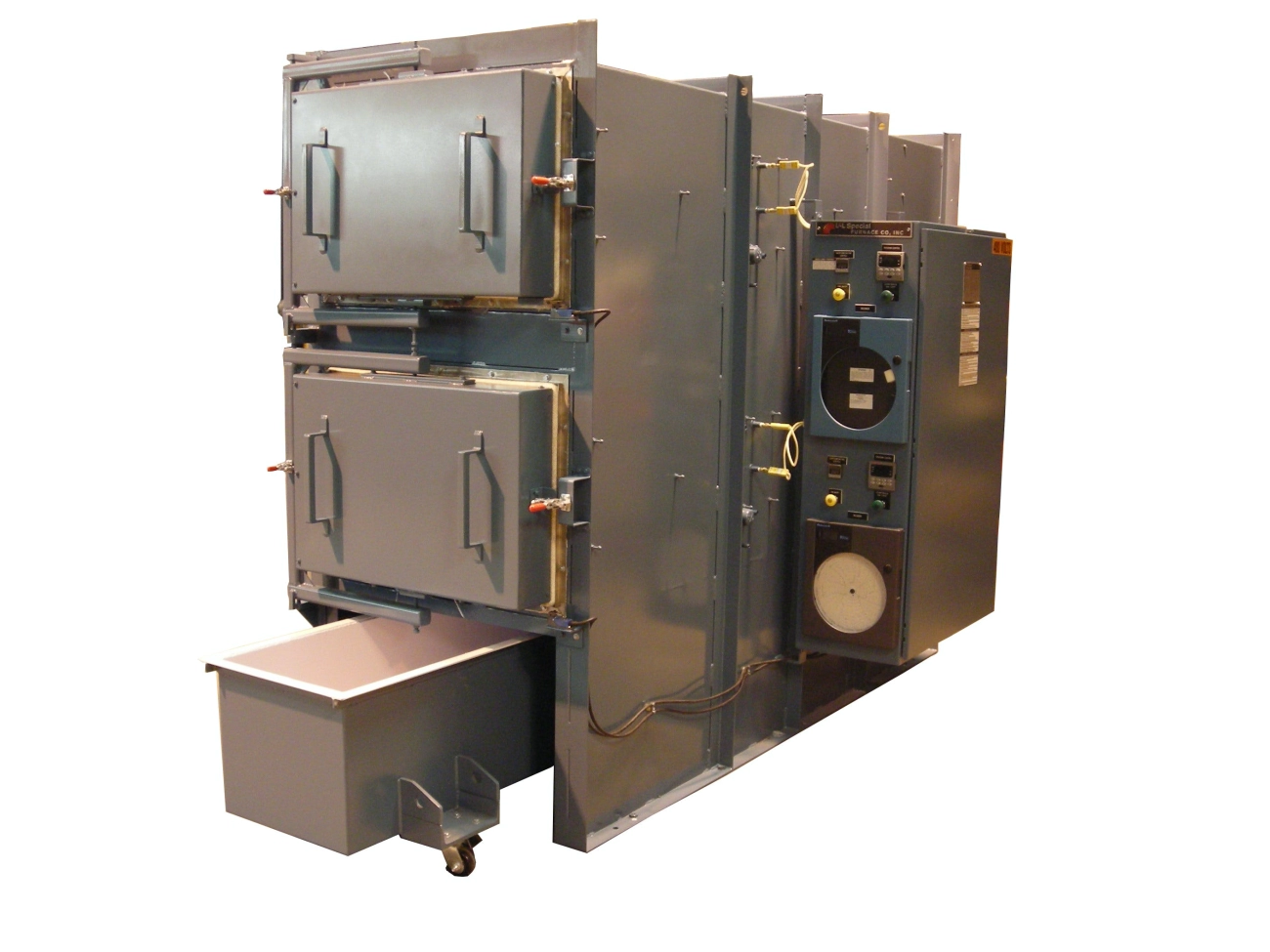
If you’re chasing higher tensile strength of aluminum, alloying is where the magic happens. Pure aluminum is soft; once we add other elements and control the temper, we can push aluminum tensile strength from under 100 MPa to well over 500 MPa in high strength aluminum alloys.
Main alloying elements that boost aluminum strength
The big strength-boosters for aluminum tensile properties are:
- Magnesium (Mg) – key in 5xxx and 6xxx series, improves strength and corrosion resistance.
- Silicon (Si) – used with Mg in 6xxx series (like 6061 aluminum tensile strength) to form hard Mg2Si particles.
- Copper (Cu) – main element in 2xxx series (e.g., 2026 aluminum strength), delivers very high yield strength of aluminum but lowers corrosion resistance.
- Zinc (Zn) – main element in 7xxx series (like 7075 aluminum tensile strength), gives some of the highest aluminum UTS in MPa and psi.
- Manganese (Mn), Chromium (Cr), Zirconium (Zr) – refine grain size and stabilize microstructure, boosting strength and fatigue performance.
By tuning these alloying elements, we get a wide aluminum alloy tensile strength chart covering everything from soft, formable grades to structural aluminum strength levels that start competing with some steels.
Heat-treatable vs non–heat-treatable aluminum alloys
When we talk about aluminum mechanical properties, alloys fall into two big buckets:
- Non–heat-treatable alloys (1xxx, 3xxx, most 5xxx)
- Strength comes mainly from solid solution strengthening and work hardening (cold rolling, drawing, etc.).
- Temper names like H14, H32, H116 indicate how hard they’ve been strain-hardened.
- These are common in marine and sheet applications where corrosion resistance and formability matter as much as aluminum tensile strength.
- Heat-treatable alloys (2xxx, 6xxx, 7xxx, some 4xxx)
- Strength comes from solution heat treatment + quenching + aging (natural or artificial).
- These alloys can hit very high aluminum ultimate tensile strength and yield stress, ideal for aerospace and high-performance parts.
- If you’re used to high-temp alloys and tool steels, the concept is similar to what you’d see in engineered alloy steel products, just with aluminum’s lighter weight and different chemistry.
Temper designations and their effect on tensile strength
For aluminum tensile strength, the temper is just as important as the alloy number:
- O – annealed, lowest tensile strength, highest ductility.
- Hxx – strain-hardened (non–heat-treatable alloys). Higher numbers = more cold work = higher strength.
- T3/T4 – solution heat-treated and naturally aged, medium-to-high strength.
- T6/T651 – solution heat-treated and artificially aged, very common high strength tempers (e.g., 6061-T6, 7075-T6).
- T7x – overaged for better stress-corrosion resistance, slightly lower UTS but better durability.
The same alloy in a different temper can swing from “easy to form” to “structural grade” just by changing the heat treatment and work history.
How precipitation hardening raises aluminum tensile strength
Heat-treatable aluminum alloys rely on precipitation hardening to reach high aluminum tensile strength:
- Solution heat treatment – alloy is heated so alloying elements dissolve into solid solution.
- Quenching – rapid cooling traps those elements in a supersaturated state.
- Aging (natural or artificial) – fine, hard precipitates (like Mg2Si in 6xxx or Al2Cu in 2xxx) form inside the grains.
Those precipitates block dislocation motion, which directly increases:
- Ultimate tensile strength of aluminum
- Yield strength of aluminum
- Fatigue resistance
For U.S. designers working in aerospace, automotive, or heavy equipment, this is why you’ll see tempers like T6, T651, T73 highlight both strength and stability – they tell you how far that alloy has been pushed along the precipitation curve to get the tensile strength for aluminum you need.
Tensile strength of common aluminum alloys
When you’re picking an alloy, the tensile strength of aluminum—both ultimate tensile strength (UTS) and yield strength—is what really drives your design decisions. Here’s how the most common alloys stack up in real numbers (typical room-temperature values, not design allowables).
6061 aluminum tensile strength (UTS and yield)
6061-T6 aluminum is the go-to “all-rounder” in the U.S. for structural parts, frames, and machined components.
- Ultimate tensile strength (UTS): ~290 MPa (42 ksi)
- Yield strength: ~240 MPa (35 ksi)
You get a solid balance of strength, weldability, and machinability, which is why 6061 shows up everywhere from truck frames to light structural components.
7075 aluminum tensile strength (UTS and yield)
7075-T6 aluminum is one of the highest-strength aluminum alloys you can buy off the shelf.
- UTS: ~570–600 MPa (83–87 ksi)
- Yield strength: ~500–540 MPa (73–78 ksi)
It rivals some steels in strength but is harder to weld and a bit less corrosion resistant. I see it used a lot in high-performance parts, aerospace fittings, and premium sporting goods where strength-to-weight is everything.
2026 aluminum strength for aerospace
2026-T3 aluminum is a classic aerospace alloy, especially in skins and structural members where fatigue performance matters.
- UTS: ~470 MPa (68 ksi)
- Yield strength: ~325 MPa (47 ksi)
You get high strength and good fatigue resistance, but you must protect it well against corrosion (primers, cladding, coatings are standard in airframes).
5083 aluminum strength for marine use
For marine and harsh environments, 5083-H116 / H321 aluminum is a standard pick.
- UTS: ~275–320 MPa (40–46 ksi)
- Yield strength: ~125–215 MPa (18–31 ksi), depending on temper
You’re trading peak tensile strength for excellent corrosion resistance and weldability in saltwater, making it ideal for boat hulls, ship structures, and offshore equipment. For cast marine parts, a specialized alloy casting foundry is often the best route to get consistent mechanical properties.
Tensile strength ranges of 1xxx, 3xxx, 5xxx series alloys
Here’s a quick look at typical tensile strength ranges (wrought, common tempers):
- 1xxx series (pure aluminum, e.g., 1100-O to H18)
- UTS: ~60–120 MPa (9–17 ksi)
- Used when conductivity and formability matter more than strength.
- 3xxx series (e.g., 3003-H14)
- UTS: ~110–200 MPa (16–29 ksi)
- Good for sheet metal, HVAC, cooking equipment—moderate strength, easy forming.
- 5xxx series (e.g., 5052-H32, 5083-H116)
- UTS: ~190–350 MPa (28–51 ksi)
- Go-to for structural sheet/plate with strong corrosion resistance, especially in marine and transportation.
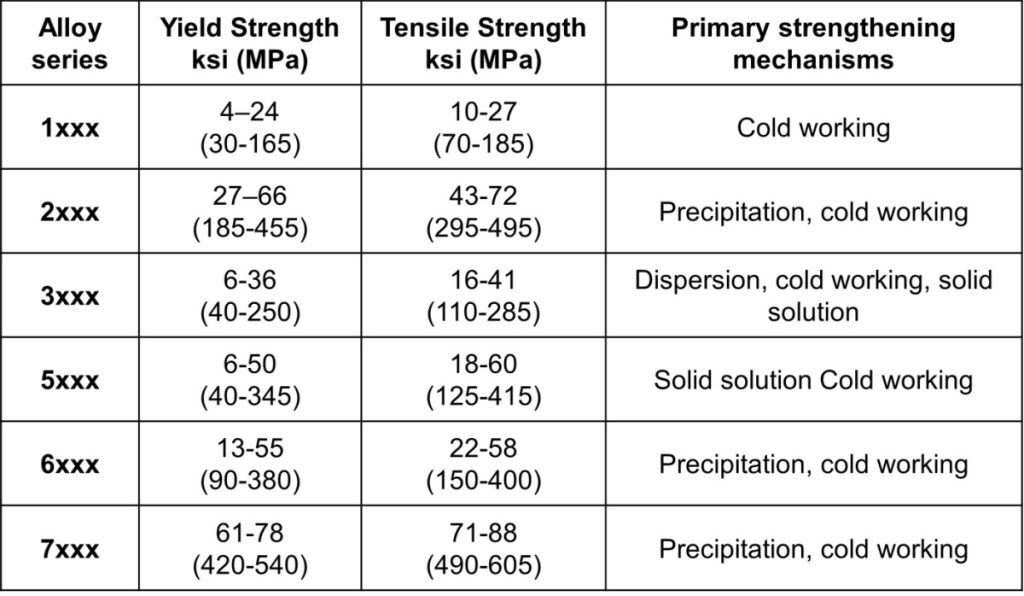
Typical Tensile Ranges for Common Aluminum Alloy Families
Below is a quick feel for tensile strength ranges (room temperature, typical values):
| Alloy Family | Type | Typical Ultimate Tensile Strength |
|---|---|---|
| 1xxx | Wrought, non-HT | ~70–125 MPa (10–18 ksi) |
| 3xxx | Wrought, non-HT | ~110–200 MPa (16–29 ksi) |
| 5xxx | Wrought, non-HT | ~190–350 MPa (28–51 ksi) |
| 6xxx | Wrought, HT | ~200–350 MPa (29–51 ksi) |
| 2xxx | Wrought, HT | ~320–480 MPa (46–70 ksi) |
| 7xxx | Wrought, HT | ~430–600+ MPa (62–87+ ksi) |
| Cast Al-Si | Cast | ~130–320 MPa (19–46 ksi) |
Tensile strength of cast vs wrought aluminum grades
Wrought aluminum (rolled, extruded, forged) almost always delivers higher tensile strength and better ductility than cast grades because of its refined, worked microstructure.
- Cast aluminum alloys (like A356, 319):
- Typical UTS: ~130–280 MPa (19–41 ksi)
- Strength heavily depends on casting process, porosity control, and heat treatment. A quality alloy casting guide is key if you’re designing cast components.
- Wrought aluminum alloys (like 6061-T6, 7075-T6):
- UTS easily runs 250–600 MPa (36–87 ksi)
If you need maximum tensile strength and fatigue life, go wrought. If you need complex shapes at lower cost, cast aluminum can work—just design with its lower tensile strength and potential defects in mind.
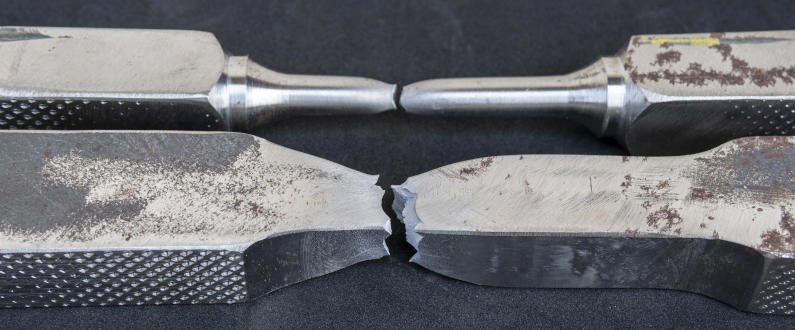
Factors Affecting Tensile Strength of Aluminum
Alloy Composition and Temper
The tensile strength of aluminum depends heavily on alloying elements and temper:
- Elements like Mg, Si, Cu, Zn can dramatically boost aluminum tensile strength compared to pure aluminum.
- The temper designation (O, H32, T6, T651, etc.) tells you how the alloy was hardened:
- O (annealed): lowest strength, highest ductility
- H tempers (cold worked): higher strength from strain hardening
- T tempers (heat treated): highest ultimate tensile strength of aluminum for that alloy
Same alloy, different temper, can easily double the yield strength of aluminum, so I always check both alloy and temper in the spec sheet.
Temperature Effects on Aluminum Tensile Strength
Temperature can make or break your design:
- At elevated temperatures (above ~200°F / 95°C), the aluminum ultimate tensile strength and yield strength drop fast.
- At very low temperatures, aluminum usually gets stronger while staying tough, which is why it’s used in cryogenic tanks.
If you need reliable strength at high temperature, you might compare aluminum with high-temperature alloys like certain titanium alloys that offer better retention of strength in extreme heat (titanium alloy materials).
Grain Size and Microstructure
The grain size and microstructure control how aluminum carries load:
- Finer grains → higher tensile strength and better toughness
- Controlled processing and heat treatment refine grains and optimize aluminum mechanical properties
- Precipitates and phases formed during aging or heat treatment can dramatically shift aluminum tensile properties
For high-performance parts, I always look at both the alloy spec and the process route, not just the nominal strength number.
Forming Processes: Rolling, Extrusion, Forging
How the material is formed changes its strength profile:
- Rolling: increases strength along the rolling direction through cold work
- Extrusion: good for long profiles; creates directional strength and can improve yield strength of aluminum
- Forging: typically delivers the best combination of strength and toughness thanks to a refined, aligned grain structure
Wrought processes usually give higher tensile strength for aluminum than most cast grades.
Corrosion, Fatigue, and Aging Over Time
Long-term aluminum tensile strength isn’t just about day-one numbers:
- Corrosion (especially in salt or chemical environments) can pit the surface and reduce cross-section, which cuts effective aluminum yield stress and fatigue life.
- Fatigue loading (cyclic stress) can cause cracks well below the stated UTS, especially at notches or welds.
- Aging (natural or artificial) can increase or decrease strength depending on the alloy and heat history; over-aging usually lowers aluminum ultimate tensile strength but may improve toughness.
For critical, long-life parts, I rely on real aluminum tensile test data under service conditions rather than just room-temperature catalog numbers.
Tensile strength of aluminum vs steel
Absolute strength: aluminum vs steel
If you only look at absolute tensile strength, most steels beat most aluminum alloys:
- Typical structural steels: 400–550 MPa ultimate tensile strength
- High‑strength steels: 800–1,400 MPa+
- Common aluminum alloys: 200–600 MPa ultimate tensile strength
So if you need the highest possible strength in a small cross‑section, steel usually wins. That’s why we still lean on steel for critical tools, heavy machinery, and applications similar to what you’d see in alloy vs stainless steel comparisons.
Strength‑to‑weight ratio: where aluminum shines
The story flips when you factor in weight:
- Aluminum density: ~2.7 g/cm³
- Steel density: ~7.8 g/cm³
Even though steel is stronger per square inch, aluminum offers similar strength per pound. High‑strength aluminum like 7075-T6 can reach 500–600 MPa UTS while weighing about one‑third of steel, which is why the strength‑to‑weight ratio of aluminum is a big selling point in U.S. aerospace and automotive projects.
When to pick aluminum instead of steel
Choose aluminum when:
- Weight savings matter: aircraft parts, EV battery enclosures, trailer frames, bike frames
- Corrosion resistance is critical: marine hardware, outdoor structures, HVAC components
- Good machinability and formability are needed: housings, brackets, consumer products
- Thermal conductivity helps: heat sinks, intercoolers, power electronics cases
In these cases, aluminum tensile strength is “strong enough,” and the weight and corrosion benefits pay off.
When steel still makes more sense
Stick with steel when:
- You need very high tensile strength in a compact part
- High temperature performance matters (aluminum loses strength faster with heat)
- Extreme fatigue or impact loads are expected (cranes, heavy construction, some suspension parts)
- Very stiff structures are required in a small package (steel is ~3x stiffer than aluminum)
- You’re matching existing steel fabrication and welding lines, or following steel‑based codes
Here, well‑chosen low‑carbon or alloy steels often deliver better long‑term durability and design margins.
Real‑world examples of aluminum replacing steel
You see aluminum replacing steel in the U.S. market all the time:
- Automotive: hood, doors, tailgates, pickup beds, and complete body structures in modern trucks and EVs
- Aerospace: wing skins, fuselage frames, seat tracks, and structural ribs that used to be heavier steel
- Transportation: semi‑trailers, box trucks, and rail cars built with wrought aluminum to cut fuel use
- Consumer products: ladders, toolboxes, laptop shells, bike frames, and sports gear where a lighter feel sells
When I choose between aluminum and steel, I start with the required tensile strength, then check weight, corrosion, stiffness, fabrication, and cost. That balance—not just raw strength—decides the winner.
Applications Based on Tensile Strength of Aluminum
Aerospace: High Tensile Strength Aluminum Alloys
In aerospace, high strength aluminum alloys like 2026, 7075, and other 7xxx grades are picked for their high ultimate tensile strength and great strength‑to‑weight ratio. You’ll see them in:
- Wing skins, ribs, and spars
- Fuselage frames and seat tracks
- Landing gear components (when not using titanium or steel)
Here, designers push right up against the limits of aluminum tensile strength and yield strength, so every alloy and temper is chosen based on certified tensile data and strict standards.
Automotive: Medium Strength Aluminum Alloys
For cars and trucks in the U.S. market, OEMs use medium tensile strength aluminum (mainly 5xxx and 6xxx series like 5052 and 6061) in:
- Body panels and closures (hoods, doors, tailgates)
- Extruded crash beams and bumper systems
- Structural parts in EV battery enclosures
Here the goal is to balance tensile strength, formability, and cost so you can reduce weight without blowing up your stamping and welding budgets.
Construction & Marine: Corrosion‑Resistant Alloys
In construction and marine, corrosion resistance and weldability often matter more than max tensile strength. Common choices:
- 5xxx series (like 5083 aluminum and 5086) for boat hulls, decks, and offshore structures
- 6xxx series for building facades, curtain walls, and structural extrusions
If you’re also working with cast parts in harsh environments, it helps to understand how cast alloy properties differ from wrought, similar to how casting grades are broken down in a detailed casting alloy guide on types and properties.
Consumer Products: Lower Strength Aluminum
For laptops, phones, cookware, light fixtures, and furniture, we usually don’t need aerospace‑grade aluminum tensile strength. Lower to medium strength alloys keep parts:
- Easy to form and machine
- Cost‑effective for high‑volume production
- Strong “enough” for daily use with good dent resistance
How Tensile Strength Guides Alloy Selection
In real design work, tensile strength of aluminum is one of the main filters when picking an alloy and temper:
- Start with loads: What’s the max stress your part will see (with safety factor)?
- Match yield strength first: Make sure the yield strength of aluminum in your chosen alloy/temper comfortably beats that value.
- Check UTS and ductility: Ensure enough ultimate tensile strength and elongation so the part fails safely, not suddenly.
- Balance trade‑offs:
- Need higher strength? You may move to a 7xxx alloy but give up some corrosion resistance or weldability.
- Need better welds or marine durability? A 5xxx alloy might be the safer call, even if the aluminum tensile strength is lower.
For U.S. engineers and buyers, I always recommend locking selections to ASTM or AMS specs, then confirming the aluminum tensile properties with mill certs—and doing your own tensile test when the project is critical or liability is high.
How to choose the right tensile strength of aluminum for your project
Balance tensile strength, weight, and stiffness
When I pick an aluminum alloy, I always start with what actually matters in use:
- Loads & safety factor:
- Light/medium loads, non-structural → lower tensile strength of aluminum (1xxx, 3xxx, soft 5xxx) is usually fine.
- Structural parts, high loads, moving equipment → higher aluminum tensile strength (6061-T6, 6082-T6, 7075-T6).
- Weight targets:
- If you’re trying to cut weight (auto, aerospace, robotics), favor higher strength-to-weight ratio alloys like 6061 or 7075 over mild steel.
- Stiffness (deflection):
- Aluminum’s stiffness (modulus) doesn’t change much between alloys, even though tensile strength does.
- If deflection is the problem, you usually solve it by changing geometry (thicker section, ribbing), not just picking a higher ultimate tensile strength of aluminum.
Corrosion resistance and weldability vs strength
You can’t just chase maximum aluminum tensile strength; you have to keep the part alive in the real world:
- Need strong welds?
- 5xxx alloys (like 5083) and 6xxx (like 6061) are good welding choices.
- Many high strength aluminum alloys (7075, 2026) lose a lot of strength near welds and are usually bolted or riveted, not welded.
- Harsh environments (saltwater, outdoors, chemicals):
- Marine and outdoor structures lean on 5xxx series for a mix of good tensile strength and excellent corrosion resistance.
- If corrosion will eat the part, the “high aluminum ultimate tensile strength” on paper doesn’t mean much.
Cost and availability of aluminum alloys
In the U.S. market, I always see projects fail more on logistics than on theory:
- Common, affordable choices:
- 6061 is usually the best “default” for structural use: decent tensile strength, widely stocked, good machinability.
- 5052 and 3003 sheet are cheap and easy to bend for enclosures, panels, and non-critical structures.
- Higher strength = higher cost + longer lead times:
- Alloys like 7075 and 2026 cost more and aren’t available in as many shapes and sizes.
- For CNC or turning work, confirm material availability with your shop before you lock in the alloy. A full-service shop with strong testing and quality capabilities can help validate both material and final parts.
How to read aluminum material specs and standards
When you look at aluminum mechanical properties in a datasheet, focus on:
- Alloy + temper:
- Example: 6061-T6
- “6061” = composition, “T6” = heat-treated for high strength.
- Same alloy, different temper = completely different tensile strength of aluminum.
- Key values:
- Ultimate tensile strength (UTS) – the maximum stress before fracture.
- Yield strength – where permanent deformation starts.
- Elongation – how “stretchy” or brittle the alloy is.
- Standards:
- In the U.S. you’ll see ASTM (like ASTM B221 for extrusions) and sometimes AMS for aerospace.
- Always verify that the supplier certs match the spec and temper you designed around.
When to test tensile strength instead of trusting datasheets
I trust datasheets for early design, but I don’t rely on them blindly in critical builds:
- You should tensile test aluminum when:
- Parts are safety critical (lifting equipment, pressure systems, aerospace, racing).
- You’re using non-standard suppliers or low-cost imports and need proof the aluminum tensile properties are real.
- You’ve done custom heat treatment, welding, or forming that could change yield strength or UTS.
- How to do it right:
- Use a certified lab or a manufacturer with proper aluminum tensile testing and quality systems in place, similar to what we run in our own testing and quality setup.
- Test a few samples per heat/lot and keep records tied to your project and material certs.
If you line up load requirements, environment, joining method, and actual supply chain, picking the right tensile strength for aluminum gets a lot more predictable—and you avoid paying for “overkill” strength you don’t really need.
FAQs on tensile strength of aluminum
What is the strongest aluminum alloy by tensile strength?
For commercial grades, 7075-T6 aluminum is one of the strongest, with an ultimate tensile strength of about 570–600 MPa (83–87 ksi). Some specialized aerospace tempers can go even higher, but for most real-world projects in the U.S., 7075-T6 is the benchmark when people talk about “high strength aluminum alloys.”
Is aluminum strong enough to replace steel?
Sometimes yes, sometimes no.
Aluminum’s tensile strength is usually lower than steel, but its strength-to-weight ratio can be very competitive. You’ll often choose aluminum instead of steel when:
- Weight savings matter (vehicles, aerospace, portable equipment)
- Corrosion resistance is key
- You can design larger sections to make up for lower stiffness
If you need very high stiffness, thin sections, or extreme loads, steel still makes more sense.
Can heat treatment increase aluminum tensile strength?
Yes. Heat-treatable aluminum alloys (like 2xxx, 6xxx, and 7xxx series) can gain a lot of tensile strength through:
- Solution heat treatment
- Quenching
- Aging / precipitation hardening
This is how we take a common grade like 6061 from moderate strength in the O temper to much higher strength in T6 or T651. For finishing needs after heat treatment, we also handle specialized surface treatment services to balance strength, corrosion resistance, and appearance: professional surface treatment for metal parts.
What units are used to measure aluminum tensile strength?
Most specs for aluminum tensile strength use:
- MPa (megapascals) – common in engineering data sheets
- psi or ksi (pounds per square inch / thousand psi) – widely used in U.S. shops and fab drawings
Example: 310 MPa ≈ 45 ksi.
Is pure aluminum suitable for structural use?
Pure aluminum (1xxx series) has low tensile strength (often under 100–125 MPa / 15–18 ksi), so it’s not ideal for primary structural parts. It’s mainly used where:
- High electrical or thermal conductivity matters
- Formability and corrosion resistance are more important than strength
For structural aluminum strength, you’ll typically move to alloyed and tempered grades like 6061, 6082, 2026, 5083, or 7075, depending on your load, weight, and environment requirements.