Understanding Stainless Steel Casting: Core Processes Explained
As a leading stainless steel casting manufacturer, we know that selecting the right production method is critical for balancing cost, precision, and performance. At Vastmaterial, we primarily utilize precision investment casting (lost-wax) and sand casting to deliver components that meet rigorous industrial standards. Understanding how these processes differ ensures you get the exact mechanical properties and surface finish your project demands.
The Investment Casting Process (Lost-Wax)
For parts requiring high precision and complex geometries, stainless steel investment casting is our standard. This method allows us to produce intricate designs with thin walls (down to 2-3mm) that would be impossible or too costly to machine from solid stock.
Here is the step-by-step breakdown of our process:
- Wax Pattern Creation: We inject wax into a metal die to create an exact replica of the final part.
- Ceramic Shell Building: The wax pattern is dipped into a ceramic slurry and coated with sand to build a hard shell.
- Dewaxing: The shell is heated, causing the wax to melt and drain away, leaving a hollow cavity.
- Pouring: Molten stainless steel—whether it’s 304, 316, or specialized 400 series alloys—is poured into the pre-heated shell.
- Shell Removal: Once the metal solidifies, the ceramic shell is vibrated or blasted away to reveal the raw casting.
Investment vs. Sand Casting: Which is Right for You?
While investment casting offers superior detail, sand casting remains a powerhouse for larger, heavier components. We operate state-of-the-art plants capable of handling both methods, allowing us to recommend the best fit based on your part’s weight and tolerance requirements.
| Feature | Investment Casting | Sand Casting |
|---|---|---|
| Ideal Application | Complex, precision parts (Valves, Fittings) | Large, heavy structural parts |
| Weight Range | 0.1 lb – 150 lb | 5 lb – 5,000+ lb |
| Linear Tolerance | Extremely Tight (±0.003 – 0.005 in/in) | Standard (±0.03 – 0.06 in/in) |
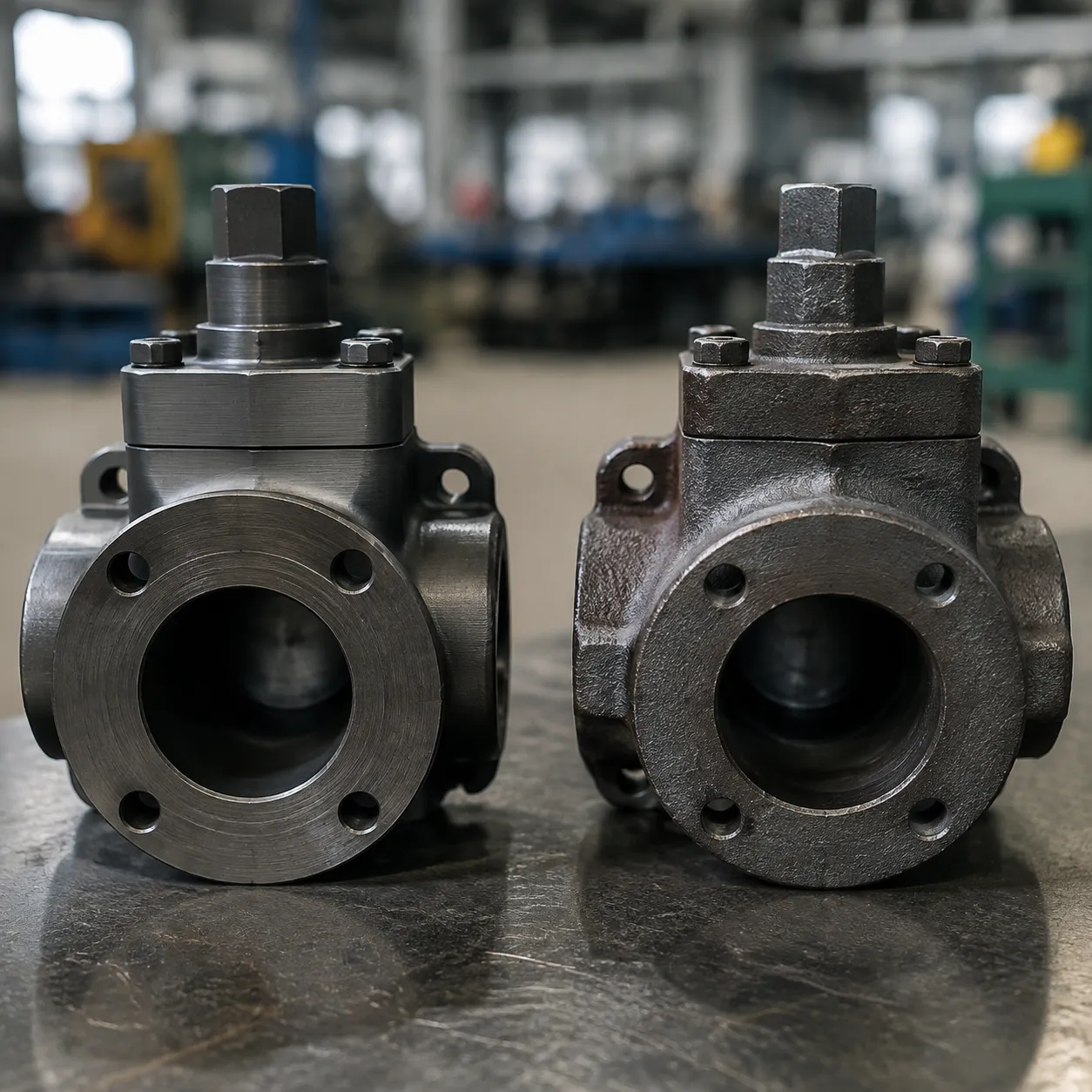
| Surface Finish | Smooth, near-net-shape | Rougher, granular texture |
Key Advantages of Precision Stainless Steel Castings
Choosing investment casting process stainless steel over fabrication or machining offers distinct advantages, particularly for the 300 and 400 series grades we specialize in:
- Superior Surface Finish: We achieve high-quality surfaces (Ra 3.2-6.3) straight out of the mold, reducing the need for extensive polishing.
- Tight Tolerances: Our process holds linear tolerances between ±0.003 and ±0.005 in/in, ensuring consistency across production runs.
- Reduced Machining: Because we cast to near-net-shape, we significantly reduce material waste and machining time, lowering the overall cost per unit.
- Design Freedom: We can cast complex internal passages and undercuts that are difficult to achieve with traditional machining methods.
Common Stainless Steel Grades Used in Casting
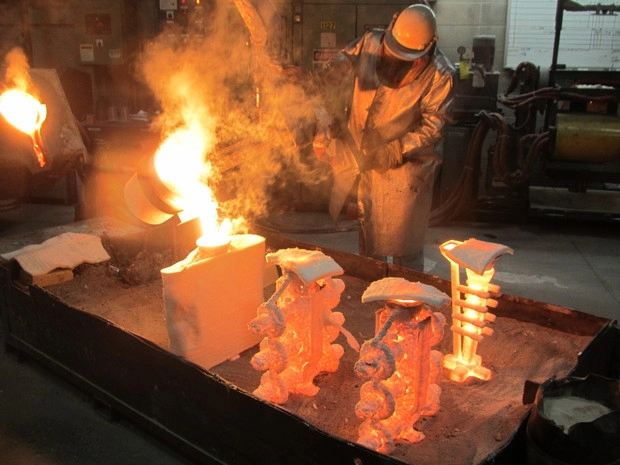
Selecting the right alloy is critical for performance, and as a stainless steel casting manufacturer, we specialize in pouring a diverse range of grades to meet specific mechanical and chemical requirements. From standard corrosion-resistant alloys to high-strength hardenable steels, our facility manages the entire metallurgical process.
Austenitic Grades: The Industry Standard
The 300 series represents the most widely used cast stainless steel grades 304 316. These austenitic steels are non-magnetic in the annealed condition and offer excellent corrosion resistance.
- 304 (CF8): The versatile “18-8” stainless steel. It is the go-to choice for food processing, architectural hardware, and general industrial components where sanitation and rust resistance are paramount.
- 316 (CF8M): Contains added molybdenum, which significantly improves resistance to chlorides and pitting. This grade is essential for marine hardware, pharmaceutical equipment, and chemical processing environments.
Duplex Stainless Steel Casting
For applications requiring higher strength than the 300 series and superior resistance to stress corrosion cracking, we utilize Duplex stainless steel casting alloys like 2205. These grades feature a mixed microstructure of austenite and ferrite, making them ideal for the oil and gas industry, heat exchangers, and desalination plants where components face high pressure and aggressive corrosive media.
Martensitic and PH Grades for High Strength
When hardness and wear resistance are the priority, we turn to the 400 series and Precipitation Hardening (PH) steels.
- 400 Series (410, 420, 440A/B/C): These are magnetic and heat-treatable. They are cost-effective alternatives to nickel-heavy alloys and are perfect for pump parts, valve seats, and cutlery.
- 17-4PH (UNS S17400): This grade offers an exceptional balance of corrosion resistance and high strength. Through specialized heat treatments (like H900), we can achieve tensile strengths up to 190 ksi (1310 MPa), making it a staple in aerospace and defense.
Balancing Performance and Cost
Choosing the correct material involves balancing mechanical properties against budget. While austenitic grades offer premium corrosion protection, they can be subject to nickel price volatility. Conversely, high-chromium 400 series options provide a more price-stable solution for structural parts. Our team helps clients navigate this guide to processes, alloys, and uses to ensure the selected grade meets both engineering specs and project budgets.
Benefits of Stainless Steel Casting Over Alternatives

Choosing the right manufacturing process is critical for balancing performance, cost, and lead time. As a direct factory, we see firsthand how stainless steel casting outperforms traditional welding or machining from solid stock, especially when dealing with complex geometries and high-volume production.
Superior Corrosion Resistance and Durability
The primary reason industries switch to casting is the inherent material integrity. Unlike welded parts, which can suffer from intergranular corrosion at the weld seams, a casting is a single, continuous piece of metal. We utilize a wide range of stainless steel materials—including standard 304/316 grades and high-performance Duplex 2205—to ensure parts withstand harsh chemical, marine, and high-temperature environments without failure.
Near-Net-Shape Precision
Investment casting (lost wax) allows us to produce “near-net-shape” components. This means the cast part emerges from the mold very close to its final dimensions, significantly reducing the need for secondary machining.
- Complex Geometries: We can cast intricate internal channels and thin walls (down to 2-3mm) that are impossible or too costly to machine.
- Material Efficiency: Casting minimizes scrap waste compared to machining, where you often pay for a large block of metal only to cut 40% of it away.
Cost-Effectiveness for Production
While the initial tooling cost for a mold exists, the per-unit price drops drastically for medium to large runs. For parts requiring high repeatability, casting provides a lower total cost of ownership than fabricating individual pieces.
Comparison: Casting vs. CNC Machining
| Feature | Stainless Steel Casting | CNC Machining from Solid |
|---|---|---|
| Material Waste | Low (Material is poured only where needed) | High (Subtractive process removes material) |
| Design Freedom | High (Undercuts and organic shapes are easy) | Medium (Limited by tool access) |
| Consistency | Excellent (Identical parts from the same mold) | Good (Dependent on machine setup) |
| Surface Finish | Smooth (Can be polished to 8K Mirror/No. 4) | Machined (Requires additional polishing steps) |
Hygiene and Aesthetic Finish
For industries like food processing and pharmaceuticals, surface finish is not just about looks—it’s about hygiene. Our castings can be finished to an 8K Mirror, Brushed, or Electropolished standard. This eliminates microscopic crevices where bacteria can hide, making cast stainless steel the superior choice for sanitary applications compared to rougher fabricated surfaces.
Key Industries Relying on Stainless Steel Castings

As a premier stainless steel casting manufacturer, we see firsthand how diverse sectors rely on the durability and precision of investment casting. Different industries require specific alloy properties—from extreme heat resistance in automotive engines to strict hygiene standards in pharmaceutical labs. Our facility adapts the precision casting process to meet these unique demands, delivering components that perform reliably under pressure.
Food Processing and Pharmaceutical Equipment
Sanitation is non-negotiable in these sectors. We primarily utilize 300 series stainless steel (like 304 and 316) for food and pharma applications because these grades offer excellent corrosion resistance against cleaning chemicals and organic acids.
- Common Parts: Mixing paddles, valve bodies, sanitary fittings, and pump housings.
- Key Benefit: Smooth surface finishes (electropolished or mirror) prevent bacterial growth and ensure compliance with hygiene standards.
Pumps, Valves, and Marine Hardware
The oil, gas, and marine industries operate in some of the harshest environments on earth. Here, we often deploy Duplex stainless steel (2205) and 316 grade alloys. These materials provide superior resistance to pitting and stress corrosion cracking caused by saltwater and chlorides.
- Common Parts: Impellers, heavy-duty valve bodies, pipe fittings, and marine deck hardware.
- Key Benefit: High strength and longevity in corrosive, high-pressure environments.
Automotive and Heavy Machinery
For the automotive sector, cost-efficiency and heat resistance are paramount. We frequently cast 400 series stainless steel (such as 409, 410, and 430) for these applications. These ferritic and martensitic grades are ideal for parts exposed to high thermal cycling without the high cost of nickel-heavy alloys.
- Common Parts: Exhaust manifolds, turbocharger housings, and engine brackets.
- Key Benefit: Excellent thermal fatigue resistance and magnetic properties where required.
Aerospace and Defense Components
Precision and strength-to-weight ratios are critical in aerospace. We utilize specialized Precipitation Hardening (PH) steels, such as 17-4PH, which can be heat-treated (e.g., H900 condition) to achieve tensile strengths up to 190 ksi.
- Common Parts: Structural brackets, fuel system components, and landing gear parts.
- Key Benefit: Exceptional mechanical strength and wear resistance for safety-critical applications.
Real-World Component Examples
Our custom stainless steel cast parts are found in machinery across the globe. Whether it is a thin-walled aerospace bracket or a massive industrial pump casing, we handle the complexity.
- Impellers: Balanced for high-speed rotation in fluid handling.
- Housings: Pressure-tight casings for sensors and gears.
- Fittings: Precision-threaded connectors for fluid systems.
What to Look for in a Stainless Steel Casting Manufacturer
Selecting the right partner for your project is critical. Not every foundry can handle the complexities of precision stainless steel castings, especially when dealing with intricate geometries or strict metallurgical requirements. As a direct factory, we understand that you need more than just a vendor; you need a manufacturing partner who can deliver consistent quality from the first prototype to full-scale production.
Here is a breakdown of the essential factors to evaluate when vetting a stainless steel casting company:
Proven Production Experience and Capacity
A reliable manufacturer should offer flexibility in production volume and weight. You need a partner capable of scaling with you.
- Weight Range: Look for capabilities that span from small precision parts (0.1 lb) to massive heavy-duty components (5,000+ lb).
- Process Versatility: The ability to switch between investment casting for high precision and sand casting for larger structural parts is a huge advantage.
- Scalability: Ensure they can handle rapid prototyping as efficiently as high-volume runs.
Quality Certifications and Traceability
Quality isn’t just a buzzword; it’s about verifiable data. A top-tier stainless steel casting manufacturer must strictly adhere to international standards like ASTM A915, AMS 6414, and MIL-S-22141.
- Material Traceability: Every heat number should be trackable to ensure the chemical composition meets specifications (e.g., correct Cr and Ni wt% in 304 or 316 grades).
- Testing: Look for in-house Non-Destructive Testing (NDT) capabilities to detect internal voids or surface defects.
- Process Control: Reviewing a supplier’s comprehensive factory capabilities and quality processes will give you confidence in their ability to maintain tight tolerances consistently.
Advanced Integrated Capabilities
The best value comes from a “one-stop-shop” approach. Moving parts between multiple vendors for casting, machining, and finishing increases lead times and risk.
- CNC Machining: Integrated machining ensures that cast parts meet final dimensional tolerances without logistical delays.
- Heat Treatment: Expertise in specific treatments (like H900, H1150, or T6) is vital for grades like 17-4PH to achieve the desired hardness and tensile strength.
- Surface Finishing: Whether you need an 8K mirror finish, brushed, or standard 2B, the foundry should handle it in-house.
Material Expertise and Alloy Options
A competent foundry doesn’t just pour metal; they understand metallurgy. They should be able to guide you on selecting the right grade—whether it’s standard 300 series for corrosion resistance, 400 series for hardness, or specialized Duplex stainless steel for high-stress environments.
Red Flags to Avoid
Be cautious of suppliers who:
- Cannot provide material certifications (MTRs) for every shipment.
- Lack clear communication regarding lead times or logistics.
- Outsource critical steps like heat treatment without oversight.
- Offer prices that seem too good to be true, often signaling the use of subpar scrap metal or poor process control.
The Vastmaterial Advantage: Precision and Reliability
As a premier stainless steel casting manufacturer, Vastmaterial (Haoyu Material) combines direct factory capabilities with advanced metallurgical expertise. We specialize in delivering high-performance components that meet the rigorous demands of global industries, from aerospace to industrial fluid handling. Our integrated production facility allows us to control every step of the manufacturing process, ensuring that your custom stainless steel casting projects are delivered on time and within budget.
Our Investment Casting Expertise
We utilize state-of-the-art investment casting (lost-wax) techniques to produce complex, thin-walled parts that sand casting simply cannot match. Our process is optimized for intricate geometries, allowing for a minimum wall thickness of approximately 2-3mm. By leveraging our precision casting services, clients benefit from near-net-shape components that significantly reduce material waste and machining costs.
Commitment to Quality and Traceability
Reliability is built into our chemistry. We strictly adhere to ASTM A915, AMS 6414/6415, and MIL-S-22141 standards. Whether you require the corrosion resistance of 316 stainless steel or the high strength of 17-4PH (H900 condition), we provide full material certification and heat number traceability for every batch.
Key Manufacturing Capabilities:
- Tight Tolerances: Achieving linear tolerances of ±0.003–0.005 in/in for investment castings.
- Surface Excellence: Offering diverse finishes including 2B, BA, No. 4 Brushed, and 8K Mirror directly from our facility.
- Material Versatility: Expertise in pouring 300 series (Austenitic), 400 series (Martensitic/Ferritic), Duplex 2205, and Precipitation Hardening steels.
End-to-End Manufacturing Solutions
We go beyond simple pouring. Vastmaterial offers a complete “print-to-part” solution. Our in-house capabilities include CNC machining, precision laser cutting, and specialized heat treatments (such as Q&T or T6) to dial in specific mechanical properties like hardness or ductility. This integrated approach eliminates the headache of managing multiple vendors, making us a preferred stainless steel casting company for businesses seeking streamlined supply chains.
Frequently Asked Questions About Stainless Steel Casting
What is the typical tolerance for stainless steel investment castings?
Precision is the main draw here. For our investment casting process, we typically hold linear tolerances between ±0.003 and ±0.005 inches per inch. This allows for near-net-shape parts that require very little machining. If you are opting for sand casting for larger, heavier components (5 lb to 5,000+ lb), the tolerances are naturally looser, generally falling in the ±0.030 to ±0.060 inches range.
How does casting compare to forging for stainless steel?
Casting wins on complexity; forging wins on structural grain flow. We recommend casting when you have intricate internal geometries, thin walls, or complex contours that would be too expensive or impossible to machine from a forged block. If you are deciding between methods, our comprehensive guide to stainless investment casting breaks down the cost and design advantages in detail. Casting also allows us to utilize a wider range of alloys, including specialized 400 series and Duplex grades, without the high tooling costs associated with forging dies.
What post-casting processes are common?
Raw castings rarely go straight to assembly. We provide a full suite of secondary operations to get parts production-ready:
- Heat Treatment: Processes like Solution Annealing, Quenching & Tempering (Q&T), or Precipitation Hardening (e.g., H900 condition for 17-4PH) to adjust hardness and tensile strength.
- CNC Machining: Precision grinding, drilling, and tapping to hit tight dimensional specs.
- Surface Finishing: Options range from standard blasting to 8K Mirror, Brushed, or Electropolishing for sanitary applications.
Lead times and minimum order quantities?
We operate with the flexibility of a direct factory. While lead times depend on the complexity of the mold and the specific alloy grade (like 304 vs. 410), we generally move faster than massive automated foundries because we handle integrated production management in-house. We don’t enforce prohibitive Minimum Order Quantities (MOQs) for every project; we work with you to accommodate prototype runs as well as full-scale production batches.
How to ensure corrosion resistance in cast parts?
Material selection is step one. We pour standard austenitic grades like 304 and 316 for general corrosion resistance, and Duplex 2205 for harsh environments. For applications requiring high strength alongside corrosion resistance, understanding the properties of 17-4 stainless steel is crucial for proper grade selection. Beyond the alloy itself, we perform passivation treatments to remove surface contaminants and enhance the natural oxide layer that protects the steel.