

What Is Aluminum Tensile Strength?
When people ask whether a part “is strong enough,” they’re really asking about aluminum tensile strength—how much pulling force it can take before it breaks.
Definition: Ultimate Tensile Strength (UTS)
Aluminum tensile strength (ultimate tensile strength, UTS) is:
The maximum stress aluminum can withstand in tension before it fractures, measured in force per unit area.
Once aluminum reaches its ultimate tensile strength, any extra load causes necking and final break.
Tensile vs Yield vs Elongation
These three numbers always show up together in aluminum tensile data:
| Property | What It Means | Why It Matters |
|---|---|---|
| Tensile strength (UTS) | Max stress before final fracture | Absolute limit in a tensile test |
| Yield strength | Stress where noticeable permanent deformation starts | Design limit to avoid permanent bending |
| Elongation (%) | How much it stretches before breaking (ductility) | Indicates formability and toughness |
- Yield strength is usually lower than UTS.
- High elongation means the aluminum is ductile and more forgiving in real use.
Basic Stress–Strain Behavior in Tension
In a tensile test, aluminum shows a typical stress–strain curve:
- Linear elastic region – Stress and strain are proportional; remove load, it springs back.
- Yield point / plastic region – Material starts to deform permanently.
- Strain hardening – Strength increases with more deformation.
- Ultimate tensile strength – Peak stress.
- Necking and fracture – Local thinning and final break.
This curve is the foundation for aluminum tensile design guidelines and safety factors.
Common Units for Aluminum Tensile Data
You’ll see aluminum tensile properties expressed in:
| Unit | Name | Typical Use in US Market |
|---|---|---|
| ksi | kilopounds per square inch | Common in US structural design |
| psi | pounds per square inch | Detailed engineering data |
| MPa | megapascal | Global standards, datasheets |
Engineers in the United States often think in ksi, but most global datasheets list MPa. Both describe the same aluminum tensile strength, just in different units.
Why Aluminum Tensile Properties Matter
For my own products and platform, getting the aluminum tensile numbers right is non‑negotiable. They directly affect:
- Safety – Will that bracket, beam, or frame fail under load?
- Weight – Can we downsize a part and still hold the load?
- Cost – Can we avoid over‑designing with an overly strong (and expensive) alloy?
- Reliability – Will parts deform over time under repeated stresses?
Whenever we choose an alloy, a temper, or a cross‑section, we’re really matching the aluminum tensile strength, yield strength, and elongation to the real-world loads our customers put on the product.
Pure Aluminum Tensile Properties
When we talk about aluminum tensile strength, pure aluminum sits at the lower end of the strength range but wins big on formability and corrosion resistance.
Typical Tensile Strength of Pure Aluminum
Commercially pure aluminum (like 1100 or 1050):
- Ultimate tensile strength (UTS): about 70–110 MPa (≈ 10–16 ksi)
- Yield strength: roughly 25–45 MPa (≈ 3–6 ksi)
- Very low strength compared with high-strength alloys, but very predictable and easy to work with.
You can see typical values for pure aluminum and alloyed grades in more detail in this breakdown of the tensile strength of aluminum.
Ductility and Elongation of Commercially Pure Aluminum
Pure aluminum is extremely ductile:
- Elongation at break: usually 30–40%, sometimes higher in fully annealed (O) temper
- Bends, deep draws, and forms easily without cracking
- Great choice when you need high aluminum elongation percentage and forgiving forming behavior
Limitations in Structural Applications
For structural or load‑bearing parts, pure aluminum has real limits:
- Low aluminum yield strength → parts can deform permanently under modest loads
- Larger cross-sections are needed to carry the same load as alloyed aluminum or steel
- Not ideal where stiffness and fatigue resistance are critical (frames, beams, heavy brackets)
In other words, you don’t pick pure aluminum when ultimate tensile strength or high load capacity is your main design driver.
When Pure Aluminum Is Still a Good Choice
Pure aluminum still makes sense in a lot of U.S. applications where strength isn’t everything:
- Electrical and thermal applications: bus bars, heat sinks, heat exchangers
- Packaging: foil, cans, food and pharma packaging
- HVAC and building products: fins, light-gauge sheet where formability matters
- Decorative and non-structural parts: trim, nameplates, panels
When you need excellent ductility, easy forming, top-tier corrosion resistance, and low cost—and only moderate strength—commercially pure aluminum is a very smart pick.
Aluminum Tensile Strength in Alloys
Aluminum alloys are where the real tensile strength gains happen. Pure aluminum is soft and very ductile, but once we add the right alloying elements and control the processing, aluminum tensile strength jumps dramatically.
Why Aluminum Alloys Are Stronger Than Pure Aluminum
We boost ultimate tensile strength of aluminum by adding elements like:
- Magnesium (Mg) – solid-solution strengthening, great for marine and sheet alloys
- Silicon (Si) – improves castability, used heavily in casting grades
- Copper (Cu) – big strength increase, used in 2xxx and 7xxx series (often with zinc)
- Zinc (Zn) – key for very high strength 7xxx alloys
- Manganese (Mn), Chromium (Cr), Zr – refine grain structure, improve toughness and stability
These elements create strengthening mechanisms (solid solution, precipitate hardening, grain refinement) that lift both tensile strength and yield strength far above pure aluminum while still keeping a good elongation percentage when needed.
Wrought vs Cast Aluminum Tensile Behavior
Aluminum alloys fall mainly into two buckets:
- Wrought aluminum alloys (rolled, extruded, forged)
- Finer, more uniform grain structure
- Higher tensile and yield strength for the same chemistry
- Better ductility and toughness
- Used for structural parts, extrusions, plate, aerospace, and automotive
- Cast aluminum alloys (die cast, sand cast, investment cast)
- Lower tensile strength on average due to porosity and coarser microstructure
- More complex shapes and near-net form
- Ideal for housings, brackets, and structural castings when designed correctly
If you’re designing structural cast parts, tight process control and good foundry practice matter a lot. That’s why we rely on high-precision aluminum die casting services with large-tonnage machines and CNC finishing to protect both tensile properties and dimensional accuracy.
How Alloying Elements Change Tensile Properties
Alloying and temper selection let us “tune” aluminum tensile properties:
- Heat-treatable alloys (2xxx, 6xxx, 7xxx):
- Use solution heat treatment + aging to form hard precipitates
- Big jump in yield strength and ultimate tensile strength (e.g., 6061-T6, 7075-T6)
- Non-heat-treatable alloys (1xxx, 3xxx, 5xxx):
- Strength mainly from solid solution and work hardening
- Great elongation and toughness, excellent for forming and welding
We pick alloy + temper based on whether we prioritize:
- Maximum tensile strength
- Formability and elongation
- Weldability and corrosion resistance
- Cost and availability
Typical Tensile Ranges for Common Aluminum Alloy Families
Below is a quick feel for tensile strength ranges (room temperature, typical values):
| Alloy Family | Type | Typical Ultimate Tensile Strength |
|---|---|---|
| 1xxx | Wrought, non-HT | ~70–125 MPa (10–18 ksi) |
| 3xxx | Wrought, non-HT | ~110–200 MPa (16–29 ksi) |
| 5xxx | Wrought, non-HT | ~190–350 MPa (28–51 ksi) |
| 6xxx | Wrought, HT | ~200–350 MPa (29–51 ksi) |
| 2xxx | Wrought, HT | ~320–480 MPa (46–70 ksi) |
| 7xxx | Wrought, HT | ~430–600+ MPa (62–87+ ksi) |
| Cast Al-Si | Cast | ~130–320 MPa (19–46 ksi) |
For cast components, well-controlled processes like precision aluminum investment castings help you get closer to the upper end of these tensile ranges by minimizing porosity and improving microstructure.
If you’re in the U.S. and speccing parts, you’ll usually match these mechanical properties of aluminum with your required tensile strength, yield strength, and elongation from ASTM or OEM standards, then choose the alloy family and process (wrought vs cast) that hits those targets with the lowest weight and total cost.
Key Factors Affecting Aluminum Tensile Strength
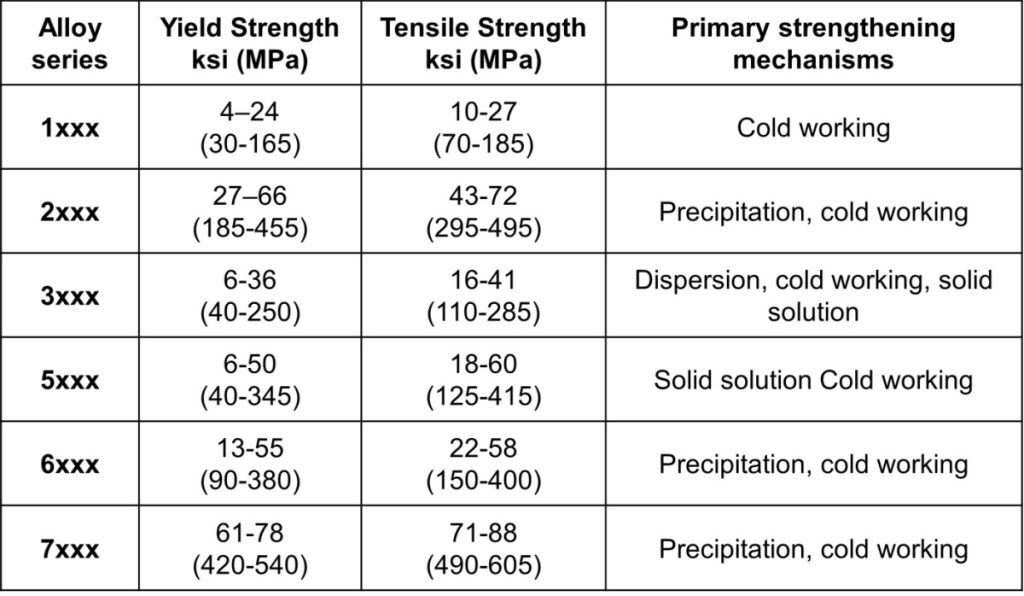
Aluminum tensile strength isn’t fixed—it’s driven by how the metal is alloyed, processed, and used. If you’re designing parts for the U.S. market where strength, weight, and cost all matter, these are the levers you actually control.
Alloy composition and strengthening mechanisms
The base metal (pure aluminum) is soft. We boost aluminum tensile strength by adding elements like magnesium, silicon, copper, zinc, and manganese.
- Solid solution strengthening – alloying elements dissolved in aluminum resist deformation.
- Precipitation hardening – in heat‑treatable alloys (like 6061, 2026, 7075), tiny hard particles (precipitates) form and block dislocation movement.
- Dispersion and grain‑boundary strengthening – fine particles and refined grains increase both ultimate tensile strength and aluminum yield strength.
Choosing the right composition is step one in hitting your required tensile properties of aluminum alloys.
Heat treatment and tempers (O, H, T4, T6)
Temper matters as much as alloy.
- O (annealed) – softest, lowest tensile strength, highest ductility.
- H tempers – strain‑hardened (cold worked) and sometimes partially annealed; common on non‑heat‑treatable alloys like 5052.
- T4 – solution heat treated and naturally aged; good balance of strength and formability.
- T6 – solution heat treated and artificially aged; maximum aluminum tensile strength for many alloys (e.g., 6061‑T6, 7075‑T6).
If you need a deeper dive into how temper shifts yield strength and tensile values, I break that down in our guide to aluminum yield strength and tempers.
Work hardening and cold working
Cold working (rolling, drawing, bending, forming at room temperature) increases aluminum tensile strength by piling up dislocations in the metal.
- More cold work → higher ultimate tensile strength and yield strength
- But also → lower elongation percentage and less formability
For high‑volume U.S. manufacturing, we often tune the amount of cold work to hit a specific strength/ductility window instead of just maxing out hardness.
Manufacturing process impact (extrusion, rolling, casting)
How we shape the metal directly affects mechanical properties of aluminum:
- Extrusions (e.g., 6063, 6061) – directional grain flow and good surface finish; strong in the extrusion direction.
- Rolled plate/sheet – typically higher and more uniform strength than cast, ideal for structural applications.
- Cast aluminum – usually lower tensile strength and ductility than wrought, but great for complex shapes; casting parameters and alloy choice are critical. Many of the same principles carry over from stainless steel casting processes—solidification control, porosity, and cooling rate still drive strength.
Temperature effects on aluminum tensile strength
Aluminum loses strength faster with heat than steel.
- At elevated temperatures (above ~200–250 °F / 95–120 °C), tensile strength and yield strength drop noticeably.
- At low temperatures, most aluminum alloys actually get stronger and retain good toughness.
If your part sees under‑hood heat, welding, or continuous high‑temp service, you can’t just use room‑temperature tensile test aluminum data and call it good.
Grain size, impurities, and environment
Microstructure and environment quietly shape real‑world aluminum tensile performance:
- Fine grain size → higher strength and often better fatigue resistance.
- Impurities and inclusions → stress concentrators that reduce ductility and sometimes lower effective tensile strength.
- Environment (corrosion, moisture, salt, galvanic contact) can:
- Pit the surface, reducing cross section.
- Drive stress‑corrosion cracking in some high‑strength alloys (e.g., certain 7xxx series) under sustained load.
For U.S. applications in marine, coastal, or de‑icing salt conditions, you always balance aluminum tensile strength with corrosion behavior, not strength alone.
Tensile properties of common aluminum alloys
When I choose an aluminum grade, I always start with tensile strength, yield strength, and elongation. Here’s how the most common alloys stack up so you can quickly match them to your job.
1100 series aluminum tensile strength and elongation
1100 is commercially pure aluminum, great when you need formability and corrosion resistance more than strength.
- Ultimate tensile strength (UTS): ~90–130 MPa (13–19 ksi)
- Yield strength: ~30–45 MPa (4–7 ksi)
- Elongation: ~25–35% (very ductile)
Best for: deep drawing, light sheet parts, non-structural panels.
2026 aluminum tensile strength (T3, T4)
2026 is a high-strength aerospace alloy with good fatigue resistance, but weaker in corrosion.
- 2026-T3:
- UTS: ~470 MPa (68 ksi)
- Yield: ~325 MPa (47 ksi)
- Elongation: ~15–20%
- 2026-T4:
- UTS: ~450 MPa (65 ksi)
- Yield: ~290 MPa (42 ksi)
- Elongation: ~17–20%
Best for: aircraft skins, structural ribs, high-load parts where fatigue matters.
6061 aluminum tensile strength and yield strength (T6)
6061-T6 is the go-to structural aluminum in the U.S. for a reason: strong, weldable, and widely available.
- 6061-T6:
- UTS: ~290–320 MPa (42–46 ksi)
- Yield: ~240–275 MPa (35–40 ksi)
- Elongation: ~8–17% (depends on thickness and product form)
Best for: frames, machine parts, weldments, general structural components. If you’re comparing to alloy steels or other specialty alloys, 6061-T6 is usually the baseline.
6063 aluminum tensile strength for extrusions
6063 is optimized for extrusions with clean surface finish and good anodizing.
- 6063-T5 / T6 (extrusions):
- UTS: ~190–240 MPa (28–35 ksi)
- Yield: ~150–215 MPa (22–31 ksi)
- Elongation: ~8–12%
Best for: window frames, architectural shapes, decorative trims, light structural profiles.
5052 and 5083 aluminum tensile properties for marine use
These non-heat-treatable alloys are workhorses in marine and transportation because of their corrosion resistance and weldability.
- 5052-H32:
- UTS: ~215–260 MPa (31–38 ksi)
- Yield: ~160–195 MPa (23–28 ksi)
- Elongation: ~7–14%
- 5083-H116 / H321 (marine):
- UTS: ~275–345 MPa (40–50 ksi)
- Yield: ~125–240 MPa (18–35 ksi)
- Elongation: ~10–20%
Best for: boat hulls, ship structures, fuel tanks, coastal equipment.
7075 aluminum tensile strength (T6 and other tempers)
7075 is one of the highest-strength aluminum alloys you can buy, used where weight is critical and loads are high.
- 7075-T6:
- UTS: ~510–570 MPa (74–83 ksi)
- Yield: ~430–505 MPa (63–73 ksi)
- Elongation: ~5–11%
- 7075-T73 (stress corrosion–resistant):
- UTS: ~470–510 MPa (68–74 ksi)
- Yield: ~380–435 MPa (55–63 ksi)
- Elongation: ~7–13%
Best for: aerospace fittings, highly loaded structural members, performance parts.
Aluminum tensile strength overview table
Use this snapshot table when you’re shortlisting alloys by tensile strength, yield strength, and elongation (typical values, room temperature):
| Alloy / Temper | UTS (MPa) | Yield (MPa) | Elongation (%) | Typical Use Case |
|---|---|---|---|---|
| 1100-O | 90–130 | 30–45 | 25–35 | Formed, non-structural parts |
| 2026-T3 | ~470 | ~325 | 15–20 | Aerospace skins & structures |
| 6061-T6 | 290–320 | 240–275 | 8–17 | General structural aluminum |
| 6063-T6 | 200–240 | 160–215 | 8–12 | Architectural extrusions |
| 5052-H32 | 215–260 | 160–195 | 7–14 | Marine sheet, fuel tanks |
| 5083-H116 | 275–345 | 125–240 | 10–20 | Shipbuilding, offshore |
| 7075-T6 | 510–570 | 430–505 | 5–11 | High-strength aerospace |
If you’re juggling aluminum against alloy steel or nickel-based options, you can cross-compare these numbers with high-strength alloys such as those in our casting alloy and specialty alloy guide to pick the right material for your load, weight, and cost targets.
Aluminum Tensile Strength vs Other Materials
Aluminum vs steel tensile strength
On pure tensile strength, most steels beat aluminum.
- Typical structural steel: 400–550 MPa ultimate tensile strength
- Common aluminum like 6061-T6: ~290 MPa UTS
But steel is about 2.5–3x heavier. So if you’re designing by weight, raw strength numbers don’t tell the whole story. For reference, many U.S. manufacturers will compare aluminum to common low carbon steel or even duplex stainless steel when deciding which material gives the best performance per pound.
Strength-to-weight: aluminum vs steel
This is where aluminum wins big.
- Density:
- Aluminum: ~2.7 g/cm³
- Steel: ~7.8 g/cm³
Even though aluminum’s tensile strength is lower, its strength-to-weight ratio is often equal or better than mild steel. That’s why aluminum is so common in transportation, aerospace, and lightweight structures where every pound matters.
Aluminum vs titanium tensile properties
Titanium is the heavy hitter for strength:
- High-strength titanium alloys: 900–1,100 MPa UTS
- Density: ~4.5 g/cm³
Titanium beats aluminum on both strength and corrosion resistance, but it’s much more expensive and harder to machine. In U.S. markets, aluminum is usually the cost-effective middle ground between steel and titanium for high-performance, high-volume parts.
Aluminum vs magnesium tensile properties
Magnesium is even lighter than aluminum but usually weaker:
- Density: ~1.7–1.8 g/cm³
- Tensile strength: often 150–300 MPa depending on the alloy
Magnesium alloys are great for ultra-light parts, but aluminum typically offers better overall strength, corrosion resistance, and durability, especially for outdoor and structural applications.
Practical design takeaways
When you’re choosing materials by tensile performance:
- Use steel when:
- You need high absolute strength at low cost
- Weight is less critical (fixed structures, heavy-duty hardware)
- Use aluminum when:
- Weight savings are critical (vehicles, aerospace, portable equipment)
- You need a good balance of tensile strength, corrosion resistance, and machinability
- Use titanium or magnesium when:
- Titanium: extreme performance and budgets allow premium materials
- Magnesium: maximum weight reduction with moderate strength needs
In real U.S. manufacturing, aluminum’s tensile strength combined with low weight is often the sweet spot for hitting performance, fuel efficiency, and cost targets in one shot.
Applications Driven by Aluminum Tensile Properties
Aerospace: High Tensile Aluminum in Flight
In aerospace, high-strength aluminum alloys like 2026, 6061, and 7075 are go-to materials for:
- Wing skins and ribs
- Fuselage frames and bulkheads
- Landing gear components (in specific alloys/tempers)
Engineers pick these alloys because their ultimate tensile strength and great strength-to-weight ratio help cut aircraft weight while still meeting strict FAA safety margins.
Automotive Parts and Lightweight Design
In the U.S. auto market, OEMs lean on aluminum tensile strength to:
- Reduce vehicle weight for better MPG and EV range
- Maintain crash performance with controlled deformation
Typical uses include:
- Suspension arms, knuckles, subframes (often 6xxx and 7xxx series)
- Body-in-white components and bumper beams
- Wheels and structural battery housings
Construction and Architectural Aluminum
Structural aluminum profiles rely on predictable tensile properties of aluminum alloys to meet building codes. Common applications:
- Curtain wall frames and window systems
- Roof trusses, canopies, pedestrian bridges
- Guardrails, handrails, and structural extrusions
Designers count on the yield strength and elongation percentage to make sure parts can handle wind loads, live loads, and thermal movement without failure.
Marine and Offshore: Corrosion-Resistant Alloys
For boats, ships, and offshore platforms, 5052, 5083, and 5086 aluminum tensile properties matter as much as corrosion resistance:
- Hull plating and deck structures on workboats and ferries
- Ramps, gangways, and marine frames
- Offshore walkways and support structures
These alloys balance good tensile strength, high ductility, and strong saltwater corrosion resistance, which is why they’re often paired with specialized nickel and copper-nickel alloys in demanding marine and high-temperature systems, similar to how some projects also rely on copper-nickel alloy brake line machining services for harsh environments.
Consumer Products and Electronics
Everyday products quietly rely on aluminum tensile strength for durability and feel:
- Laptop housings, tablet bodies, and phone frames (typically 6xxx and 7xxx series)
- Sports gear: bike frames, baseball bats, climbing hardware
- Tool housings, ladders, and outdoor equipment
Here, designers look at tensile strength plus elongation to prevent cracking under drops, impacts, or repeated loading while keeping products thin and light.
Real-World Examples: Tensile Data Driving Material Choice
Engineers in the U.S. routinely use tensile test aluminum data to select alloys:
- Choosing 7075‑T6 over 6061‑T6 when ultimate tensile strength and fatigue life are critical in aerospace brackets
- Selecting 5083 for a workboat hull instead of steel to cut weight while still meeting minimum yield strength and weldability requirements
- Switching from cast to wrought 6063 extrusions in building systems when higher aluminum yield strength and better elongation are needed for safety margins
In every case, the decision is grounded in actual stress–strain curves, code requirements, and certified mechanical properties of aluminum, not just generic “lightweight” claims.
How to Choose Aluminum Alloy by Tensile Requirements

Step‑by‑step tensile‑based selection process
When I pick an aluminum alloy for a job, I start with tensile strength and work backward from the design:
- Define the loads
- Max tension, bending, and fatigue loading
- Required ultimate tensile strength (UTS) and aluminum yield strength based on your stress calculations
- Set minimum mechanical targets
- UTS (MPa or ksi)
- Yield strength
- Aluminum elongation percentage (ductility) for forming or impact
- Shortlist alloy families
- Need formability + corrosion: 5xxx (5052, 5083)
- Need high strength: 2xxx (2026) or 7xxx (7075)
- Need general structural: 6xxx (6061, 6063)
- Pick temper for strength
- O / H tempers: softer, higher elongation, lower tensile strength
- T4/T5/T6/T7 tempers: higher tensile strength, lower elongation
- Confirm dimensions and process
- Plate, sheet, extrusion, or machined from billet
- If you’re CNC machining, make sure the alloy machines cleanly and is available in the stock sizes you need; the same logic applies whether you’re running a small shop or a full CNC turning production setup.
Balancing strength, weight, and cost
When you’re designing for the U.S. market, your trade‑offs usually come down to:
- Tensile strength vs weight
- Higher strength alloys like 7075-T6 give you serious strength-to-weight ratio but can cost more and be harder to weld.
- Cost vs performance
- 6061-T6 is the go‑to “value” choice: solid tensile properties, decent corrosion resistance, and widely available.
- Manufacturability
- If you need bending, deep drawing, or high elongation, you might step down in strength to a softer temper or a 5xxx series.
Environment and corrosion with tensile needs
Don’t chase tensile numbers and ignore the environment:
- Marine / coastal: favor 5052, 5083 — good tensile strength plus excellent corrosion resistance. Avoid bare high‑copper 2xxx alloys outside.
- High humidity / road salt (U.S. North & Midwest): stick with 5xxx or 6xxx; use coatings or anodizing on 2xxx and 7xxx.
- Welded structures: know that welds reduce tensile strength in the heat‑affected zone; design around the weaker weld properties, not the parent metal.
Using standards and datasheets for tensile values
For reliable tensile properties of aluminum alloys, always pull data from standards and real datasheets, not guesses:
- ASTM (e.g., ASTM B209 for plate/sheet, B221 for extrusions)
- EN / ISO standards if you’re cross‑referencing European stock
- Mill or supplier datasheets for 6061 aluminum tensile strength, 7075 aluminum tensile strength, 2026, 5052, 5083, etc.
Look at:
- Ultimate tensile strength
- Yield strength (0.2% offset)
- Elongation percentage
- Temper designation (T6, T651, T5, etc.)
Practical tips to match alloy, temper, and tensile performance
To lock in the right aluminum tensile strength for your project:
- Start from the lowest strength alloy/temper that meets your load case, then move up only if:
- Weight must come down further, or
- Space is tight and you need thinner sections.
- Use 6xxx (6061, 6063) for most structural and extrusion‑based parts unless you clearly need 2xxx/7xxx strength levels.
- For high‑end structural parts where titanium is an option, compare aluminum vs titanium tensile properties and total system cost; this is exactly what I do when deciding whether to stay with aluminum or upgrade to our available titanium alloy options.
- Always verify that the chosen alloy/temper is stocked in your required:
- Thickness
- Shape (sheet, plate, bar, extrusion)
- Certification level (mill certs, lot traceability)
If your design is right on the edge of the numbers, bump up to a stronger temper or thicker section and bake in a safety margin instead of running the material at its limit.
Common questions about aluminum tensile strength
Strongest aluminum alloys by tensile strength
If you’re chasing the highest aluminum tensile strength, look at high-strength heat-treated alloys like 7075‑T6, 7050‑T76, and 7150.
- 7075‑T6 ultimate tensile strength: roughly 72–83 ksi (500–570 MPa)
- These alloys rival some steels in strength, but at a much lower weight.
How heat treatment changes aluminum tensile strength
Heat treatment is the main lever for changing ultimate tensile strength of aluminum:
- O (annealed): lowest strength, highest elongation
- T4: solution heat treated, naturally aged – good balance of strength and ductility
- T6/T651: solution heat treated, artificially aged – max strength, higher yield strength, lower elongation
The same alloy (like 6061 aluminum tensile strength in O vs T6) can nearly double in tensile strength after proper heat treatment.