Qu'est-ce qui rend l'acier inoxydable de la série 300 unique ?
Lorsque nous parlons des alliages les plus polyvalents et les plus utilisés dans le monde de la fabrication, acier inoxydable de la série 300 est invariablement en haut de la liste. Ce qui distingue ce groupe des autres aciers, c'est sa microstructure austénitique. Cette structure cristalline cubique centrée face est obtenue grâce à un équilibre chimique spécifique, composé principalement de 16% à 26% de chrome et Du nickel 6% au 22%. Cette composition ne modifie pas seulement l'architecture interne du métal ; elle change fondamentalement la façon dont le matériau se comporte sous contrainte et dans des environnements corrosifs.
Principales caractéristiques de la série 300
Pour vous aider à comprendre pourquoi nous recommandons cette série pour autant d'applications, voici une ventilation de ses propriétés physiques déterminantes :
- Résistance supérieure à la corrosion : La forte teneur en chrome réagit avec l'oxygène pour former une couche invisible et auto-réparatrice couche d'oxyde passive. Cette barrière est ce qui définit acier inoxydable résistant à la corrosion, protégeant le métal de la rouille même lorsqu'il est rayé ou endommagé.
- Propriétés non magnétiques : Dans son état recuit (adouci), la série 300 est un acier inoxydable non magnétique. Il s'agit d'une distinction cruciale par rapport à d'autres grades d'acier, ce qui la rend idéale pour les applications médicales et électroniques où l'interférence magnétique est une préoccupation.
- Réaction au travail à froid : Bien qu'initialement non magnétique, la structure est réceptive. Lorsque nous traitons l'acier inoxydable travaillé à froid (par roulage, pliage ou dessin), la déformation peut induire une légère réponse magnétique et augmenter considérablement la résistance à la traction.
Aciers austénitiques vs. martensitiques et ferritiques
Il est important de distinguer la série 300 de ses homologues. Contrairement à les grades martensitiques et ferritiques (généralement la série 400), qui sont magnétiques et peuvent être durcis par traitement thermique, le acier inoxydable austénitique groupe 300 est durci uniquement par travail à froid. Nous privilégions la série 300 lorsque la ductilité, la ténacité et la résistance maximale à la corrosion sont plus importantes que la dureté de surface.
Principales propriétés mécaniques et physiques
Lorsque nous examinons acier inoxydable de la série 300, nous ne regardons pas seulement un métal brillant ; nous regardons un matériau défini par un équilibre incroyable entre résistance, ductilité et résistance à la corrosion. Comme un acier inoxydable austénitique, sa composition physique lui permet de fonctionner dans des environnements où d'autres métaux échoueraient simplement.
Résistance à la traction, Résistance à la limite d'élasticité et Dureté
La référence mécanique pour cette série est impressionnante. En condition recuite, la série 300 offre généralement une résistance à la limite d'élasticité d'environ 30-40 ksi (205-275 MPa) et une résistance à la traction d'environ 75-90 ksi (515-620 MPa).
Cependant, ces chiffres ne sont pas statiques. L'une des meilleures caractéristiques de ce matériau est sa réponse au travail à froid. Par le travail à froid, nous pouvons augmenter considérablement la dureté et la résistance à la traction sans perdre trop de ténacité. Cela rend l'acier inoxydable travaillé à froid idéal pour les composants structurels qui doivent résister aux chocs.
Performance à des températures extrêmes
La plupart des métaux ont une zone de confort spécifique, mais la série 300 est une exception. Elle présente une excellente ténacité à températures cryogéniques, ce qui signifie qu’il ne devient pas cassant et ne se brise pas lorsqu’il est congelé — un facteur critique pour les équipements de traitement à basse température.
À l'autre extrémité du spectre, les nuances comme le 304 et le 310 conservent bien leur résistance lorsque la chaleur augmente. Elles résistent à l'oxydation et à la formation de calamine à des températures qui déformeraient l'acier au carbone. Si votre projet implique des environnements de chaleur extrême, l'étude des d'alliages à haute température options spécialisées au sein de la famille austénitique est souvent la solution la plus judicieuse pour une durabilité à long terme.
Capacités de résistance à la corrosion
C'est la principale raison pour laquelle les industries s'appuient sur acier inoxydable résistant à la corrosion. La série 300 forme une couche passive d'oxyde de chrome qui s'auto-répare en présence d'oxygène.
- Atmosphérique : Pratiquement immunisé contre la rouille dans les environnements extérieurs standard.
- Acide : excellente résistance aux acides organiques (comme ceux présents dans la transformation alimentaire).
- Chlorure : Alors que le 304 supporte bien l'exposition générale, nous passons souvent au 316 (qui contient du molybdène) pour les environnements marins afin de prévenir la corrosion par piqûres due au sel.
Soudabilité et Formabilité
D'un point de vue de fabrication, acier inoxydable de la série 300 est un plaisir à travailler. Sa haute ductilité permet des opérations de formage profond et de dessin complexe sans fissuration. Contrairement à la série 400, elle est facilement soudable par toutes les méthodes de fusion standard, souvent sans nécessiter de préchauffage ou de recuit après soudure. Cette formabilité réduit les coûts de fabrication et les délais pour les pièces sur mesure.
| Propriété | Gamme typique (recuite) |
|---|---|
| Densité | 7,9 – 8,0 g/cm³ |
| Point de fusion | 1400 – 1450°C (2550 – 2650°F) |
| Allongement | 40% – 60% |
| Module d'élasticité | 28 – 29 x 10⁶ psi |
Souhaitez-vous que je détaille les différences spécifiques de composition chimique entre les grades populaires comme 304 et 316 dans la section suivante ?
Grades populaires de la série 300 et leurs différences

Lorsque nous parlons de acier inoxydable de la série 300, nous ne parlons pas seulement d’un métal. C’est une famille de acier inoxydable austénitique alliages, chacun ajusté pour gérer des tâches spécifiques. Bien qu’ils partagent tous ce ADN non magnétique et résistant à la corrosion, le diable est dans les détails—plus précisément, la composition chimique.
Les Porte-Drapeaux : Acier inoxydable 304 vs 316
La question la plus courante que nous recevons concerne la bataille de acier inoxydable 304 vs 316.
- Acier inoxydable 304/304L : C’est la qualité la plus utilisée dans le monde, souvent appelée “ 18-8 ” en raison de sa composition en chrome 18% et nickel 8%. Elle est la norme pour les équipements alimentaires et l’infrastructure générale. Elle est résistante, se façonne bien et supporte la corrosion standard sans problème. La version “ L ” (304L) a un taux de carbone plus faible pour éviter la dégradation lors de la soudure.
- Acier inoxydable 316/316L: Si votre projet est proche de la mer ou implique des produits chimiques, le 304 ne suffira pas. Nous passons à l'acier inoxydable 316 en ajoutant le molybdène dans l'acier inoxydable (généralement 2-3%). Cet ajout améliore considérablement la résistance à la piqûre causée par les chlorures et les acides. C'est le acier inoxydable de qualité marine définitif.
Grades spécialisés pour la chaleur et la résistance
Au-delà des deux grands, nous utilisons des alliages spécifiques pour des conditions extrêmes. Lors du choix des matériaux pour des pièces industrielles complexes, consulter un guide complet des alliages de moulage aide à déterminer si ces grades spécialisés de la série 300 sont adaptés à votre processus de fabrication.
- 321 et 347 : Ce sont des grades stabilisés. Nous ajoutons du titane (pour le 321) ou du niobium (pour le 347) pour prévenir la corrosion intergranulaire lorsque le métal est chauffé entre 427°C et 816°C. Ils sont essentiels pour les échappements et collecteurs d'avion.
- 301: Ce grade est connu pour son taux élevé de durcissement par travail. Lorsqu'on le travaille à froid 301, il atteint une résistance à la traction incroyable, ce qui le rend parfait pour les ressorts et les pièces structurelles.
- 309 et 310 : Ce sont les poids lourds résistants à la chaleur. Avec une teneur en chrome et en nickel plus élevée, ils résistent à l'oxydation à des températures allant jusqu'à 1093°C, couramment utilisés dans les pièces de four et les revêtements de kiln.
Composition chimique et matrice de performance
Voici une brève synthèse pour vous aider à comparer le composition chimique de l'acier inoxydable et utilisations principales de ces grades.
| Classe | Différence clé des alliages | Caractéristique principale | Application courante |
|---|---|---|---|
| 304 | 18% Cr, 8% Ni | Excellente formabilité | Équipements de cuisine, plomberie |
| 316 | Molybdène ajouté | Résistance au chlorure | Quincaillerie marine, réservoirs chimiques |
| 321 | Titane ajouté | Stabilité de soudure | Échappement d'avion, joints d'expansion |
| 301 | Ratio Cr/Ni inférieur | Haute résistance (travail à froid) | Sources, bandes transporteuses |
| 310 | 25% Cr, 20% Ni | Résistance à l'oxydation à haute température | Pièces de four, brûleurs |
Choisir la bonne qualité dans la série 300 se résume généralement à deux facteurs : l'environnement (corrosif ou propre) et la température à laquelle la pièce sera exposée.
Applications courantes par industrie

Le acier inoxydable de la série 300 la famille est le cheval de bataille incontesté de l'industrie moderne. Parce que ces alliages offrent un mélange polyvalent de résistance à la corrosion et de formabilité, nous les voyons utilisés partout, des laboratoires stériles aux environnements extérieurs difficiles. Voici comment certains secteurs comptent sur inoxydable 300 grades pour accomplir la tâche.
Équipements de traitement des aliments et des boissons
L'hygiène est la priorité absolue ici. Nous comptons principalement sur acier inoxydable de qualité alimentaire (principalement de grade 304) car il résiste aux acides organiques présents dans le lait, les fruits et la viande. Il possède une surface non poreuse dans laquelle les bactéries ne peuvent pas se cacher, ce qui facilite le nettoyage et la désinfection.
- Usages courants : Cuves de brassage, tuyaux de pasteurisation, mélangeurs industriels et plans de travail commerciaux.
Outils médicaux et pharmaceutiques
Dans le domaine de la santé, les matériaux doivent être strictement biocompatibles et capables de résister à des méthodes de stérilisation rigoureuses. Acier inoxydable austénitique tel que le 316L est le choix standard car il ne réagit pas avec les fluides corporels et résiste à l'autoclavage répété.
- Usages courants : Instruments chirurgicaux, implants orthopédiques et réservoirs de stockage pharmaceutiques.
Quincaillerie marine et côtière
L'eau salée détruit rapidement les métaux moins résistants. Pour ces environnements, acier inoxydable de qualité marine définitif (Grade 316) est essentiel. Le molybdène ajouté lui confère une résistance supérieure à la piqûre de chlorure. Que vous construisiez des raccords de bateau ou des infrastructures côtières, acier inoxydable 300 série offre la défense nécessaire contre l'air marin.
Unités chimiques et pétrochimiques
Les usines de traitement font face à une chaleur extrême et à des produits chimiques agressifs. Nous avons besoin de composants qui ne faillissent pas sous pression. Beaucoup de ces valves, pompes et raccords complexes sont fabriqués en utilisant le processus de coulée en acier inoxydable pour garantir une durabilité sans faille et une performance étanche. Des grades comme 309 et 310 sont souvent privilégiés ici pour leur résistance à l'oxydation à haute température.
Architecture et composants structurels
Les architectes spécifient acier inoxydable Sery 300 car il allie attrait esthétique et intégrité structurelle. Il nécessite peu d'entretien et conserve sa finition pendant des décennies, même dans les atmosphères urbaines polluées.
- Utilisations structurelles : Revêtement, toiture, rampes, et poutres de support.
Matrice de décision industrielle :
| Industrie | Qualité principale | Exigence clé |
|---|---|---|
| Alimentation & Boissons | 304 / 304L | Hygiène et résistance aux acides |
| Marin | 316 / 316L | Résistance au chlorure (sel) |
| Industriel | 309 / 310 | Tolérance à la haute température |
| Médical | 316L | Biocompatibilité |
Acier inoxydable de la série 300 contre la série 400
Lors du choix des matériaux pour un projet, le choix se réduit souvent à acier inoxydable de la série 300 contre la série 400. Bien que les deux soient des alliages d'acier, leurs microstructures et applications sont très différentes. La principale distinction réside dans la teneur en nickel ; le série 300 contient du nickel (le rendant austénitique), alors que la série 400 ne le fait généralement pas (le rendant ferritique ou martensitique).
Magnétisme et résistance à la corrosion
C'est le moyen le plus rapide d'identifier votre métal. acier inoxydable de la série 300 est généralement non magnétique à l'état annealed. En revanche, le acier 400 série est magnétique. Si vous n'êtes pas sûr de la nuance spécifique que vous tenez, comprendre les propriétés magnétiques dans l'acier inoxydable peut vous aider à identifier instantanément le matériau.
concernant la durabilité, Grades de la série 300 (comme le 304 et le 316) offrent une capacité supérieure acier inoxydable résistant à la corrosion par rapport à la série 400. La combinaison de nickel et de chrome crée une couche d'oxyde passive auto-réparatrice qui résiste bien aux acides oxydants et à la corrosion atmosphérique.
Analyse des coûts et trempabilité
- Trempabilité : Si vous avez besoin d'un matériau pouvant être durci par traitement thermique (comme pour les bords de couteaux ou les instruments chirurgicaux), le série 400 est votre choix. Le acier inoxydable de la série 300 ne peut pas être durci par traitement thermique ; il ne peut être durci que par travail à froid.
- Coût : Parce que le nickel est un métal de commodité dont les prix fluctuent, la série 300 est généralement plus chère que la série 400. Cependant, pour des applications à long terme nécessitant peu d'entretien, le coût initial de notre produits en acier inoxydable dans la série 300 est souvent amorti en évitant les coûts de remplacement.
Matrice de décision : Choisir la bonne série
Pour simplifier votre décision d'approvisionnement, utilisez cette matrice de comparaison pour faire correspondre les exigences de votre projet avec la famille d'alliages appropriée.
| Caractéristique | Série 300 (Austénitique) | Série 400 (Ferritique/Martensitique) |
|---|---|---|
| Perméabilité magnétique | Non magnétique (devient légèrement magnétique lorsqu'il est travaillé à froid) | Magnétique |
| Résistance à la Corrosion | Excellente (Haute résistance aux acides/salés) | Passable à Bon (Résistance inférieure) |
| Traitement thermique | Ne peut pas être durci par la chaleur | Peut être durci (grades martensitiques) |
| Formabilité | Excellente ductilité (idéale pour le tirage/la formage) | Ductilité équitable |
| Usage principal | Réservoirs chimiques, transformation alimentaire, matériel marin | Couverts, arbres, échappements automobiles, pales de turbines |
| Coût | Plus élevé (en raison du Nickel) | Plus bas |
Étape suivante : Si vous n'êtes pas sûr que votre application nécessite la haute résistance à la corrosion de la série 300 ou la dureté de la série 400, envoyez-nous les spécifications de votre projet pour une consultation rapide.
Grades équivalents internationaux pour l'acier inoxydable de la série 300
Lorsque nous gérons des chaînes d'approvisionnement mondiales, se fier uniquement aux normes américaines ne suffit pas. Bien que nous utilisions généralement AISI (Institut Américain de Fer et d'Acier) désignations ici aux États-Unis, vos fournisseurs en Europe ou en Asie fonctionnent probablement selon EN, JIS, ou GB normes. Comprendre les grades d'acier inoxydable équivalents est crucial pour maintenir le contrôle de la qualité, peu importe l'origine de votre matière première.
Référence croisée des normes mondiales
Ci-dessous un guide de référence rapide associant les acier inoxydable de la série 300 grades à leurs homologues internationaux. Bien que ceux-ci soient considérés comme équivalents, vérifiez toujours les rapports d'essais spécifiques du fabricant pour l'exactitude composition chimique.
| AISI (États-Unis) | EN ( Europe ) | JIS (Japon) | GB (Chine) | Caractéristique clé |
|---|---|---|---|---|
| 304 | 1.4301 | SUS 304 | 06Cr19Ni10 | L’acier inoxydable standard “ 18-8 ” |
| 304L | 1.4307 | SUS 304L | 022Cr19Ni10 | Faible teneur en carbone, meilleure soudabilité |
| 316 | 1.4401 | SUS 316 | 06Cr17Ni12Mo2 | Molybdène ajouté pour la résistance à la corrosion |
| 316L | 1.4404 | SUS 316L | 022Cr17Ni12Mo2 | Acier marin à faible teneur en carbone |
| 321 | 1.4541 | SUS 321 | 06Cr18Ni11Ti | Stabilisé au titane |
| 310S | 1.4845 | SUS 310S | 06Cr25Ni20 | Résistance à l'oxydation à haute température |
Alignement de l'approvisionnement mondial et des spécifications
Navigation les grades d'acier inoxydable équivalents nécessite une attention aux détails. Une qualité “comparable” ne signifie pas toujours des performances identiques. De légères variations dans des éléments comme le Nickel ou le Molybdène peuvent influencer le comportement du matériau lors du traitement. Par exemple, si vous configurez usinage CNC de précision avec des tolérances strictes, même de légères déviations dans la dureté ou la structure de grain de l'alliage entre un JIS SUS 304 et un AISI 304 peuvent affecter la durée de vie des outils et la qualité de la finition.
Conseils pour l'alignement :
- Spécifiez des plages, pas seulement des grades : Lors de commandes à l’étranger, définissez la plage requise pour les éléments critiques (comme le carbone ou le chrome) plutôt que de simplement indiquer “ 304 ”.
- Vérifiez la norme : Assurez-vous que le composition chimique de l'acier inoxydable respecte la norme spécifique requise pour votre application (par exemple, les normes ASTM vs. EN ont souvent des impuretés admissibles légèrement différentes).
- Certification : Exigez toujours une double certification (par exemple, certifié conforme à la fois à l'AISI 316 et à l'EN 1.4401) chaque fois que possible pour simplifier la gestion des stocks.
Étape suivante
Souhaitez-vous que je crée une liste de contrôle pour vérifier les rapports d'essais en usine par rapport à ces normes internationales ?
Comment choisir la bonne qualité de la série 300
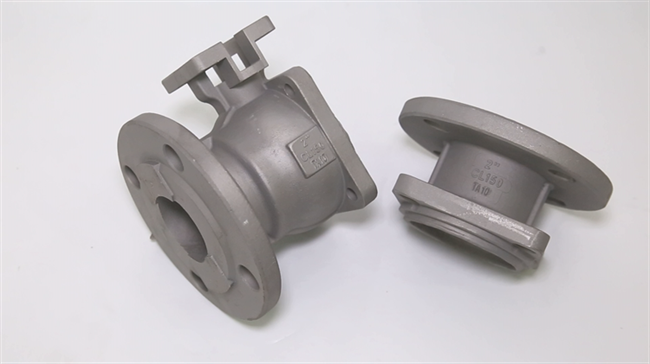
Choisir la bonne alliage dans la acier inoxydable de la série 300 famille ne consiste pas seulement à choisir un métal qui ne rouille pas ; il s'agit d'associer des propriétés chimiques spécifiques à votre environnement d'exploitation. Lorsque nous aidons nos clients à naviguer parmi leurs options, nous utilisons une approche systématique pour équilibrer performance et budget, en veillant à ne pas surdimensionner ou sous-dimensionner le matériau.
Facteurs de décision étape par étape
Pour cibler la qualité parfaite, nous examinons trois variables critiques :
- Environnement de corrosion : C'est le plus important. Si vos composants sont à l'intérieur ou dans des conditions atmosphériques douces, acier inoxydable 304 est le choix standard de l'industrie et le plus économique. Cependant, si la pièce est exposée à l'eau salée, aux chlorures ou aux acides industriels, vous devez passer à l'acier inoxydable 316. L'ajout de molybdène dans le 316 offre la résistance à la piqûre nécessaire pour les environnements marins ou de traitement chimique.
- Plage de température : Alors que acier inoxydable austénitique est connu pour sa résistance, la chaleur extrême change la donne. Pour un chauffage intermittent au-dessus de 425°C (800°F), nous recommandons souvent des grades stabilisés comme le 321 ou le 347 pour éviter la précipitation de carbures lors de la soudure. Inversement, pour les applications cryogéniques, la série 300 conserve une excellente ténacité là où d'autres aciers deviennent cassants.
- Charge mécanique : Les grades de la série 300 standard recuits sont relativement doux. Si votre application exige une haute résistance à la traction ou des propriétés de ressort, vous devriez envisager l'acier inoxydable travaillé à froid des options, comme le grade 301, ou considérer si votre charge dépasse la limite d'élasticité de l'acier standard 304/316. Bien que les aciers de la série 300 soient polyvalents, les environnements extrêmes à haute température et haute contrainte peuvent nécessiter de passer aux superalliages, comme ceux utilisés dans des ressorts en alliage de nickel à haute température.
Contraintes de coûts et réglementations
Le budget dicte souvent la décision finale, mais le coût initial le plus bas n’est pas toujours la meilleure valeur. acier inoxydable 304 vs 316 est un débat courant ; le 304 est moins cher, mais s'il corrode en un an, les coûts de remplacement éclipsent les économies.
Vous devez également respecter les normes réglementaires. Pour acier inoxydable de qualité alimentaire applications, vous êtes généralement limité à des grades conformes aux normes FDA ou NSF pour l'hygiène et la nettoyabilité. De même, les dispositifs médicaux exigent souvent strictement des grades biocompatibles comme le 316L (faible teneur en carbone) pour éviter les réactions dans le corps.
Éviter les pièges courants de sélection
Une erreur fréquente que je vois est de négliger la corrosion galvanique. Même les plus acier inoxydable résistant à la corrosion peuvent échouer si elles sont boulonnées à un métal dissemblable (comme l'aluminium ou l'acier au carbone) en présence d'un électrolyte (comme l'eau salée). Considérez toujours l'ensemble de l'assemblage, pas seulement la pièce individuelle. De plus, assurez-vous de spécifier des variantes à faible teneur en carbone (comme le 304L ou le 316L) si vous prévoyez de souder intensément pour éviter la corrosion intergranulaire dans la zone affectée par la chaleur.
Étape suivante : Hésitez-vous si votre environnement actuel nécessite la protection supplémentaire de la Grade 316 ? Je peux vous aider à analyser vos risques de corrosion pour voir si la Grade 304 suffit ou si une mise à niveau est nécessaire.
Fabrication de précision avec l'acier inoxydable de la série 300
Lorsque nous travaillons avec acier inoxydable de la série 300, nous ne façonnons pas seulement du métal ; nous concevons la durabilité. Parce que cela acier inoxydable austénitique est plus résistante et a tendance à se durcir plus rapidement que d'autres grades, elle nécessite une expertise spécifique en fabrication pour maintenir des tolérances strictes sans endommager les outils.
Fonderie d'investissement et capacités CNC
Pour des géométries complexes où l'usinage à partir d'un bloc solide serait trop coûteux ou gaspilleur, nous comptons sur des services de moulage de précision de haute qualité pour obtenir des formes proches de la nette. Cela est particulièrement efficace pour Acier inoxydable 304 et 316 composants utilisés dans la gestion des fluides ou la quincaillerie marine.
Lorsque une précision extrême est requise, Usinage CNC est la norme. Nous utilisons des configurations d'outillage avancées pour gérer la nature collante de la série 300, garantissant que les trous filetés et les surfaces de contact répondent aux spécifications exactes.
Options de finition de surface
La finition de surface de alliages de la série 300 détermine souvent leur performance en corrosion. Nous proposons une variété de finitions adaptées à l'application :
- Passivation : Essentiel pour éliminer le fer libre de la surface et maximiser la couche d'oxyde naturelle.
- Électropolissage : Couramment utilisé dans acier inoxydable de qualité alimentaire et les applications pharmaceutiques pour réduire la rugosité de la surface et l'attachement bactérien.
- Sablage à la bille : Offre une texture mate uniforme qui masque les marques de manipulation sur les pièces architecturales.
Assurance qualité et certification
Vous ne pouvez pas juger la qualité à l'œil nu avec des alliages haute performance. Nous respectons des protocoles stricts d'assurance qualité pour garantir chaque lot de acier inoxydable Sery 300 respecte les normes mondiales.
- Certification des matériaux : Vérification de composition chimique (vérification des niveaux de Chrome et de Nickel).
- Inspection dimensionnelle : Utilisation de CMM (Machines de Mesure de Coordonnées) pour les géométries complexes.
- Conformité aux normes : Conformité totale aux spécifications ASTM, EN et ISO pour assurer le les grades d'acier inoxydable équivalents alignement avec vos exigences d'ingénierie.
Souhaitez-vous que je vous présente la section “ FAQ : Acier inoxydable de la série 300 ” ensuite ?
FAQ : Acier inoxydable de la série 300
Voici les réponses aux questions les plus courantes que nous recevons concernant ces alliages. Nous simplifions pour que vous puissiez prendre les bonnes décisions de fabrication sans vous perdre dans les définitions de manuel.
Qu'est-ce que l'acier inoxydable de la série 300 ?
acier inoxydable de la série 300 est une famille de acier inoxydable austénitique alliages. Cela signifie qu'ils sont principalement composés de chrome (généralement 18%) et de nickel (généralement 8%), ce qui leur confère une excellente résistance à la corrosion et une bonne formabilité. Contrairement aux aciers au carbone standard ou acier allié vs acier inoxydable comparaisons où la résistance est souvent le point focal, la série 300 privilégie sa capacité à résister à la rouille et à maintenir son intégrité structurelle dans des environnements difficiles.
L'acier inoxydable de la série 300 est-il magnétique ?
Généralement, non. Dans son état recuit (ramolli), acier inoxydable non magnétique est la norme pour la série 300. Cependant, il y a un piège. Si le métal subit de fortes travail à froid (flexions, formages ou usinages), il peut devenir légèrement magnétique. Ceci est distinct de la série 400, qui est toujours magnétique.
Quelle est la principale différence entre le 304 et le 316 ?
La plus grande différence réside dans la composition chimique, en particulier l'ajout de le molybdène dans l'acier inoxydable qualité 316.
| Caractéristique | Acier inoxydable 304 | Acier Inoxydable 316 |
|---|---|---|
| Élément clé | Chrome + Nickel | Chrome + Nickel + Molybdène |
| Meilleur pour | Cuisines, structures intérieures, plomberie générale | Environnements marins, traitement chimique, outils médicaux |
| Résistance à la Corrosion | Excellent (Général) | Supérieur (Résiste aux chlorures/sel) |
| Coût | Plus abordable | Prime supérieure |
Pouvez-vous traiter thermiquement la série 300 pour la durcir ?
Non. Vous ne pouvez pas durcir acier inoxydable de la série 300 par traitement thermique. C'est une idée reçue courante. Ces grades ne peuvent pas être durcis par la chaleur ; ils durcissent uniquement par travail à froid (travail à froid). Si vous avez besoin d'un grade qui durcit par traitement thermique, vous devriez regarder les grades martensitiques (comme la série 400) ou les grades à précipitation-durcissement.
Pourquoi choisir la série 300 plutôt que la série 400 ?
Vous choisissez la série 300 lorsque la résistance à la corrosion et la ductilité sont vos priorités absolues.
- Choisissez la série 300 : Si votre pièce est exposée à l'humidité, aux produits chimiques ou nécessite une soudure intensive.
- Choisissez la série 400 : Si vous avez besoin d'un acier magnétique, d'une dureté plus élevée ou d'une résistance à l'usure (comme dans la coutellerie), et que la corrosion est une préoccupation secondaire.
Nous recommandons souvent l'acier inoxydable 316 pour des projets nécessitant une durabilité maximale dans les régions côtières françaises riches en sel, tandis que acier inoxydable 304 reste le cheval de bataille pour la plupart des applications industrielles intérieures.