
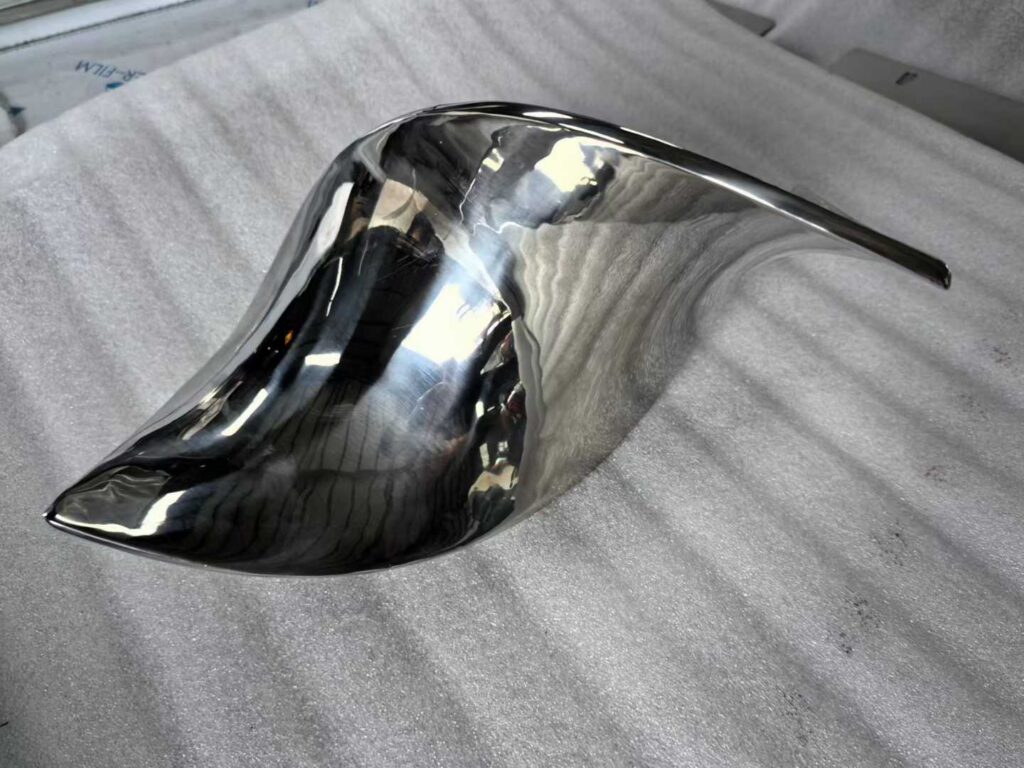
How to Reduce Production Costs with Near-Net Shape ManufacturingAre high machining costs and excessive material waste eating into your production margins? When your engineering designs require complex undercuts, thin-walled geometries, or tough superalloys, traditional subtractive manufacturing often falls short.
At Vastmaterial, we utilize the advanced lost-wax casting process to deliver near-net shape manufacturing solutions. By choosing to investment cast your components, you drastically reduce secondary operations, minimize scrap rates, and protect your bottom line.
Core Advantages of Precision Metal Casting
Why do leading industries pivot from sand casting or forging to precision investment casting? The answer lies in the balance of complexity and cost.
- Unrestricted Complex Geometries: We cast intricate internal passageways, extremely thin walls (down to 0.040″), and complex undercuts that standard 3-axis or 5-axis CNC machining simply cannot achieve without astronomical costs.
- Superior Material Versatility: Stop burning through expensive end mills. We routinely cast difficult-to-machine superalloys, 17-4 PH stainless steel, and Titanium Grade 5 directly into their final working shapes.
- Enhanced Surface Integrity: Our process achieves an average surface finish of 125 RMS, significantly smoother than sand casting, reducing the need for manual polishing or vibration finishing.
Technical Capability Breakdown
| Feature | Our Standard Capability | Bottom-Line Benefit to You |
| Linear Tolerances | ±0.005 inch per inch | Meets rigorous aerospace casting and medical device specs. |
| Surface Finish | 125 RMS (micro-inch) | Eliminates expensive secondary machining. |
| Alloy Range | Superalloys & Custom Blends | Removes the friction of cutting hardened steels. |
| Design Freedom | Near-net shape | Drops total part weight and simplifies complex assemblies. |
Ultimate Guide to Precision Investment Casting: Reducing Costs with Near-Net Shape Manufacturing
In today’s competitive manufacturing landscape, the challenge is clear: How do you balance design complexity with production efficiency? Traditional subtractive manufacturing (CNC machining) often leads to high material waste and skyrocketing costs when dealing with intricate geometries.
As a premier custom casting foundry, we specialize in the lost-wax casting process—a centuries-old technique refined with modern aerospace-grade technology. This guide explores how investment cast solutions provide a superior alternative to sand casting, forging, and heavy machining.
1. The Lost-Wax Casting Process: Engineering Step-by-Step Precision
The secret to our high-precision results lies in our rigorous 6-step ceramic shell casting protocol. Unlike sand casting, which uses granular molds, our process creates a glass-smooth ceramic cavity for unmatched surface integrity.
Step 1: Precision Wax Pattern Injection
We begin by engineering high-precision aluminum tooling. Molten wax is injected to create a 1:1 replica of your CAD design. This ensures that every detail—from micro-grooves to internal threads—is captured before the metal is even poured.
Step 2: Strategic Tree Assembly
To optimize mass production efficiency, individual wax patterns are welded onto a central wax sprue. This “tree” configuration allows us to cast dozens of parts simultaneously, drastically reducing your per-unit production cost.
Step 3: Multi-Layer Shell Building
The wax tree is repeatedly dipped into a high-grade liquid ceramic slurry and coated with fine stucco sand. This builds a durable, heat-resistant shell capable of withstanding the extreme thermal shock of molten superalloys.
Step 4: Autoclave Dewaxing & Firing
Using a high-pressure steam autoclave, we melt out the wax. The empty shell is then fired at temperatures exceeding 1000°C. This not only strengthens the mold but also eliminates any volatile residues, ensuring zero gas porosity in the final part.
Step 5: Advanced Vacuum & Gravity Pouring
We utilize both standard gravity pouring and vacuum investment casting. For reactive metals like Titanium or high-performance Inconel 718, vacuum melting prevents oxidation and ensures the metal flows into the thinnest wall sections (down to 0.040″).
Step 6: Knockout, Gate Grinding & Finishing
Once cooled, the ceramic shell is mechanically removed. Our finishing team performs precision gate grinding, sandblasting, and heat treatment to ensure the metallurgical properties meet your exact specifications.
2. Material Capabilities: High-Performance Alloys for Extreme Environments
The versatility of investment cast parts comes from the wide range of alloys we pour. Whether you need corrosion resistance or high-strength-to-weight ratios, we have the solution.
- Stainless Steel Casting: We specialize in 304, 316L, and 17-4 PH. These grades are the industry standard for corrosion-resistant hardware and food-grade components.
- Superalloy Casting: Our foundry is equipped for Inconel (625/718), Hastelloy, and Cobalt-based alloys. These materials are essential for gas turbines and components operating at 1200°C+.
- Titanium Alloys: For the aerospace and medical sectors, we cast Titanium to provide high-strength performance with 40% less weight than steel.
- Carbon & Low-Alloy Steels: Ideal for high-impact applications in heavy machinery, mining, and the oil and gas industry.
3. Industry Applications: Where Precision is Non-Negotiable
Aerospace & Defense: AS9100 Quality
Weight reduction is critical in flight. We produce lightweight airframe structures, fuel system manifolds, and turbine blades. Our process meets the stringent AS9100 quality standards, ensuring structural integrity under high-G loads.
Medical Technology: Biocompatible Solutions
We manufacture orthopedic implants (knees/hips) and surgical instruments. By using Cobalt-Chrome and specialized finishing, we deliver the mirror-like surface finishes required for human implantation.
Oil & Gas: Harsh Environment Durability
From downhole drilling tools to high-pressure valve components, our castings are built to resist hydrogen sulfide (H2S) and high-pressure wear. We also offer electropolishing and passivation to further enhance chemical resistance.
4. Quality Assurance: Proving Excellence through NDT
In precision manufacturing, we don’t just promise quality—Our Non-Destructive Testing (NDT) suite includes:
- X-Ray Radiography: Deep-tissue inspection to ensure internal structural soundness.
- Dye Penetrant Inspection (DPI): High-contrast testing to detect microscopic surface fissures.
- CMM Dimensional Verification: Utilizing Coordinate Measuring Machines to verify tolerances as tight as ±0.005 inch per inch.
- Spectrographic Analysis: Every melt is tested via Optical Emission Spectrometry to guarantee the chemical composition matches your data sheet.
5. Investment Casting FAQ: Strategic Decision Making
Q: How does investment casting reduce lead times? By delivering near-net shape components, you skip weeks of heavy rough-machining. Our rapid prototyping casting services can deliver first-article samples in just 3 to 5 weeks.
Q: Is investment casting cost-effective for medium volumes? Yes. Unlike die casting, which requires expensive hardened steel dies, our aluminum wax tooling is significantly more affordable, making it ideal for volumes ranging from 100 to 10,000 pieces.
Q: Do you provide secondary CNC machining? Absolutely. We offer a “one-stop-shop” solution. While the casting provides the shape, our precision CNC machining services handle critical bores, threading, and mating surfaces that require micron-level accuracy.