
What Is Precision Casting? Understanding the Lost-Wax Process
As a dedicated precision casting foundry, we frequently help engineers and procurement managers navigate the complexities of metal manufacturing. Precision casting, widely known as investment casting or the lost-wax process, is distinct from other methods like sand casting or die casting. While sand casting is typically used for larger, rougher components and die casting targets high-volume non-ferrous parts, precision casting is the superior choice for complex geometries requiring tight tolerances and excellent surface finishes.
The Lost-Wax Workflow: Step-by-Step
At Vastmaterial, we control every stage of the process to ensure consistency and accuracy. The workflow transforms a digital design into a solid metal component through a series of precise steps:
- Wax Pattern Injection: We inject molten wax into a metal die to create an exact replica of the final part. These patterns are assembled onto a “tree.”
- Ceramic Shell Building: The wax tree is dipped into a ceramic slurry and coated with fine sand (stucco). This process is repeated to build a robust ceramic shell.
- Dewaxing: The shell is heated in an autoclave, causing the wax to melt and drain away—hence the term “lost wax”—leaving a perfect hollow cavity.
- Pouring & Shell Removal: Molten metal is poured into the pre-heated shell. Once the metal solidifies, the ceramic material is vibrated or blasted away to reveal the casting.
Key Advantages: Near-Net-Shape Geometry
The primary reason industries turn to a precision investment casting partner is the capability for near-net-shape casting. This technology offers unparalleled design freedom, allowing for the production of:
- Complex Geometries: Intricate internal passageways, undercuts, and thin-wall sections that are difficult or impossible to machine.
- Reduced Material Waste: By casting parts close to their final dimensions, we significantly reduce the amount of expensive alloy scrap.
- Minimal Secondary Machining: The superior surface finish and dimensional accuracy mean many parts require little to no additional machining, streamlining your supply chain and reducing costs.
Key Capabilities of a Modern Precision Casting Foundry

At Vastmaterial, we define the standard for a high-tech precision casting foundry by combining advanced metallurgy with rigorous process control. We don’t just pour metal; we engineer components that minimize downstream processing and maximize performance. Our integrated production management systems allow us to deliver custom precision castings that meet the exact demands of industries like aerospace and marine engineering.
Tolerances and Dimensional Accuracy
Achieving consistent geometry is critical. We strictly adhere to ISO 8062 tolerances, typically delivering parts within the CT7–CT8 range. This level of accuracy ensures that the components we produce fit seamlessly into your assemblies. By maintaining these tight controls, we significantly reduce the need for secondary machining, saving you both time and material costs.
Weight, Size, and Complex Geometries
Our infrastructure is designed for scalability and versatility. We handle a diverse range of projects, from micro-components requiring extreme detail to heavy industrial parts built for durability.
- Thin-Wall Sections: We successfully cast intricate designs with thin walls that maintain structural integrity.
- Internal Features: Our process captures complex internal channels and undercuts that are impossible with traditional forging methods.
- Material Versatility: Whether you need robust steel alloys or lightweight solutions, our aluminum die casting services provide high-precision options for complex OEM requirements.
Superior Surface Finish
A hallmark of our near-net-shape casting process is the ability to achieve superior surface finishes directly out of the mold. We target excellent Ra values that often eliminate the need for rough machining. When even finer finishes are required, our in-house capabilities ensure a smooth transition from casting to final polishing or coating. regarding specific material properties, we also specialize in aluminum casting alloy grades that offer exceptional fluidity and surface quality for high-performance parts.
Materials Expertise: Alloys for Demanding Applications
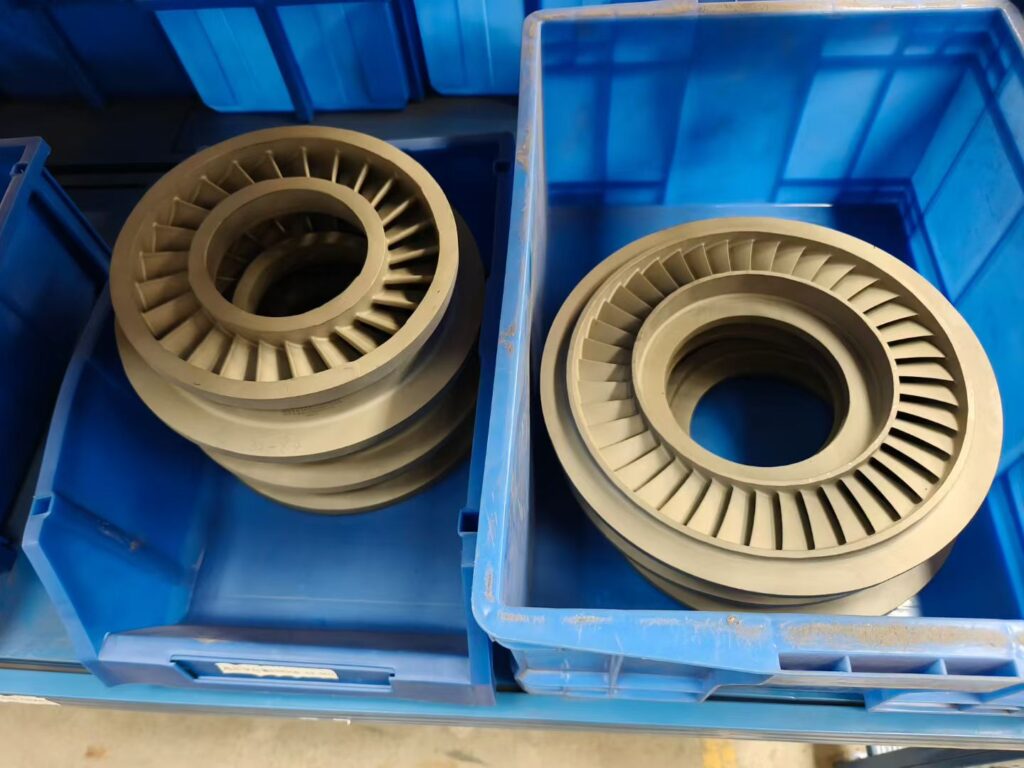
As a dedicated precision casting foundry, we understand that the integrity of a component starts with the right material. We don’t just pour metal; we engineer mechanical properties to meet specific operational environments. Our facility is equipped to handle a diverse spectrum of ferrous and non-ferrous metals, ensuring we can match the exact specifications required for aerospace, marine, and industrial applications.
We specialize in stainless steel investment casting for parts requiring superior corrosion resistance and strength. Our standard production includes:
- Austenitic Stainless Steels: Grades like 304 and 316 for general corrosion resistance.
- Precipitation Hardening Steels: Specifically 17-4PH (Type 630), which offers an excellent combination of high strength and good corrosion resistance.
- Duplex Steels: For environments requiring higher yield strength and stress-corrosion cracking resistance.
For structural components that demand toughness, we serve as a reliable alloy steel casting supplier. We routinely cast 4140 and 4340 alloy steels, often utilized in high-stress machinery and automotive parts. You can explore our specific alloy steel casting solutions to see how these materials fit heavy-duty applications. Additionally, we process Aluminum A356, applying T6 heat treatments to maximize hardness and durability for lightweight, high-performance needs.
Our capabilities extend to high-temperature alloy castings for extreme environments. We work with:
- Nickel-Based Superalloys: Essential for gas turbines and high-heat applications.
- Cobalt-Chrome (Chromium Cobalt Molybdenum): Known for exceptional wear resistance and biocompatibility.
- Titanium Alloys: Offering the highest strength-to-weight ratios.
Selecting the correct alloy involves balancing ductility, tensile strength, and cost. We work closely with our clients to navigate these trade-offs, similar to the detailed breakdowns found in our comprehensive casting alloy guide. Whether you need standard carbon steel or a custom superalloy formulation, our R&D team ensures the material chemistry meets strict industry standards.
Integrated Manufacturing: From Casting to Finished Component
At Vastmaterial, we operate on the belief that a top-tier precision casting foundry must be more than just a place where metal is melted and poured. We function as a comprehensive manufacturing partner, offering a true “concept-to-delivery” pipeline. By keeping tooling design and engineering strictly in-house, we eliminate the communication gaps and delays that typically occur when you juggle multiple vendors for a single project. This integrated approach ensures that your design intent is preserved perfectly from the initial wax pattern creation to the final quality check.
The “One-Stop Shop” Advantage
Modern supply chains demand efficiency, which is why we have structured our facility to provide one-stop casting solutions. Instead of sourcing raw castings from one supplier and finishing services from another, we handle the entire lifecycle. This vertical integration allows us to:
- Control Quality: We monitor every step, ensuring material properties and dimensional accuracy meet strict industry standards.
- Reduce Costs: Eliminating third-party logistics and markups lowers the total cost per unit.
- Shorten Lead Times: With all processes under one roof, we can transition parts from casting to finishing immediately, without shipping delays.
Foundry CNC Machining Integration
While investment casting delivers excellent near-net-shape geometry, specific features often require tighter tolerances than casting alone can provide. This is where our foundry CNC machining integration becomes a critical asset. We utilize state-of-the-art CNC turning, milling, and boring equipment to achieve consistent accuracy and superior surface finishes.
Rather than shipping raw parts to a separate machine shop, we machine critical dimensions in-house. This seamless transition allows us to catch potential issues early and adjust the casting process to minimize machining allowances, saving material and time. For a deeper dive into how we balance these processes, read our guide on machining casting for tight tolerances.
Surface Treatments and Finishing
To deliver a component that is truly ready for assembly, we offer a wide range of surface treatments tailored to your application’s environmental requirements. Our capabilities extend beyond basic cleaning to include:
- Plating and Coating: Enhancing corrosion resistance and durability.
- Passivation: Critical for stainless steel parts to prevent oxidation.
- Phosphating: Improving wear resistance and preparing surfaces for painting.
- Polishing: Achieving specific Ra values for aesthetic or functional needs.
By integrating these finishing steps, we ensure that every part leaving our facility is a complete, custom precision casting ready for immediate use in your assembly line.
Industry Applications and Success Stories

As a dedicated precision casting foundry, we engineer high-performance components for sectors where reliability is non-negotiable. Our manufacturing capabilities allow us to deliver custom precision castings that meet the rigorous demands of extreme environments and critical safety standards.
Aerospace and Defense
In the aerospace sector, precision and weight reduction are critical. We specialize in aerospace investment casting to produce complex geometries like turbine blades and structural fittings. By utilizing high-temperature nickel-based superalloys, we ensure these components maintain structural integrity under extreme thermal stress, meeting the exacting specifications required for modern aviation and defense systems.
Oil & Gas and Marine
Harsh operating environments require materials that can withstand high pressure and corrosive elements. We supply robust castings for oil and gas applications, including valve bodies and pump impellers manufactured from corrosion-resistant stainless steel and duplex alloys. Our marine components are designed to resist saltwater corrosion, ensuring long-term durability and reducing maintenance costs for offshore and subsea operations.
Medical Devices
When it comes to medical technology, biocompatibility and surface finish are paramount. We manufacture surgical instruments and orthopedic implants with superior dimensional accuracy. Our capabilities include producing high-strength Co28Cr6Mo tibial plateau implants, which offer the wear resistance and biological safety essential for successful joint reconstruction and arthroplasty procedures.
General Industrial
For the general industrial sector, we focus on durability and efficiency. We produce wear-resistant machinery components that handle heavy loads and continuous friction. By delivering near-net-shape parts, we minimize the need for secondary machining, providing a cost-effective solution for equipment manufacturers looking to optimize their supply chain.
Quality Assurance and Certifications at vastmaterial
At vastmaterial, we understand that consistency is the backbone of any reliable precision casting foundry. We don’t just aim for quality; we engineer it into every step of the manufacturing process. Our facility operates under strict quality management systems designed to meet the rigorous demands of the aerospace, marine, and automotive sectors.
Compliance and Industry Standards
We align our operations with global standards to ensure our components perform safely in critical environments. Our quality framework is built to support:
- ISO 9001 Certification: The foundation of our quality management system.
- PED Compliance: Meeting Pressure Equipment Directive standards for high-pressure applications.
- IATF 16949 Alignment: Adhering to strict automotive quality requirements.
- Marine Classifications: Capabilities to meet ABS, DNV, and LR standards for marine engineering components.
In-Process Controls and Traceability
Quality starts before the metal is even poured. We maintain complete material traceability from the raw ingot to the finished part. Our integrated production management systems track every batch, ensuring that heat treatment records and chemical compositions match your exact specifications. This level of transparency is critical for industries requiring full documentation trails.
Advanced Testing Protocols
To guarantee ISO 8062 tolerances and structural integrity, we utilize a suite of advanced inspection technologies. Our comprehensive testing and quality control protocols ensure that no defect goes unnoticed.
Our inspection capabilities include:
- Spectrometer Analysis: Verifies exact chemical composition of alloys (Stainless 17-4PH, 4140 Steel, etc.).
- CMM (Coordinate Measuring Machine): Validates complex dimensional geometry and tight tolerances.
- Non-Destructive Testing (NDT): Utilizing X-ray and dye penetrant inspection to detect internal voids or surface cracks without damaging the part.
- Mechanical Testing: Confirming tensile strength, hardness, and elongation properties post-heat treatment.
Why Choose Vastmaterial as Your Precision Casting Foundry Partner?
At Vastmaterial, we operate as more than just a supplier; we are your strategic precision casting foundry partner. Our approach combines advanced manufacturing infrastructure with deep material science expertise to deliver results that go beyond simple metal pouring. We understand the rigorous demands of the US market, which is why our facility is designed for total flexibility and reliability.
Scalability and Engineering Excellence
We don’t believe in a “one-size-fits-all” approach. Our integrated production management systems allow us to scale operations effortlessly. Whether you are in the early stages requiring a single rapid prototype or ramping up for high-volume mass production, our workflow adapts to your schedule. We leverage our capabilities in precision aluminum casting and complex alloy processing to ensure consistency across every batch.
Our Partnership Advantages:
- Advanced R&D Collaboration: We actively collaborate with academic institutions to push the boundaries of alloy development. This allows us to offer material recommendations that optimize durability and thermal stability for your specific application.
- Design Optimization: Our engineering team reviews your CAD files to suggest modifications that reduce weight and manufacturing costs without compromising structural integrity.
- Global Supply Chain Management: We handle the logistics of the investment casting supply chain, ensuring cost-effective delivery and reduced lead times.
Speed and Efficiency
Time is money in manufacturing. We have streamlined our quoting and engineering review process to keep your project moving.
| Feature | Vastmaterial Standard | Benefit to You |
|---|---|---|
| Response Time | Quotes within 24 hours | Faster project kickoff and budget planning. |
| Production Scale | Prototype to Mass Production | Seamless transition from testing to market. |
| Quality Control | Real-time Data Analytics | Consistent adherence to ISO standards. |
By choosing us, you gain access to a precision casting foundry that prioritizes technical precision and efficient communication, ensuring your components are delivered on time and to specification.
Frequently Asked Questions About Precision Casting Services
What is the typical lead time for a new investment casting project?
Lead times at our precision casting foundry depend on the complexity of the part and the specific alloy required. Generally, the process moves through three stages: tooling design and fabrication, sample casting for approval, and full-scale production. Because we utilize integrated production management systems with real-time monitoring, we minimize downtime between steps. For urgent projects, our engineering team works to expedite the tooling phase to get first articles in your hands as quickly as possible.
How does precision casting compare to CNC machining in terms of cost?
Precision casting is typically more cost-effective for medium to high-volume production runs, especially for components with complex geometries. Unlike machining, which removes material from a solid block (subtractive manufacturing), our precision casting services add material only where needed (near-net-shape), significantly reducing waste. However, for very low volumes or simple shapes, CNC machining might be the cheaper initial option due to the absence of tooling costs. Since we offer both casting and machining, we can objectively guide you to the most economical method for your specific project.
What file formats are required to initiate an RFQ?
To provide an accurate quote and feasibility analysis, we recommend submitting 3D CAD models in STEP (.stp) or IGES (.igs) formats. These allow our engineers to evaluate volume, weight, and geometry. Additionally, please include 2D engineering drawings (PDF) that specify critical tolerances, surface finish requirements, and material grades (e.g., 17-4PH Stainless Steel or A356 Aluminum). Clear documentation helps us determine if the part fits our investment casting foundry capabilities and ensures a faster response to your inquiry.
Can you handle rapid prototyping before full-scale production?
Yes, we support rapid prototyping to validate designs before you commit to hard tooling for mass production. Our “concept-to-delivery” approach allows us to produce prototype castings or machined samples to test fit and function. This step is crucial for identifying potential design improvements and ensuring the final lost wax casting products meet all performance criteria. By collaborating with our R&D team early in the development phase, you ensure a smoother transition to volume manufacturing.