
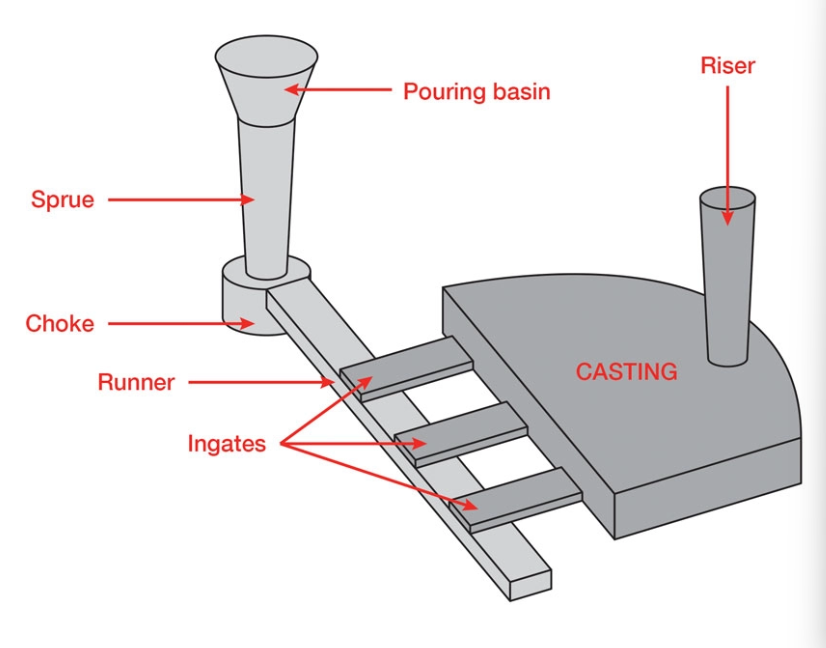
In high-performance engineering, the “channel” is more than just a shape—it is either the backbone of a structure or the critical artery of a fluid system. At Vastmaterial, we specialize in manufacturing high-integrity metal casting channels that eliminate common foundry defects like air entrapment and solidification shrinkage before the first pour.
Whether you require a heavy-duty U-channel metal profile for construction or an intricate investment casting runner for aerospace applications, our engineered solutions protect your project’s structural integrity.
1. Categorizing Cast Channels: Structural vs. Internal Systems
Understanding the distinction between external profiles and internal feed systems is essential for selecting the right casting method.
A. Structural Cast Channels (External)
Built for load-bearing and environmental resistance, these profiles replace welded assemblies to offer superior strength.
-
C-Channel & U-Channel Casting: Ideal for industrial chassis, heavy machinery frames, and architectural supports.
-
Custom Strut Channels: Engineered for secure mounting and bracing in corrosive offshore or chemical environments.
-
Materials: Primarily cast in 316 Stainless Steel or Carbon Steel for maximum durability.
B. Internal Casting Channels (Gating & Runners)
This is the hidden network within the mold that dictates the quality of the final component.
-
Precision Gating Systems: We design complex ceramic shell channels that ensure a laminar flow of molten alloy.
-
Molten Metal Runners: Strategically engineered pathways that prevent turbulence and ensure the mold fills evenly, crucial for thin-walled castings.
2. Overcoming Technical Challenges: Flow & Shrinkage Control
The success of a cast metal channel depends on how the foundry manages fluid dynamics and thermal contraction.
Mastering Metal Casting Shrinkage
As molten metal cools, it naturally contracts. Without proper engineering, this leads to internal voids or warping. We mitigate metal casting shrinkage through:
-
Advanced Simulation: Utilizing ProCAST or Magmasoft to visualize the solidification process.
-
Strategic Riser Design: Placing “reservoirs” of molten metal that feed the casting as it shrinks, ensuring a 100% solid cross-section.
Eliminating Air Entrapment
Turbulent flow can trap air, causing sub-surface porosity. Our fluid flow casting analysis allows us to optimize the velocity of the pour, ensuring that internal runners and investment casting molds are filled smoothly.
3. Material Selection for High-Performance Channels
| Material Category | Key Alloys | Primary Benefit |
| Stainless Steel | 304, 316, 17-4 PH | Superior corrosion resistance for U-channel profiles. |
| Superalloys | Inconel 718, Hastelloy | Maintains strength in aerospace turbine cooling channels. |
| Non-Ferrous | Aluminum, Bronze | Lightweight, excellent heat dissipation for automotive manifolds. |
4. Industry Applications: From Infrastructure to Aerospace
Aerospace & Defense
We manufacture complex internal cooling passages for gas turbine blades. These investment cast channels allow engines to operate at temperatures higher than the melting point of the metal itself.
Oil & Gas Infrastructure
Our foundry produces heavy-duty valve bodies and structural rig channels. By utilizing stainless steel sand casting, we deliver large-scale components that withstand high-pressure, “sour gas” (H2S) environments.
Automotive & Industrial
From chassis rails to engine fluid transfer blocks, our cast solutions focus on “lightweighting” without sacrificing the rigidity required for high-stress mechanical assemblies.
5. Quality Assurance: Verifying Internal Integrity
A channel’s performance is only as good as its hidden interior. Our Quality Management System (QMS) includes:
-
Non-Destructive Testing (NDT): X-ray and Ultrasonic testing to ensure zero internal defects in the gating system or structural walls.
-
CMM Dimensional Inspection: Automated verification of wall thickness and geometric tolerances per ISO 8062.
-
Hydrostatic Pressure Testing: Mandatory for any internal fluid runner to guarantee leak-proof performance under operational loads.
6. Frequently Asked Questions (FAQ)
Q: What is the minimum wall thickness for a cast U-channel?
A: It depends on the process. Investment casting can achieve walls as thin as 2mm (0.08″), while sand casting for heavy structural steel typically requires 4.5mm – 6mm to ensure proper metal flow.
Q: How do you handle complex curved internal runners?
A: For winding, multi-directional internal paths, we use lost-wax casting with soluble cores. This allows us to create geometries that are impossible to produce via CNC machining.
Q: Can you provide finished parts?
A: Yes. While we deliver near-net-shape castings, we offer precision CNC machining services to finish critical mating surfaces, threads, and high-purity flow paths.

Reviews
There are no reviews yet.