
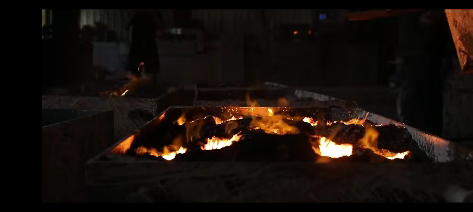
When engineers and procurement teams ask us, “what is sand casting?”, they are looking for a practical breakdown of how we turn raw material into complex, heavy-duty components. At its core, this metal casting process uses a non-reusable sand mold to form metal parts. It is one of the oldest and most reliable manufacturing techniques, but today’s foundries execute it with incredible precision.
Here is the step-by-step breakdown of how we handle the casting cycle on the foundry floor at Vastmaterial.
The 7-Step Sand Casting Process
- Pattern Creation: We start by manufacturing a physical replica (the pattern) of your final part. This pattern is slightly oversized to account for the metal shrinking as it cools.
- Mold Preparation: We pack specialized sand around the pattern. The mold is divided into two distinct halves: the top half is the cope, and the bottom half is the drag. We ram the sand tightly to ensure the cavity perfectly mirrors the pattern.
- Core Placement: If your component requires internal channels, undercuts, or hollow sections, we place pre-formed sand cores directly into the mold cavity before closing it.
- Mold Assembly and Gating: We securely assemble the cope and drag halves. We also set up the gating system—a network of sprues, runners, and risers that acts as plumbing to guide the liquid metal smoothly into the cavity.
- Molten Metal Pouring: This is the critical moment in foundry casting. We carefully pour the molten metal, filling the mold cavity completely while allowing trapped gases to escape through the porous sand.
- Cooling and Solidification: We monitor the cooling phase closely. The metal must solidify at a controlled rate to prevent internal stress, shrinkage, or warping.
- Shakeout and Removal: Once the metal is entirely solid, we break apart the sand mold in a process known as shakeout. The raw part is removed, and we perform an initial cleaning to cut away the gating system and risers.
Modern Process Controls: While traditional sand molded casting relied heavily on manual skill, modern production is highly data-driven. We monitor sand moisture, control pouring temperatures, and utilize simulation software to drastically reduce the risk of defects like porosity and shrinkage.
Types of Sand Casting Methods
Not all sand molds are created equal. At Vastmaterial, we primarily utilize two distinct variations of the process depending on the project’s specific requirements for surface finish, dimensional accuracy, and production volume.
Green Sand Casting
This is the most traditional and widely used method. “Green” refers to the moisture present in the mold, not the color. The sand is bonded with clay (usually bentonite) and water.
- Mechanism: Moist clay binds the sand grains together under pressure.
- Best For: High-volume production runs where cost efficiency is the top priority.
- Pros: Extremely economical, reusable sand, and fast production cycles.
- Cons: Slightly rougher surface finish and lower dimensional accuracy compared to chemical methods.
No-Bake (Resin) Sand Casting
Also known as air-set casting, this method uses a chemical binder to harden the mold at room temperature without heat.
- Mechanism: Liquid resin and a catalyst are mixed with the sand, causing a chemical reaction that hardens the mold into a rigid structure.
- Best For: Low to medium volume production, large heavy castings, and parts requiring tighter tolerances.
- Pros: Superior dimensional stability, better surface finish, and complex geometry capabilities.
- Cons: Higher material cost and slower production rates than green sand.
Green Sand vs. No-Bake Comparison
| Feature | Green Sand Casting | No-Bake (Resin) Sand Casting |
| Bonding Agent | Clay and Water | Chemical Resin |
| Surface Finish | Rougher | Smoother |
| Dimensional Accuracy | Moderate | High |
| Production Speed | Fast (High Volume) | Slower (Low/Medium Volume) |
| Typical Application | Engine blocks, simple brackets | Large machinery bases, precision pump housings |
Materials Commonly Used in Sand Casting
Sand casting offers incredible material versatility. Unlike methods restricted to specific metal groups, we can work with almost any alloy that can be melted.
- Ferrous Metals: We frequently cast steel grades like Duplex Stainless Steel, Low Carbon Steel, and 17-4 Stainless Steel for heavy-duty, corrosion-resistant components.
- Non-Ferrous Metals: We cast Aluminum Alloys for high strength-to-weight ratios, Copper Alloys (Brass and Bronze) for thermal conductivity, and Titanium Alloys for high-performance weight reduction.
- High-Temperature Alloys: We cast exotic materials like Chromium Cobalt Molybdenum for extreme environments, such as gas turbines and nuclear power applications.
Key Advantages of Sand Casting
- Low Tooling Costs: Pattern creation is much cheaper and faster than producing molds for die casting, making it ideal for prototyping and short-run production.
- Exceptional Design Flexibility: Because the mold is destroyed after each cast, we can create intricate geometries and internal cavities that are impossible to machine from solid blocks.
- Wide Material Scalability: We can cast parts weighing just a few ounces up to several tons in a single pour across a massive spectrum of alloys.
- Custom Production ROI: For low-to-medium volume runs, the amortized tooling costs keep per-unit pricing highly competitive.
Limitations to Consider
- Surface Finish: The raw casting has a rougher texture. For smooth mating surfaces, secondary CNC machining is required.
- Dimensional Tolerances: Achieving extremely tight tolerances directly from the mold is challenging compared to investment casting.
- Defect Risks: High heat and gas can cause porosity, shrinkage, or sand inclusions. We mitigate this through rigorous testing and quality assurance protocols.
Industry Applications
This metal casting process is the backbone of American manufacturing. We regularly produce structural components for:
- Automotive Sector: Engine blocks, cylinder heads, and transmission housings.
- Aerospace and Energy: Wind turbine nodes, compressor housings, and high-pressure valves.
- Marine, Mining, and Oil & Gas: Rugged drill bits, heavy pump casings, and marine structural fittings.
- Industrial Machinery: Solid frames, counterweights, and large internal gears for tractors and excavators.
Post-Casting Processes: Finishing the Component
The raw casting from the foundry floor undergoes critical finishing steps to meet industry standards:
- Shakeout and Sand Reclamation: Separating the metal from the sand and recycling the sand to minimize environmental impact.
- Cleaning and Heat Treatment: Removing gates/risers and applying heat treatments to enhance mechanical properties like hardness and tensile strength.
- Precision CNC Machining: Refining critical dimensions, drilling holes, and smoothing mating surfaces to meet tight tolerances.
- Surface Treatments: Applying plating, powder coating, or polishing to protect against corrosion and wear.
Why Partner with Vastmaterial?
We elevate traditional foundry techniques by integrating advanced engineering and strict quality controls.
- State-of-the-Art Monitoring: Real-time data analytics track every stage to minimize defects.
- Hybrid Processes: We combine expert casting of diverse alloys with in-house precision CNC machining.
- Client-Focused Engineering: We offer custom engineering support, R&D collaboration, and transparent communication from design to delivery.
Frequently Asked Questions (FAQs)
What is the difference between green sand and resin sand casting?
Green sand casting uses a mixture of sand, clay, and moisture. It is cost-effective and perfect for high-volume, simpler parts. Resin sand casting (no-bake) uses chemical binders to harden the mold without heat, resulting in a more rigid mold, tighter dimensional accuracy, and a smoother finish.
Is sand casting suitable for mass production?
Yes. While famous for low-cost prototyping, automated molding lines can produce thousands of molds daily. It is the go-to method for mass-producing automotive engine blocks and heavy equipment housings.
What tolerances can be achieved with sand casting?
Standard sand casting holds tolerances around ±0.030 to ±0.060 inches (CT10-CT12). For tighter requirements, we use precision resin sand methods combined with secondary CNC machining to hit strict specifications.
How does sand casting compare to investment casting?
Investment casting (lost wax) offers superior surface finishes and tighter tolerances right out of the mold but is significantly more expensive and time-consuming. Sand casting is far more versatile regarding part size/weight and supports a wider range of ferrous and non-ferrous alloys.