
If you’ve ever tried to pick the right aluminum grade for casting, you know it’s not as simple as “just use aluminum.”
Choose the wrong alloy, and you’ll fight issues like poor fluidity, shrinkage defects, leaks, or parts that crack under load. Choose the right one, and you get clean, dimensionally accurate castings with the strength, corrosion resistance, and cost balance your project actually needs.
In this guide, you’ll quickly learn:
- Why cast aluminum alloys (like A356, A380, ADC12) are completely different from wrought grades like 6061
- Which aluminum casting alloys work best for die casting, sand casting, and investment casting
- How to match mechanical properties, castability, and heat treatment options to your real-world application
If you’re serious about getting reliable, high-quality aluminum castings—without wasting money on the wrong alloy—you’re in the right place.
Understanding Aluminum Grades for Casting
When people search for an aluminum grade for casting, they’re usually asking a few core questions:
Will this alloy fill my mold properly? Will the part be strong enough? And can I machine or finish it without headaches?
In casting, “aluminum grade for casting” doesn’t just mean “any aluminum.” It means a specific alloy chemistry designed to flow into a mold, solidify without cracking, and deliver the right balance of strength, ductility, and machinability. That’s why foundries rely on dedicated aluminum casting alloys like A380, A356, 319, and ADC12, instead of just melting whatever aluminum is on hand.
Cast vs Wrought Aluminum in Simple Terms
Think of aluminum in two families:
- Cast aluminum
- Designed to be poured into molds
- Higher silicon and other alloying elements for fluidity and shrinkage control
- Used for complex shapes, housings, brackets, and structural castings
- Wrought aluminum (like 6061, 7075)
- Designed to be rolled, extruded, or forged
- Optimized for strength, forming, and machining as bar, plate, or sheet
- Not optimized for filling thin sections in a mold
Both are aluminum, but the chemistry and behavior in a casting process are very different.
Why You Can’t Just Pour 6061 Into a Mold
You technically can melt 6061 and pour it, but you’ll almost always get poor casting quality:
- Low fluidity → doesn’t fill thin walls or complex details well
- High hot cracking risk → cracks as the metal solidifies and shrinks
- Unpredictable properties → not engineered for casting, so mechanical performance is inconsistent
- More scrap → more defects, leaks, and rework
Foundries in the US rarely agree to cast 6061 for production because true casting grades simply perform better and more consistently in real molds.
How Alloy Chemistry Changes Casting Performance
Casting performance is driven by alloy chemistry, not just the name “aluminum”:
- Silicon (Si) improves fluidity, lowers melting temperature, and reduces shrinkage. This is why alloys like A380 and A356 cast so well.
- Magnesium (Mg) boosts strength and heat-treat response (important in A356, 319, etc.).
- Copper (Cu) can increase strength and hardness, but may reduce corrosion resistance.
- Zinc (Zn) and other elements tweak strength, wear resistance, and pressure tightness.
By tuning these elements, we get die casting aluminum grades, sand casting aluminum alloys, and gravity casting aluminum alloy options that are each optimized for a specific process and application. Choosing the right aluminum grade for casting is really about matching this chemistry to your mold, your process, and your performance targets.
Aluminum Casting Alloy Numbering Basics
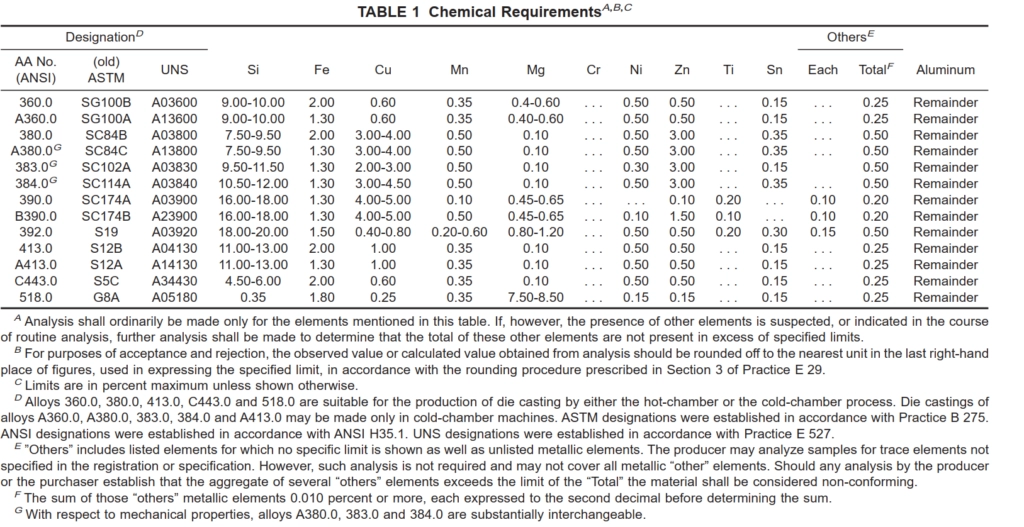
When you’re picking an aluminum grade for casting, the numbering system tells you exactly what you’re working with.
How cast aluminum alloy numbers (xxx.x) work
Cast aluminum alloys use a three-digit plus decimal format, like A380.0, 356.0, or 319.0:
- The first digit = main alloy family (what element is added the most after aluminum).
- The next two digits = specific alloy in that family.
- The “.0” at the end = cast alloy (vs “.1” or “.2” for ingot forms).
So when you see A380.0, you’re looking at a specific aluminum casting alloy, not a wrought grade like 6061.
What the 1xx–9xx casting series mean
For aluminum casting alloys, the first digit (1xx to 9xx) points to the main alloying element:
- 1xx.x – nearly pure aluminum (good conductivity, low strength)
- 2xx.x – aluminum–copper (high strength, lower corrosion resistance)
- 3xx.x – aluminum–silicon with copper and/or magnesium (A380, 319, 356 – most common casting alloys)
- 4xx.x – aluminum–silicon (great fluidity, good castability)
- 5xx.x – aluminum–magnesium (535 – high corrosion resistance, ductile)
- 6xx.x – aluminum–magnesium–silicon (rare in cast form)
- 7xx.x – aluminum–zinc (high strength, more specialty)
- 8xx.x – aluminum–tin (bearing and sliding applications)
- 9xx.x – other or special alloys
Most die casting aluminum grades for US manufacturing live in the 3xx.x series because they balance strength, castability, and cost.
Main alloying elements in aluminum casting
The chemistry drives performance. For aluminum casting alloys, the big players are:
- Silicon (Si) – boosts fluidity, reduces shrinkage, improves castability. High-Si alloys (like A380, 390) fill thin walls and complex shapes.
- Magnesium (Mg) – enables heat treatment, increases strength and hardness (e.g., A356), helps with fatigue resistance.
- Copper (Cu) – increases strength and hardness, but hurts corrosion resistance. Common in 319 and some 3xx.x grades.
- Zinc (Zn) – adds strength, but usually with tradeoffs on corrosion or dimensional stability; used more selectively in aluminum casting alloys.
Choosing the right aluminum grade for casting is really about choosing the right mix of Si, Mg, Cu, and Zn for your process and end use.
Common standards and global equivalents
Foundries and OEMs in the U.S. usually reference multiple standards for aluminum casting alloys:
- AA (Aluminum Association) – base designation like A380.0, 356.0, 319.0
- ASTM – material specs and test requirements (e.g., ASTM B26/B26M)
- EN – European standards (e.g., EN AC-42100 roughly aligns with A380-type alloys)
- JIS – Japanese standards (ADC12 is the JIS equivalent to A383-type alloys)
If you’re sourcing globally, it helps to work with a foundry that understands AA–EN–JIS crossovers and can match equivalents. For example, our own aluminum casting alloy grades for high-performance parts are specified with AA, EN, and regional equivalents so US buyers can compare apples to apples.
What temper codes like F, T5, T6, T7 actually change
After the alloy, the temper is the next piece you need to nail down:
- F – As-cast, no specific heat treatment. Lowest cost, lowest control.
- T5 – Cooled from casting and artificially aged (no solution treatment). Good for die castings that need a bump in strength.
- T6 – Solution heat treated + quenched + artificially aged. Big jump in strength and hardness (common for A356-T6 wheels and structural parts).
- T7 – Over-aged / stabilized. Slightly lower strength than T6, but better stress corrosion and dimensional stability, often used in high-temp or high-stress environments.
Same alloy, different temper = different performance and cost. When you define an aluminum grade for casting, you should always call out both the alloy (e.g., A356.0) and the temper (e.g., T6) on your print and RFQs.
Aluminum Casting Processes and Matching Grades
When you’re choosing an aluminum grade for casting, the first decision is which casting process you’re actually going to run. The process locks in a lot of what you can and can’t do with alloy selection.
Main Aluminum Casting Methods (Quick View)
- High-pressure die casting – Fast, high-volume, great for thin walls and complex shapes.
- Sand casting – Flexible, low tooling cost, ideal for larger parts and shorter runs.
- Gravity / permanent mold casting – Better surface and properties than sand, good repeatability.
- Investment casting – Highest detail, tight tolerances, excellent surface finish, but higher cost.
Each process has “favorite” aluminum casting alloys that flow well, fill the mold, and deliver the target strength and durability.
Die Casting Aluminum Grades and When to Use Them
For pressure die casting alloys, I usually recommend:
- A380 / ADC12 – General-purpose workhorses for automotive, electronics, consumer housings.
- A383 / 413 – Better fluidity for thin walls and more complex, pressure-tight parts.
- A360 – When you need better corrosion resistance and sealing.
Use die casting aluminum grades when you need:
- High volume and low part cost
- Thin walls and tight tolerances
- Good dimensional stability and near-net-shape parts
Sand Casting Aluminum Grades and Tradeoffs
For sand casting aluminum, you want alloys that won’t crack easily and can handle slower cooling:
- 356 / A356 – Best balance of strength, ductility, and weldability, especially after T6.
- 319 – Great for engine blocks and heads; good machinability and thermal performance.
- 535 (Almag 35) – High ductility and impact resistance without heat treat.
Tradeoffs:
- Lower tooling cost but higher part cost vs die casting
- Rougher surface finish and more machining
- Excellent for bigger parts and lower yearly volumes
Gravity and Permanent Mold Casting Alloys
Gravity and permanent mold casting aluminum sits between sand and die casting:
- Common grades: 356/A356, 319, 413, A360
- Better mechanical properties and surface than sand
- More consistent quality than sand, but tooling cost is higher
I use these when:
- Annual volume is moderate
- You need stronger, more consistent properties than sand
- You want better surface finish and dimensional control
Investment Casting Aluminum: Detail and Finish
When you need tight tolerances, fine detail, and clean surfaces, aluminum investment castings are hard to beat. Alloys like A356 and 355 are common here because they respond well to heat treatment and give strong, light parts with good fatigue resistance.
If you care about precision features and low tolerance (for aerospace or high-end industrial parts), it’s worth looking at a specialized aluminum investment casting service early in your design.
Quick Process vs Alloy Selection Table
| Process | Typical Alloys | Best For |
|---|---|---|
| High-pressure die casting | A380, A383, ADC12, 413 | High volume, thin walls, housings, brackets |
| Sand casting | 356, A356, 319, 535 | Larger parts, low–mid volume, structural |
| Gravity / permanent mold | 356/A356, 319, 413 | Better surface & properties, mid volume |
| Investment casting | A356, 355 | Precision parts, complex geometry, high value |
If you’re comparing processes and alloys for a new part, it also helps to review a broader casting alloy guide that covers properties and cost impacts across methods, like this overview of casting alloy types and applications.
Die casting aluminum grades that actually work
Die casting is where aluminum grades get picky. Not every aluminum alloy likes being shot into a steel die at high speed and high pressure, so choosing the right aluminum grade for casting is the difference between clean parts and constant scrap.
What makes an alloy good for die casting
A solid die casting alloy needs:
- High fluidity – to fill thin walls, ribs, and tight corners before it freezes
- Good pressure tightness – to avoid leaks in housings and hydraulic parts
- Low hot cracking & shrinkage – so parts don’t tear or distort as they cool
- Reasonable die soldering resistance – less aluminum sticking to the steel die
- Decent machinability – because most parts still need drilling, tapping, or milling
That’s why silicon-rich casting alloys dominate pressure die casting instead of common wrought grades.
Most used die casting aluminum grades
In the U.S. and across most high-volume production, these die casting aluminum grades are the workhorses:
- A380 – The default choice. Great balance of strength, fluidity, and cost.
- A383 (also similar to EN AC-46000) – Better fluidity for thin walls, slightly lower strength.
- ADC12 – The go-to grade in Asia, very close to A383, strong and easy to cast.
- 413/A413 – Excellent pressure tightness and castability, used in leak-critical parts.
We run these alloys regularly in our own aluminum casting lines, and they cover 90%+ of typical U.S. industrial, automotive, and consumer projects. If you’re comparing alloys or looking for part production, you can check our aluminum alloy product range or full-scale casting manufacturing services.
A380 vs A383 vs ADC12 – which to pick?
Use this as a quick rule of thumb:
- Choose A380 if:
- You want a general-purpose, proven alloy
- Parts have normal wall thickness and moderate strength needs
- Cost and availability matter most in North America
- Choose A383 or ADC12 if:
- You have very thin walls or complex flow paths
- You’re fighting cold shuts, misruns, or incomplete fill
- You’re syncing with Asian supply chains or tooling built around ADC12
- Choose 413/A413 if:
- You need high leak tightness (pumps, valves, fluid power components)
- Pressure testing and sealing are critical and scrap is expensive
Die casting defects from the wrong alloy choice
Pick the wrong aluminum casting alloy for die casting, and you’ll see it in your scrap bin:
- Misruns / cold shuts – alloy not fluid enough → often solved by switching from A380 to A383/ADC12
- Porosity and leaks – poor pressure tightness or gas entrapment → 413 or optimized A380 can help
- Hot cracking – alloy shrinks badly or has poor hot strength → wrong chemistry for part geometry
- Die soldering / sticking – alloy reacts too much with the die → costs you die life and surface quality
Lock in the right die casting aluminum grade early, and you cut down on defects, cycle time headaches, and late design changes.
Sand and Gravity Casting Aluminum Alloys

When you’re picking an aluminum grade for casting in sand or gravity/permanent mold, you can’t just reuse common die casting alloys like A380 and hope for the best. These processes fill slower, run hotter, and cool unevenly, so you need alloys designed to flow well, resist hot cracking, and still deliver solid mechanical properties.
Why sand casting needs different aluminum grades
Sand molds are rougher, more porous, and cool slower than steel dies. That means:
- You need better feeding and lower hot cracking risk
- You want alloys that tolerate gas pickup and shrinkage
- You accept a little less surface finish for stronger, sound sections
That’s why most foundries lean on 356, A356, 319, and 535 for sand and gravity casting aluminum instead of typical die cast grades.
Best aluminum grades for sand and gravity casting
For U.S. customers, these are the core workhorse alloys:
- 356 / A356 aluminum – Great combo of castability and strength. In T6 it’s a go-to for wheels, suspension parts, and higher-end structural castings. If you’re looking at A356 T6 wheels or structural parts, check out detailed A356-T6 aluminum alloy strength and applications.
- 319 aluminum – Very machinable, good thermal conductivity, solid strength with heat treatment. Common in engine blocks and cylinder heads.
- 535 (Almag 35) – Magnesium aluminum alloy with high ductility and impact resistance without heat treatment. Excellent for marine hardware and shock-loaded components.
These grades are the sweet spot when you want reliable mechanical performance from sand or gravity casting aluminum without crazy process control costs.
How mold type affects alloy choice
Mold type changes cooling speed and defect risk, so it directly affects which aluminum grade for casting makes sense:
- Green sand – Slower cooling, higher gas risk → use A356, 319, 535 that handle porosity and shrinkage better.
- No-bake / resin sand – Better dimensional control → good for A356 T6 where you need higher strength.
- Gravity / permanent mold – Faster cooling than sand → alloys like 356/A356 deliver tighter grain structure and higher mechanical properties.
Always match the alloy to your mold: faster-cooling molds allow stronger tempers and thinner sections, slower-cooling molds need alloys that stay forgiving.
Common issues in sand cast aluminum (and how alloy fixes them)
With sand and gravity castings, most headaches come from:
- Porosity and leaks – Alloys like A356 and 319 feed better and reduce shrink porosity when gated correctly.
- Hot cracking – High-silicon cast alloys relieve stress during solidification and cut cracking risk.
- Weak edges or corners – A356 T6 in permanent mold can boost edge strength and elongation versus basic cast grades.
- Corrosion in marine or outdoor use – 535 and A356 offer better corrosion resistance than some copper-heavy alloys.
If you’re not sure which aluminum casting alloy to pick for your sand or gravity casting, start by defining: required strength, section thickness, machining needs, and environment (heat, salt, vibration). Then select from 356/A356, 319, or 535 based on which tradeoffs matter most for your part.
Popular Aluminum Grades for Casting and Their Uses
When you’re picking an aluminum grade for casting, a few alloys cover most real-world jobs. Here’s how I look at the most common casting alloys in U.S. manufacturing and where each one actually makes sense.
A380 Aluminum Grade
Key properties of A380 (strength, fluidity, machinability)
A380 is the workhorse of die casting aluminum grades. It balances:
- Good strength and stiffness for housings and brackets
- High fluidity for filling complex dies
- Decent machinability for secondary ops
A380 applications in automotive, electronics, and hardware
You’ll see A380 everywhere in:
- Automotive: gear housings, brackets, transmission cases
- Electronics: heat sinks, motor housings, connector bodies
- Hardware: power tool bodies, door hardware, appliance frames
Limits of A380 and when not to use it
Don’t pick A380 when you need:
- High ductility or heavy impact resistance
- Top-tier corrosion resistance (especially for harsh marine use)
- Structural parts that must be welded or heavily formed later
A383 and ADC12 Aluminum
Why A383/ADC12 are used instead of A380
A383 (and its Asian equivalent ADC12 aluminum alloy) are used when you need:
- Better fluidity than A380
- Improved fill on thin, complex parts
- Tighter control of porosity in narrow features
Fluidity and thin-wall casting with ADC12
ADC12 is the go-to alloy in many Asian die-casting shops for:
- Thin-wall housings
- Phone, computer, and electronics frames
- Compact, high-volume components with tight dimensional control
Regional naming: A380 vs ADC12 vs EN equivalents
- North America: A380 / A383
- Asia: ADC12 (very close to A383 chemistry)
- Europe (EN): often EN AC-Al Si9Cu3(Fe) or similar equivalents
If you’re sourcing globally, always match chemical spec sheets between these names, not just the shorthand alloy label.
A356 and 356 Casting Grades
Raw vs heat treated A356 (T4, T6)
A356 can be:
- As-cast / F: good castability, moderate strength
- T4: solution treated + naturally aged, better ductility
- T6: solution treated + artificially aged, high strength and stiffness
Strength, ductility, and weldability of A356
A356 T6 delivers:
- High tensile and yield strength
- Good ductility for safety-critical parts
- Strong weldability vs most die-cast alloys
Where A356 shines: wheels, structural parts, aerospace castings
I use A356 for:
- Automotive wheels and suspension components
- Structural housings and brackets where failure is not an option
- Aerospace castings (with strict process control and certification)
A360 Aluminum Alloy
Corrosion resistance and pressure tightness of A360
A360 offers:
- Better corrosion resistance than A380 in many environments
- Improved pressure tightness, ideal for fluid or sealed parts
- Good castability with fine detail
Best fits for A360 (marine, sealed housings, complex shapes)
Solid picks for:
- Marine components needing better salt resistance
- Sealed housings for fluids, gas, or electronics
- Complex die-cast shapes where leaks are not acceptable
A360 vs A380: when to upgrade
Choose A360 over A380 when:
- Leaks, porosity, or corrosion are major risks
- You’re paying for sealing, impregnation, or heavy coatings to fix A380 weaknesses
319 Aluminum Alloy
Thermal conductivity and machinability of 319
319 is a sand and permanent-mold favorite because it offers:
- Good thermal conductivity (great for engines)
- Comfortable machinability for precise bores and threads
- Solid castability with reasonable strength
Why 319 is common in engine blocks and cylinder heads
You’ll see 319 in:
- Engine blocks
- Cylinder heads
- Other high-temp powertrain parts where heat has to move out quickly
Heat treatment options for 319 castings
319 can be:
- Used as-cast for moderate requirements
- T5 / T6 heat treated for improved strength and fatigue resistance
413 and A413 Casting Grades
Castability and leak resistance of 413/A413
413 / A413 are high-silicon die casting aluminum grades known for:
- Excellent fluidity and castability
- Strong leak resistance and pressure performance
Thin-wall and hydraulic components with 413
I like 413/A413 for:
- Thin-wall components that still need pressure integrity
- Hydraulic parts, pump housings, and valves
- High-pressure die castings where porosity is a major concern
Balancing brittleness risk vs pressure performance
Downside: higher silicon can increase brittleness. Use 413/A413 when:
- Pressure-tightness > ductility
- Parts aren’t expected to take big impacts or bending loads
535 (Almag 35) Magnesium Aluminum
High strength without heat treating in 535
535 (often called Almag 35) is a magnesium aluminum casting alloy that delivers:
- High strength and toughness right out of the mold
- No mandatory heat treatment, which cuts lead time and cost
Ductility and impact resistance benefits
It stands out for:
- Excellent ductility
- Strong impact resistance
- Good corrosion resistance, especially with proper finishing
Marine and shock-loaded parts with 535
Good fit for:
- Marine hardware and brackets
- Shock-loaded parts like steering arms, mounts, and guards
- Safety-related parts where cracking is not acceptable
390 and B390 High Silicon Alloys
Wear resistance and high temperature performance of 390/B390
390 and B390 are very high silicon aluminum casting alloys built for:
- Outstanding wear resistance
- Strong performance at elevated temperatures
- Stable dimensions over long, hot service cycles
Why pistons and sliding surfaces use B390
You’ll see these alloys in:
- Pistons
- Cylinder liners, sliding or reciprocating components
- High-mileage automotive engine parts
Machinability tradeoffs with very high silicon alloys
The tradeoff:
- Very poor machinability – tools wear fast
- You need proper tooling, coatings, and cutting strategies
- Best used when the part is mostly near-net-shape cast, not heavily machined
Comparison of Key Aluminum Casting Grades
Quick property snapshot
Below is a simplified comparison (typical ranges, not design allowables):
| Alloy | Process | Strength (rel.) | Ductility (rel.) | Corrosion | Castability | Machinability |
|---|---|---|---|---|---|---|
| A380 | Die casting | Medium | Low | Medium | High | Medium |
| A383 / ADC12 | Die casting | Medium | Low | Medium | Very High | Medium |
| A356 T6 | Sand/perm mold | High | Medium | Good | Good | Good |
| A360 | Die casting | Medium | Low–Medium | Good | High | Medium |
| 319 | Sand/perm mold | Medium | Medium | Medium | Good | Good |
| 413 | Die casting | Medium | Low | Medium | Very High | Fair |
| 535 | Sand/perm mold | Medium–High | High | Good | Medium | Good |
| 390/B390 | Die/sand (spec) | High | Very Low | Medium | Medium | Poor |
Castability, shrinkage, and hot cracking
- Best castability: A380, A383/ADC12, 413
- Lower shrinkage risk: High-silicon alloys (A380, 413, 390)
- Higher hot cracking risk: Some Mg- or Cu-rich alloys if gating/feeding is poor
Corrosion resistance and machinability quick ratings
- Top corrosion options: A360, 535, A356 (with good finishing)
- Most machinable overall: 319, A356, A380
- Hardest to machine: 390/B390 due to extreme silicon content
If you need even higher temperature or wear performance than aluminum castings can handle, that’s when I shift to high-temperature alloys like nickel-based materials or specialty springs similar to the high-temperature nickel alloy springs and components we provide for more extreme environments: high-temperature nickel alloy springs machining service.
How to Choose the Right Aluminum Grade for Casting
Picking the right aluminum grade for casting is about balancing performance, cost, and how you actually make the part. Here’s how I look at it when I’m speccing parts for production in the U.S. market.
1. Match strength and ductility to the job
Start with what the part must survive, not with the alloy name.
Ask yourself:
- Is the part structural or mostly cosmetic?
- Static load or impact/shock?
- Safety‑critical or non‑critical?
Quick guide:
| Need | Better aluminum casting alloys |
|---|---|
| High strength + ductility | A356-T6, 319-T6, 535 (no heat treat) |
| Medium strength, general | A380, A383, ADC12 |
| Wear + high temp | 390, B390 |
If you need specific numbers (tensile, yield, elongation), match your required values with a proper aluminum alloy comparison chart or mechanical data sheet before you lock in a grade. For deeper background on strength levels you can also look at general resources on yield strength in aluminum.
2. Match alloy to casting process
Not every aluminum grade for casting works in every process.
| Process | Typical best-fit grades | Notes |
|---|---|---|
| Die casting | A380, A383, ADC12, 413, A413 | Thin walls, high volumes, some porosity |
| Sand casting | 356, A356, 319, 535, 390 | Lower tooling cost, thicker sections |
| Gravity/permanent | 356, A356, 319, A360 | Better surface + properties than sand |
| Investment casting | 356, A356, 319 | High detail, smaller parts, higher cost |
If you already know you’re locked into high‑pressure die casting, that instantly rules out a lot of sand‑cast‑only alloys.
3. Fluidity, feeding, and shrinkage
Good aluminum casting alloys must fill the mold and solidify without major defects.
- Thin‑wall + complex features: A380, A383, ADC12, 413.
- Thicker sections + lower defect risk: A356, 319, 535.
- High shrinkage risk areas: Avoid very low‑ductility, high‑Si grades unless the foundry has strong process control.
Work with a foundry that understands feeding and gating; the same alloy can behave very differently in the hands of an average shop vs. an excellent one.
4. Corrosion, temperature, and environment
Environment can kill a “good on paper” alloy choice.
Corrosion / environment check:
| Condition | Recommended casting alloys |
|---|---|
| Marine / salt spray | A360, 535 (Almag 35), A356 |
| Outdoor moderate exposure | A356, 319, A380 (with coating) |
| High temperature service | 319, 390/B390 (engine, powertrain) |
If you’re designing valves, pumps, or fluid-handling parts, also think about media compatibility and sealing. For some projects we combine aluminum castings with other metals like ductile iron castings in hybrid systems when corrosion and strength targets are mixed; you can see examples of that approach in industrial valve castings and OEM valve bodies.
5. Machining, welding, finishing
Don’t pick an alloy that fights you in the machine shop.
- Easier machining: A380, A383, ADC12, 319.
- More difficult (abrasive Si): 390/B390 – plan on good tooling.
- Best weldability: A356/A356-T6, 535.
- Surface finishing: Most alloys anodize, but appearance and color shift vary; 356/A356 usually looks better than high‑Si die cast grades.
If your design needs heavy post‑machining or welding repairs, avoid the very high‑silicon die casting alloys when possible.
6. Cost vs performance
You don’t always need the “fancy” alloy.
Cost levers:
- A380 / ADC12: Lowest cost for high‑volume die cast parts; good “default” for housings and brackets.
- A356 / 319: More cost in melting + heat treatment, but better mechanical properties.
- 390/B390, 535: Specialty performance → higher alloy + processing cost.
Rule of thumb:
- Non‑critical housings, covers, brackets → start with A380/ADC12.
- Structural, wheels, suspension, safety parts → start with A356 or 319 and justify down if needed.
7. Common mistakes when picking aluminum casting grades
I see these issues over and over:
- Specifying a wrought alloy like 6061 or 7075 for a cast part (poor castability, cracking, porosity).
- Ignoring the casting process and picking an alloy the foundry can’t run efficiently.
- Over‑spec’ing strength and driving cost up, when the real load case is mild.
- Skipping environment checks, then dealing with corrosion or leakage later.
- Forgetting about machining or welding until after the alloy is locked in.
- Assuming all foundries can hit the same properties with the same alloy – process control matters as much as the grade name.
If you’re unsure between two aluminum casting alloys, involve your foundry early, share your load cases and environment, and have them quote both options with realistic property targets.
Heat Treatment of Aluminum Casting Alloys

When you’re picking an aluminum grade for casting, heat treatment is a big lever for dialing in strength, ductility, and stability. But it only pays off if the alloy is designed to respond.
What T4, T5, T6, and T7 Really Mean
For aluminum casting alloys, these temper codes are shorthand for how the metal was processed after casting:
- T4 – Solution heat treated and naturally aged
- Better ductility and moderate strength
- Common when you need forming or good impact resistance
- T5 – Cooled from casting and artificially aged
- Used mostly in pressure die casting alloys
- Fast cycle, moderate strength, good dimensional stability
- T6 – Solution heat treated and artificially aged
- Most common for structural castings
- Big jump in tensile strength and yield strength
- Typical for A356 and 319 when you want high strength and stiffness
- T7 – Solution heat treated and over-aged/stabilized
- Slightly lower strength than T6
- Better dimension stability, creep resistance, and stress-corrosion performance
- Used in high-temp or long-life parts (like some engine and high-silicon aluminum casting alloys)
Which Aluminum Casting Alloys Benefit the Most
Some aluminum casting alloys respond extremely well to heat treatment, while others barely move:
- A356 / 356
- Exceptional response to T6
- A356-T6 is a go-to for wheels, suspension, and aerospace castings
- Strong, relatively ductile, and weldable
- 319
- Widely used in engine blocks and cylinder heads
- T6/T7 improve strength and thermal fatigue performance
- Good balance of strength, machinability, and thermal conductivity
- 390 / B390 (high silicon alloys)
- Can be heat treated, but gains are more targeted
- Focus is on wear resistance and thermal stability, not just strength
- Used where high temp and sliding contact dominate (pistons, liners)
If you’re planning tight-tolerance machining or additional surface treatment on cast aluminum, picking a heat-treatable aluminum casting alloy like A356 or 319 makes the whole process more predictable.
What Actually Improves After T6
When you take a suitable aluminum grade for casting to T6, you generally see:
- Higher tensile and yield strength – often 30–60% increase vs. as-cast
- Better fatigue strength – critical for automotive and structural castings
- More consistent mechanical properties – part-to-part repeatability
- Improved hardness – better wear and dent resistance
However, elongation (ductility) usually drops compared to T4 or as-cast, so you’re trading toughness for strength. That’s why for impact-heavy parts, T4 or T5 might be a smarter move.
When Heat Treating Is Optional or Not Worth It
Some aluminum casting alloys simply don’t justify the cost and complexity of heat treatment:
- 535 (Almag 35)
- Naturally high strength and ductility without heat treatment
- Excellent for marine parts, shock-loaded components, and brackets
- You get great impact resistance and corrosion resistance as-cast
- Many high-pressure die casting grades (like A380/ADC12)
- Limited improvement from full solution heat treatment
- Risk of blistering and distortion due to trapped gas
- Most shops stick with as-cast or a T5-style artificial age at best
You should skip or minimize heat treatment when:
- Parts are non-structural or lightly loaded
- You’re chasing low cost and high volume more than performance
- The alloy doesn’t respond well (e.g., some die casting aluminum grades)
- Distortion risk would wreck your machining tolerances
Heat Treatment Risks You Need to Manage
Heat treating aluminum casting alloys isn’t “set it and forget it.” If it’s not controlled, you can easily lose more than you gain:
- Distortion & warping
- Thin walls and long sections can move during solution heat treatment or quenching
- This kills dimensional accuracy and drives up machining scrap
- Over-aging (especially in T7 or poor T6 control)
- If aged too hot or too long, strength drops and hardness falls off
- You end up with a softer part than you paid for
- Cracking & residual stress
- Rapid quenching or bad fixturing can introduce high internal stresses
- Visible cracks or microcracks that show up later under load
For US customers running production, I always recommend:
- Get a clear heat treat spec from your foundry (temper, time, and temperature)
- Confirm with mechanical testing on first articles, not just chemistry
- Build your machining plan around the post–heat treat condition, not before
If you pick the right aluminum grade for casting and pair it with the right heat treatment, you can hit automotive- and aerospace-level performance without overbuilding or overspending.
Real-World Uses of Aluminum Grades for Casting
Automotive Aluminum Castings (A380, 319, 390, A383)
In the U.S. auto market, aluminum casting alloys are all about balancing cost, reliability, and weight.
- Engine blocks, heads, and housings
- A380 is the go-to aluminum grade for casting transmission cases, pump housings, brackets, and general housings because it’s cheap, very castable, and has solid strength.
- 319 is common for engine blocks and cylinder heads where you need better thermal stability and machinability.
- 390/B390 shows up in high-wear, high-temperature areas like pistons and some performance engine parts thanks to its very high silicon and wear resistance.
- Transmission and drivetrain parts
- A380 is still the workhorse for automatic transmission cases, torque converter housings, and gear housings.
- A383 (and ADC12) are used when you need better fluidity and thin-wall filling, like complex automatic transmission bodies and tight, detailed drivetrain housings.
Aerospace & High-Performance Cast Aluminum (A356 T6)
For aerospace and performance parts in the U.S., the conversation usually shifts to A356 in T6 temper.
- Structural and suspension components
- A356 T6 is widely used for wheels, suspension arms, control arms, brackets, and structural housings where you need both strength and ductility.
- Weight saving vs safety
- Aerospace and racing teams pick A356 T6 when they want weldable, high-strength aluminum castings with predictable fatigue behavior.
- Designs are typically optimized to shave weight but keep a good safety factor for real-world road and flight loads.
If you’re comparing materials beyond aluminum—like looking at how cast aluminum stacks up against iron or steel—you’ll see a very different weight and strength balance than with options like cast iron vs steel for durable components.
Marine, Electrical & Consumer Aluminum Castings (A360, 535, A380, ADC12)
For U.S. marine, electrical, and consumer products, corrosion and appearance matter as much as strength.
- Marine gear and harsh environments
- A360 is preferred for sealed housings, marine hardware, and outdoor enclosures where corrosion resistance and pressure tightness are key.
- 535 (Almag 35) is great for shock-loaded marine fittings, steering components, and structural brackets because it offers high ductility without needing heat treatment.
- Electronics housings & heat sinks
- A380 and ADC12 are standard for electronics housings, LED heat sinks, chargers, inverters, and junction boxes due to their excellent castability, thermal conductivity, and good surface finish.
- Lightweight consumer products
- Common items like power tool bodies, furniture hardware, fitness equipment parts, and appliance frames are often die cast from A380 or ADC12 for a clean finish and low unit cost.
Trends in Aluminum Casting: EVs, Recycling & Sustainability
In the U.S. market, two big trends are driving aluminum casting alloy choices:
- Recycled casting alloys
- High-recycled-content aluminum casting alloys are becoming standard for automotive, consumer, and industrial parts to cut carbon footprint without killing performance.
- Die casting grades like A380/ADC12 are especially friendly to recycled feedstock because they tolerate wider chemistry ranges.
- Lightweighting for EVs and high-efficiency vehicles
- EV platforms are pushing large structural castings, battery housings, and motor housings made with A356, A380, A383, and advanced proprietary grades.
- The goal is simple: reduce weight, maintain crash performance, and keep casting costs under control, using the right aluminum grade for casting matched to each component’s job.
Working With Aluminum Foundries and Suppliers
When you’re picking an aluminum grade for casting, the foundry you work with matters just as much as the alloy spec on paper. In the U.S. market especially, consistency, traceability, and real-world casting experience are what keep parts on time and in tolerance.
Why foundry experience matters
Two foundries can pour the same aluminum casting alloy and give you totally different results. I always look for:
- Process experience with your alloy and process (A380 die casting, A356 sand casting, etc.)
- Proven capability in your part size and complexity (thin walls, pressure-tight housings, cosmetic surfaces)
- Documented scrap and defect rates for similar aluminum castings
If a foundry can show repeatable results with your target aluminum grade for casting, you’re already ahead.
How to talk spec sheets with your aluminum caster
Keep the conversation simple but specific:
- Share 2–3 critical properties: strength, leak tightness, corrosion resistance, or machinability
- Call out the casting process you expect: die casting, sand casting, gravity, or investment
- Reference standard specs: AA or ASTM numbers for aluminum casting alloys, plus any heat treatment (T5, T6, T7)
Then ask the caster, “What aluminum grade and process would you choose for this part?” Their answer tells you a lot.
What to ask about certificates and testing
Before you lock in an alloy and a supplier, I always ask for:
- Material certificates (mill certs) showing chemistry for each aluminum casting alloy heat
- Mechanical test data (tensile, yield, elongation, hardness) from recent production runs
- Process certifications: ISO, IATF (for automotive), or aerospace approvals if relevant
If your parts will be machined, cut, or secondary processed later, it’s worth looking at their broader metal know-how and how they handle precision work, similar to what’s required in high-accuracy metal cutting operations.
When to involve your supplier in alloy selection
Bring your foundry in early, especially if you’re not sure which aluminum grade for casting to use. Good foundries will:
- Suggest alternate aluminum casting alloys that hit your targets at lower cost
- Flag risks with thin walls, cores, or heavy sections based on alloy behavior
- Help choose heat treat condition (as-cast, T5, T6, T7) that fits your application and budget
Don’t show up with a fully locked spec if you’re not 100% sure; let them help optimize.
Getting quotes for different alloys and processes
When I request quotes, I like to see options side by side:
- Same part, multiple alloys: e.g., A380 vs A383 vs A360 for die casting
- Same part, different processes: high-volume die cast vs low-volume sand or gravity casting aluminum
- Break out tooling cost, piece price, and heat treatment separately
This makes it easy to see where a small change in aluminum casting alloy or process can save serious money without giving up performance.
FAQs About Aluminum Grades for Casting
Most common aluminum grade for die casting
For high-volume pressure die casting, A380 aluminum is the go-to in the U.S. because it balances:
- Good strength
- Great fluidity for thin walls
- Solid machinability
- Reasonable cost
If you’re unsure where to start with die casting aluminum grades, A380 is usually the first choice.
Can I cast wrought alloys like 6061 or 7075?
Short answer: you shouldn’t for normal foundry work.
- 6061, 7075, 2026 are wrought alloys (for extrusion/plate), not designed for casting.
- They don’t flow well, crack easily, and give poor, inconsistent castings.
- Use casting alloys like A356, 356, 319, or A380 that are engineered for molds, shrinkage, and feeding.
If you absolutely need “6061-like” properties, talk with your foundry about A356-T6 or similar high-strength casting aluminum instead.
Best aluminum grade for corrosion resistance in cast parts
For cast aluminum that has to live in tough environments (salt, water, outdoors), I usually look at:
| Alloy | Type | Corrosion Notes |
|---|---|---|
| A360 | Die casting | Very good corrosion & pressure tightness |
| 535 (Almag 35) | Sand/gravity | Excellent corrosion + ductility, no heat treat |
| A356-T6 | Sand/permanent mold | Good corrosion when properly treated & painted |
For marine or coastal use, A360 or 535 are hard to beat.
Which aluminum casting grade is easiest to machine?
If machining cost matters, pick alloys designed for clean chips and stable cutting:
| Alloy | Process | Machinability (relative) |
|---|---|---|
| A380 | Die casting | Very good |
| ADC12 | Die casting | Very good |
| 319 | Sand/gravity | Very good |
| A356-T6 | Sand/gravity/permanent mold | Good (slightly “gummier” than 319/A380) |
For complex CNC work, I often lean toward A380 or 319 for smoother machining and better tool life, similar to how we approach precision CNC machining of non-ferrous alloys.
Differences between A356 and A380 in plain language
Think of it like this:
| Feature | A356 (A356-T6) | A380 |
|---|---|---|
| Main process | Sand / permanent mold | High-pressure die casting |
| Strength | Higher (with T6 heat treat) | Moderate |
| Ductility | Better (less brittle) | Lower |
| Weldability | Good | Poor |
| Corrosion | Good | Good with proper finish |
| Complexity/volume | Lower volume, thicker sections | High volume, thin-wall, complex |
If you need structural strength, weldability, or fatigue resistance, go A356.
If you need high-volume, thin-wall, detailed housings, go A380.
Do I really need heat treatment for my casting?
It depends on what the part does:
Usually yes (or at least worth considering) for:
- Structural parts (suspension, wheels, brackets)
- High-stress or fatigue-loaded parts
- Alloys like A356, 356, 319, 390 that respond well to T6/T7
Usually no or optional for:
- Non-structural housings, covers, brackets in A380, ADC12, A360
- 535 (Almag 35) which is strong and ductile as-cast
- Parts where the cost of heat treat > benefit in service
If your part is mainly a housing or cover with modest loads, you can often skip heat treatment and save cost. If it’s carrying load or safety-critical, I strongly recommend reviewing a T6 or T7 temper with your foundry.