

Precision Sinker EDM Machining Services
The premier die sinking EDM process for high-complexity metal castings and critical components. Achieve flawless deep cavities, tight slots, sharp corners, and pristine geometric accuracy on hardened alloys.
Vastmaterial delivers single-source manufacturing control, seamlessly binding investment casting with advanced precision EDM service for the world's most demanding industrial applications.
Quantifiable Sinker EDM Capabilities: Precision, Surface Finish & Micro Features
- EDM Tolerance
- ±0.005 mm
- Ultra-precise dimensional control tailored to exact print specifications
- Surface Finish EDM
- Ra 0.2 μm
- Achievable mirror-like or textured finishes based on working conditions, with additional surface treatment options as required
- Micro Feature EDM
- ≥ 0.1 mm
- Fine slots, sharp corners, and micro-geometries verified via rigorous DFM
- Deep Ribs & Cavities
- 30:1 Ratio
- High aspect ratio discharge capabilities using optimized electrode strategies
- Hardened Steel EDM
- Up to 65 HRC
- Flawless machining of heat-treated alloys and tough tool steels
*Note: Actual processing metrics are driven by specific component geometry, material chemistry, and structural requirements. The Vastmaterial engineering team provides comprehensive manufacturability reviews and tailored inspection plans to ensure perfect fit and function. Prototype sampling is available to validate your design prior to volume production.
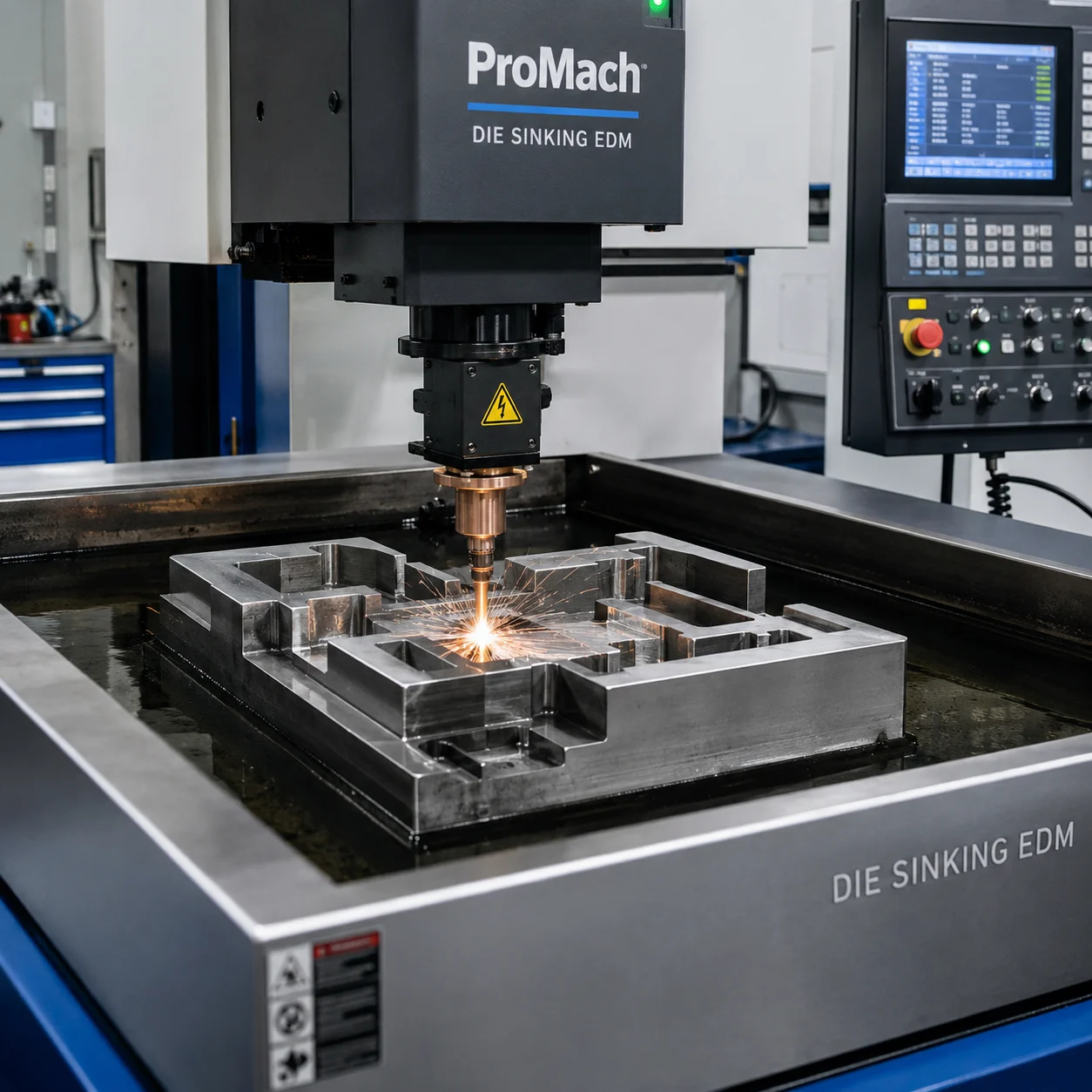
When to Choose Sinker EDM Over Conventional Milling: Solving Complex Part Geometries
Not all complex geometries can be resolved with standard CNC Milling or grinding. Vastmaterial utilizes advanced precision die sinking EDM technology to address critical structural features where tool interference, material hardness, or strict directional constraints make conventional cutting impossible.
EDM for Deep Cavities & Blind Holes
Mechanical cutting often fails in enclosed spaces due to severe tool deflection, clearance interference, and poor chip evacuation. Our sinker EDM machining service ensures highly stable, contactless erosion of deep blind cavities, maintaining uniform walls without risking tool breakage.
Narrow Slots & Deep Ribs
Machining thin, deep channels using ultra-fine end mills regularly causes tool chatter, poor surface finishes, and high scrap rates. By designing precise negative electrodes, we achieve high-aspect-ratio narrow slots EDM profiles with absolute dimensional consistency across small batches.
Sharp Corner EDM & Square Cutouts
Rotary CNC cutters always leave an internal fillet radius equal to the radius of the tool. When your design requires true zero-clearance sharp corners or precise rectangular internal features, our tailored electrode corner-wear compensation delivers sharp inner radii that meet tight mating clearances.
Hardened Steel EDM & Tough Alloys
Machining components after heat treatment prevents deformation but causes extreme mechanical wear on traditional cutting tools. Because spark erosion relies on thermal energy rather than physical force, hardened steel EDM and heat-resistant superalloys can be processed seamlessly regardless of material hardness.
Complex Molds & Local Re-machining
Modifying specific internal profiles or repairing worn section blocks requires localized material removal without disturbing surrounding geometries. Our localized precision EDM setups allow controlled engineering modifications, design updates, and localized repairs on intricate 3D contours.
Critical Casting Secondary Finishing
Vastmaterial frequently integrates investment casting with subsequent precision EDM. This combined approach safely removes machining allowances on complex cast profiles, eliminates sub-surface casting porosity risks on critical sealing faces, and guarantees exceptionally reliable assembly alignment.
Die Sinking EDM Process: Engineering Transparency & Risk Control
What is Sinker Die-Sinking EDM & How Does It Form Complex Cavities?
Sinker EDM (electrical discharge machining) utilizes a custom-machined conductive electrode—typically graphite or copper—submerged in a dielectric fluid to replicate complex, high-precision geometry into a workpiece via controlled spark erosion. Unlike conventional CNC milling that relies on rotational cutting forces, the die sinking EDM process removes material atom by atom without physical contact. This makes it the premier manufacturing method for producing blind cavities, internal sharp corners, and deep, narrow ribs that are geometrically impossible to execute with traditional end mills.
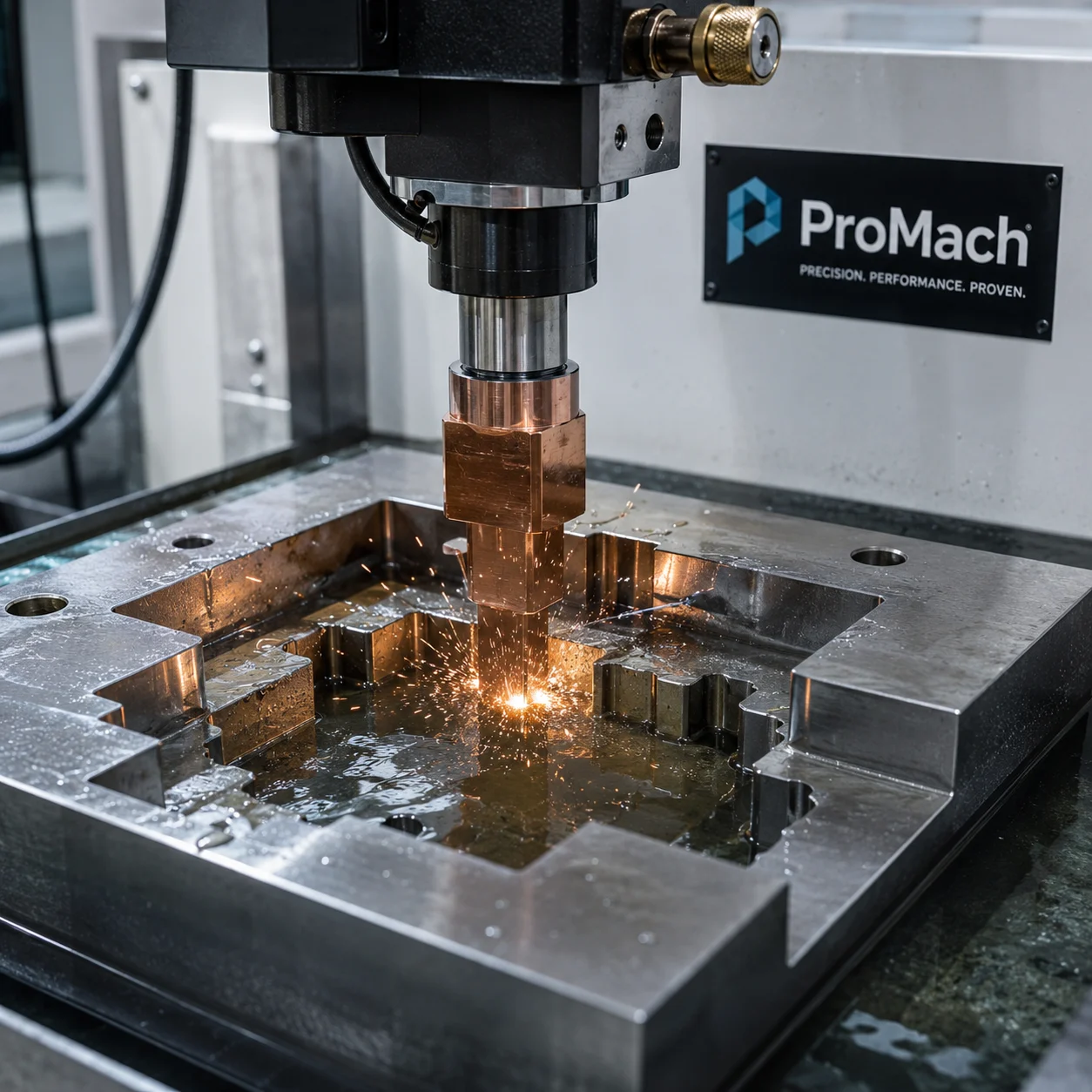
Key Advantages of Precision EDM Machining
Hardness-Independent Material Removal: Because the process relies on thermal erosion rather than mechanical shearing, it easily machines hardened tool steels, stellite, hastelloy, and heat-resistant superalloys without tool deflection.
Zero Cutting Forces on Complex Cavities: The absence of physical tool pressure allows for the safe machining of ultra-thin walls, high-aspect-ratio deep ribs, and microscopic features without risking part deformation.
True Sharp Corners and Blind Profiles: By reverse-engineering the geometry into the EDM electrode, we achieve corner radii down to the absolute minimum technical threshold, bypassing traditional CNC tool radius limitations.
Important Technical Considerations & Risk Mitigation
Managing EDM Electrode Wear: Spark discharge degrades the electrode during processing. We mitigate this through advanced multi-electrode strategies, separate roughing/finishing passes, and precise CNC wear-compensation programming.
Controlling the Recast Layer (White Layer): Intense thermal energy leaves a microscopic recast layer on the metal surface. Our engineers carefully tune discharge parameters in the final stage to keep this layer minimal, uniform, and easily cleanable via post-processing or micro-blasting.
Project Cost & Lead Time Drivers: Total tooling investment is directly tied to the number of electrodes required for a specific geometry. We optimize electrode design during our standard DFM review to compress lead times and eliminate unnecessary setups.
Vastmaterial’s Process Integrity: From Electrode Design to Closed-Loop Inspection
DEDICATED ELECTRODE DESIGN REVIEW
Every 3D model undergoes a strict engineering evaluation to determine the optimal spark-gap allowance, flushing channel placement, and electrode material selection (graphite vs. copper).
PARAMETRIC TEST RUNS & CALIBRATION
Discharge parameters—including pulse-on time, current density, and peak voltage—are calibrated specifically to your alloy's metallurgical state to eliminate thermal cracking or micro-cracking risks.
MULTI-STAGE ROUGHING & FINISHING STRATEGIES
High-amperage roughing passes remove bulk volume rapidly, followed by low-amperage, high-frequency precision EDM service cycles to refine dimensional tolerances and surface finishes.
CLOSED-LOOP CMM METROLOGY
part geometries are measured using coordinate measuring machines (CMM) and optical comparators to verify that critical internal cavity dimensions match your blueprint exactly.
Material and Heat Treatment Compatibility for Sinker EDM
Material Hardness & Engineering Properties
- Post-heat-treatment metals and fully hardened tool steels remain perfectly machinable via die sinking EDM without risking tool breakage.
- High electrical conductivity is the primary prerequisite, allowing stable, continuous spark erosion across diverse alloy grades.
- Superalloys and refractory metals that cause severe tool wear in traditional CNC milling are eroded efficiently with zero mechanical stress.
- Complex metallurgical microstructures maintain their structural integrity because the non-contact process eliminates cutting forces.
- Pre-machined cast blanks with irregular surface scales can be precisely finished in localized areas using targeted EDM parameters.
Advanced EDM Processing Strategies
- Custom discharge settings are calibrated based on thermal conductivity to balance material removal rates with electrode wear.
- Multi-stage electrode programming accounts for material-specific recast layers, ensuring tight tolerance control down to the micron.
- Integrated surface finishing options, such as micro-blasting and precision polishing, are deployed to manage the heat-affected zone.
- Pre-heat-treatment review helps align the machining sequence, optimizing stress relief and preventing dimensional distortion.
- Technical feasibility consultation is provided upfront for low-conductivity alloys or custom composite metal matrices.
Vastmaterial services a broad spectrum of engineering alloys, high-temperature superalloys, and hardened steels. By seamlessly integrating our precision casting expertise with advanced die sinking EDM capabilities, we map out optimal manufacturing routes that adapt to your material's exact heat-treated state. If your project involves non-conductive materials or specialized coatings, please reach out to our engineering team for a dedicated DFM review and process evaluation.
Advanced EDM Electrode Design & Engineering Expertise
- • Precision EDM Electrode Design: Custom-engineered geometries using premium graphite or copper alloys, optimized specifically for high conductivity and superior thermal wear resistance.
- • Predictive Electrode Wear Compensation: Advanced Spark-gap and wear-ratio simulation strategies that preserve tight dimensional tolerances across complex, deep-cavity geometries.
- • Multi-Electrode Segmented Machining: Seamless rough, semi-finish, and ultra-fine precision EDM staging designed to isolate thermal stress and prevent micro-cracking.
- • Consistency Reuse & Batch Strategies: Standardized tooling matrices and electrode replication protocols that minimize unit setup costs while ensuring high reproducibility for serial production.
At Vastmaterial, our engineering team maps out custom electrode strategies based on your part’s critical functional datums. By balancing spark parameters with geometric complexity, we consistently deliver exceptional component accuracy while controlling total tooling costs.
💡 —upload your 3D models (STEP/IGES) today for a rapid engineering review, electrode count optimization, and a detailed lead time assessment.
Roughing Electrodes
Engineered for aggressive spark discharge to achieve maximum material removal rates on heavy casting stock or bulk cavities.
Value: Drastically cuts initial cycle times and prepares complex geometries efficiently before critical finishing phases.
Finishing Electrodes
Tailored for micro-features, intricate deep ribs, and sharp interior radii that demanding industrial components require.
Value: Delivers tight linear and geometric tolerances while producing a refined, predictable EDM surface finish.
Local Repair & Modification Electrodes
Specialized for targeted post-heat treatment modifications, feature touch-ups, or selective surface recast layer removal.
Value: Provides a cost-effective alternative to full scrap-and-rework cycles when engineering or tool design changes occur.
Our Proven Sinker EDM Machining Process & Rigorous Production Workflow
- 1
Drawing Review & Requirement Alignment
We carefully audit your 3D models and engineering drawings to define critical linear dimensions, geometric tolerances, exact datum planes, and target surface finish requirements alongside your lead time expectations. For early design validation, we can align the workflow with Prototype Machining needs before committing to volume production.
Input: Part prints, 3D files (STEP/IGES), and material specification sheets
Output: ized engineering checklist approved for manufacturing design
- 2
Comprehensive DFM & Tooling Strategy
Vastmaterial engineers perform a rigorous Design for Manufacturability review. We evaluate whether CNC Milling pre-machining is required to clear bulk material, calculate precise electrode counts, and simulate the die sinking EDM process to mitigate risks.
Input: Validated component data and targeted production volumes
Output: Optimized custom EDM routing plan and electrode wear allowance matrix
- 3
Precision Electrode & Fixture Fabrication
We machine dedicated graphite or copper electrodes tailored to your deep ribs, blind cavities, or sharp corners. Every electrode is uniquely serialized, inspected for dimensional drift, and programmed with specific spark-gap compensations.
Input: Approved DFM models and toolpath programming parameters
Output: Certified electrode arrays and rigid multi-station workholding setups
- 4
Segmented Rough & Finish EDM Machining
Your components undergo multi-stage spark erosion. We apply high-amperage roughing to efficiently displace bulk metal, followed by micro-current finishing stages to meet precise EDM tolerance bounds and fine textural metrics.
Input: Prepared metal blanks, tool steel castings, and calibrated electrodes
Output: High-fidelity machined features ready for specialized post-processing
- 5
Recast Layer Removal & Finishing
To guarantee component longevity under high stress, we carefully treat the altered surface layer. Options include precision polishing, micro-bead blasting, and controlled stress-relieving to eliminate any recast layer or micro-cracking risks.
Input: As-machined electrical discharge components
Output: Thermally stabilized parts satisfying exact surface finish profiles
- 6
Metrology & Non-Destructive EDM Inspection
Every critical dimension, internal geometry, and tight corner radius is thoroughly cross-checked. Our quality control lab utilizes advanced Coordinate Measuring Machines (CMM) and optical comparators to verify perfect design conformance.
Input: Completed production batches and post-treated parts
Output: Comprehensive CMM dimensional reports and material traceability certs
- 7
FAIR Approval & Seamless Volume Scale-Up
Upon your approval of the First Article Inspection Report (FAIR), we lock down all machining parameters and software versions within our ERP system to guarantee uniform, repeatable quality across high-volume production runs.
Input: Client-approved samples and finalized inspection logs
Output: Scaled production lots backed by strict configuration control
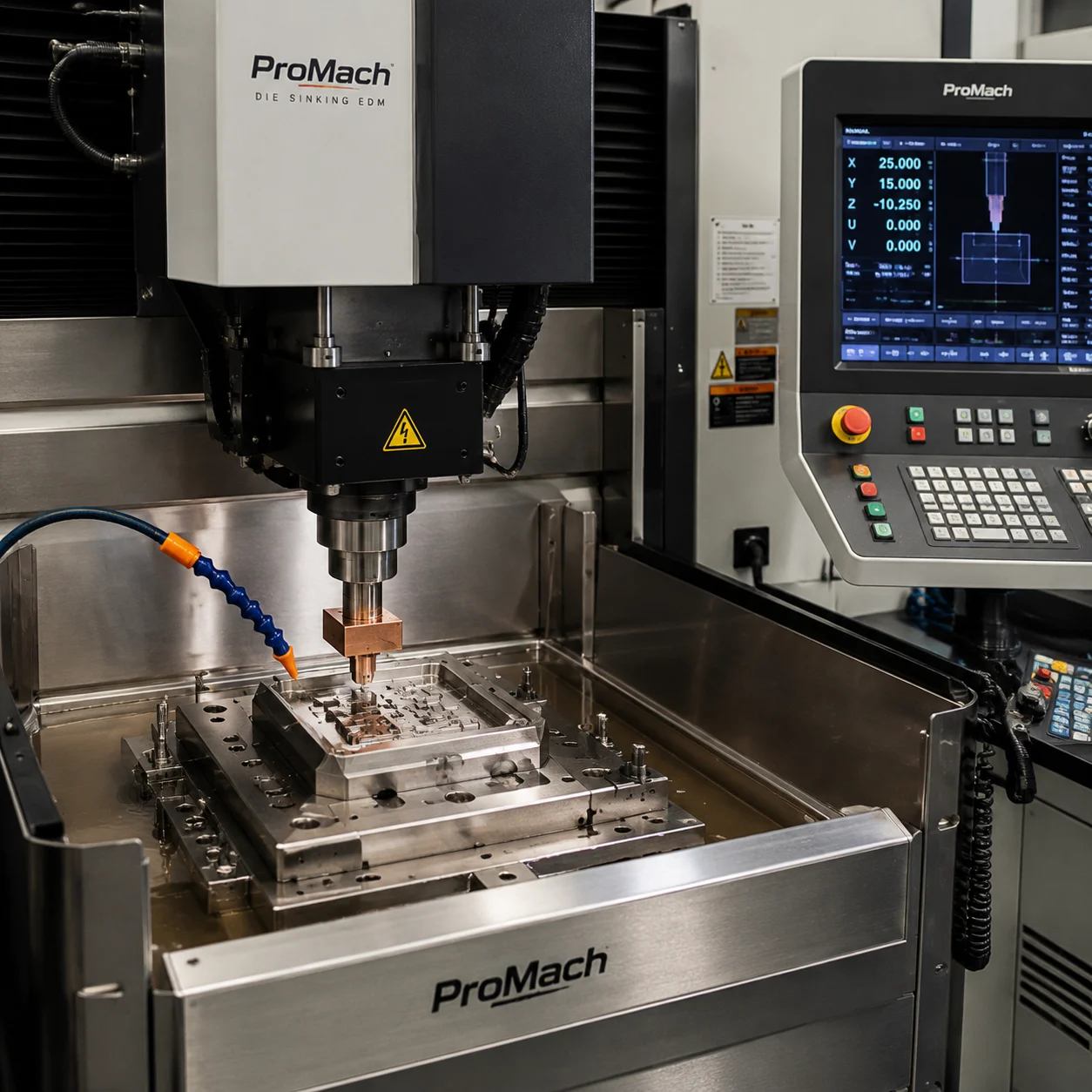
Rigid Quality Control & Traceability for Complex EDM Geometries
Process Control Protocols
- ◆ First Article Inspection (FAI): Complete validation of initial electrode discharge and setup accuracy before full batch release.
- ◆ In-Process Sampling & Auditing: Continuous monitors on die sinking EDM spark gaps, positioning, and wear tracking.
- ◆ Critical Feature Control: focus on micro-features, narrow slots, sharp internal corners, and deep ribs.
- ◆ Electrode & CNC Program Versioning: Strict digital management preventing drift across repeat or high-volume orders.
- ◆ End-to-End Batch Traceability: Complete linkage from raw material cast lots to final precision EDM machining parameters.
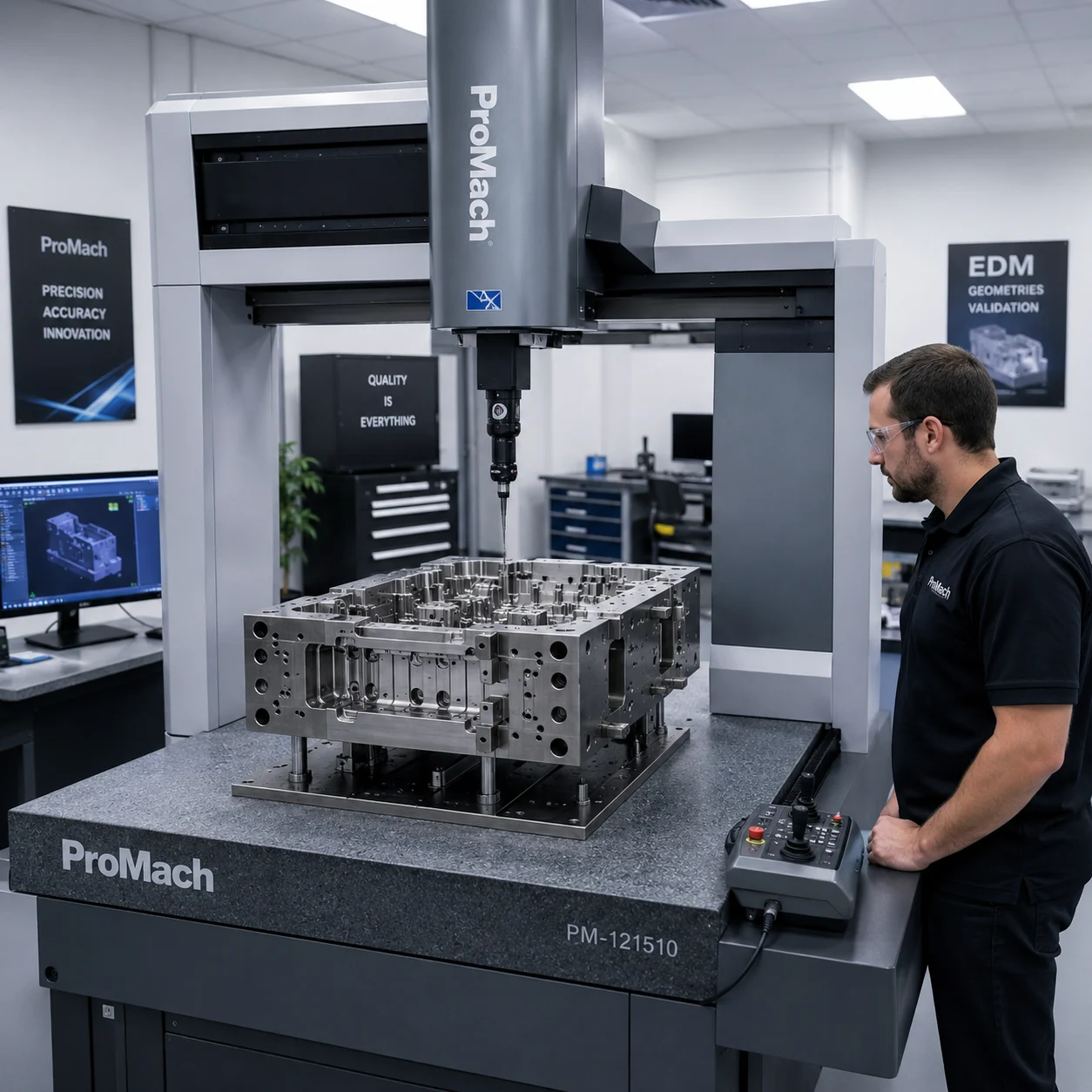
Verifiable Inspection Deliverables
Vastmaterial serves severe-service industries requiring complete transparency. By combining precision casting with secondary sinker EDM machining under a unified quality management system, we minimize cross-vendor errors and back every component with complete, traceable manufacturing history.
Choosing the Right EDM Process: Sinker EDM vs. Wire EDM vs. CNC Milling
| Machining Capability | Sinker EDM (Die Sinking) | Wire EDM (WEDM) | CNC Milling |
|---|---|---|---|
| Blind Cavities & 3D Shapes | Superior capability for deep blind cavities, internal molds, and complex 3D geometries. | Incapable of machining blind cavities; requires a through-hole for the wire guide. | Limited by tool reach, deflection, and chip evacuation in deep, enclosed pockets. |
| Contour Cutting & Through-Holes | Possible using specialized electrodes, but less efficient for straight, continuous through-cuts. | Industry standard for ultra-precise through-hole cuts, complex profiles, and slotting. | Highly efficient for standard open profiles, but restricted by tool diameter and length. |
| Corner Radius & Sharp Angles | Achieves virtually perfect zero-radius sharp internal corners and micro-scale features. | Limited strictly by the wire diameter (typically down to R0.1 mm or smaller). | Strictly limited by the cutting tool radius; leaves a round fillet in all internal corners. |
| Surface Finish & Recast Layer | Produces fine, isotropic matte textures; requires controlled parameters to manage the recast layer. | Achieves exceptional, mirror-like linear surface finishes with an extremely thin recast layer. | Produces directional tool marks; surface roughness depends heavily on feed rates and stepovers. |
| Primary Cost Drivers | Custom electrode design, electrode material (copper/graphite), and total spark time. | Machine cycle run-time, wire consumption rate, and part thickness/height. | Tool wear, machine hourly rates, and fixture complexity for multi-axis setups. |
| Typical Engineering Applications | Injection molds, deep ribs, blind keyways, hardened steel dies, and investment casting post-refinement. | Extrusion dies, stamping tool components, gear profiles, and thick plate blanking. | Roughing out large volumes, general mechanical housings, brackets, and structural components. |
Technical Selection Guidelines: When to Choose Which Process
- Choose Sinker EDM when your part requires deep, blind cavities, micro-features, sharp internal corners, or complex geometry in hardened steels or heat-resistant alloys that standard CNC tools cannot reach without interference.
- Choose Wire EDM when you need to slice through thick, hardened conductive blocks with tight tolerances, create narrow slots, or generate continuous, intricate two-dimensional profiles with minimal material waste.
- Choose CNC Milling as the primary roughing step or for fully accessible geometries where high material removal rates and production throughput take priority over extreme geometric complexity.
At Vastmaterial, we eliminate the guesswork. Our facility integrates precision investment casting, multi-axis CNC milling, Wire EDM, and advanced die sinking EDM under one roof. This allows our engineering team to combine processes seamlessly, routing your parts through the most cost-effective and accurate manufacturing sequence possible.
Sinker EDM Process FAQs: Cost, Lead Time, Surface Integrity & Engineering Changes
Explore the most common engineering and manufacturing questions related to precision sinker EDM machining, including electrode design, machining tolerances, recast layer control, production scheduling, and process optimization for complex industrial components.
Sinker EDM tooling and processing costs are primarily driven by the complexity of the custom electrode design, the total spark-erosion machine time, and your specified EDM tolerance or surface finish requirements. Hardened tool steels, stainless steels, and heat-resistant superalloys demand strategic parameter adjustments, impacting cycle times.
Additionally, deep ribs, blind cavities, and micro-features may necessitate a multi-electrode strategy (roughing, semi-finishing, and finishing stages) to compensate for volumetric electrode wear and preserve geometric fidelity.
Electrode Complexity
Intricate cavity geometries require advanced graphite or copper electrode manufacturing strategies.
Surface Finish Targets
Fine surface roughness specifications significantly increase finishing cycle durations.
Material Hardness
High-hardness alloys require calibrated EDM discharge parameters and slower erosion cycles.
Our engineering team analyzes your 3D CAD models and technical drawings to project lead times based on electrode fabrication complexity, pre-machining requirements (such as CNC Milling rough milling to remove bulk material from complex cavities), and the specified depth-to-width ratios of features like sharp corners or narrow slots.
By synchronizing our in-house investment precision casting, CNC machining, and precision EDM services under one roof, Vastmaterial optimizes the production workflow to mitigate lead-time risks and eliminate cross-vendor transit delays.
Typical Lead Time Evaluation Factors
- Electrode manufacturing quantity and complexity
- Required roughing and finishing EDM cycles
- Material preparation and pre-machining requirements
- Final inspection, CMM validation, and post-processing
The electrical discharge machining process inherently creates a thin recast layer (white layer) due to rapid melting and resolidification. To control and minimize this, we employ multi-stage EDM parameters, transitioning systematically from high-amperage roughing to low-amperage, high-frequency fine finishing cycles that restrict the recast depth.
For critical fatigue-sensitive aerospace or medical components, we incorporate secondary post-processing steps such as chemical etching, ultrasonic polishing, or glass bead blasting to completely remove the altered layer and guarantee material integrity.
Recast Layer Control
Fine discharge tuning and low-energy finishing pulses reduce thermal stress concentration and white-layer thickness.
Secondary Surface Treatment
Additional polishing and micro-finishing processes ensure superior fatigue resistance and metallurgical consistency.
Precision sinker EDM machining is widely utilized across aerospace, medical, energy, automotive, mold manufacturing, and industrial tooling sectors where conventional machining methods cannot achieve the required geometry or tolerance.
The process is especially valuable for hardened steel tooling, injection molds, turbine components, medical implants, micro-features, and intricate blind cavities requiring exceptional dimensional accuracy and surface consistency.