Introduction to 8640 Alloy Steel
What is 8640 Steel?
8640 steel is a versatile, medium-carbon triple-alloy steel engineered for components requiring high strength and tough wear resistance. By balancing carbon with key alloying elements, this material delivers exceptional core toughness and surface hardness after heat treatment. It bridges the gap between standard carbon steels and high-cost superalloys, making it a reliable workhorse for high-stress industrial applications.
Common Designations and Standards
8640 alloy steel is recognized globally under various industrial standards. These designations guarantee uniform chemical composition and quality parameters across international markets.
| Standard / Organization | Designation / Grade | Type |
|---|---|---|
| AISI / SAE | 8640 | Ni-Cr-Mo Alloy Steel |
| UNS | G86400 | Unified Numbering System |
| ASTM | ASTM A29 / A322 | Standard Specification for Alloy Bars |
| DIN (Germany) | 41CrNiMo2 (approx.) | European Structural Alloy |
Key Benefits and Advantages
Selecting 8640 alloy steel provides distinct engineering advantages for precision manufacturing and heavy-duty operation:
- Excellent Hardenability: Responds exceptionally well to quenching and tempering, achieving deep hardness penetration.
- High Fatigue Strength: Resists structural fatigue and fracturing under cyclic loading conditions.
- Superior Wear Resistance: The medium carbon content ensures high surface durability after hardening.
- Balanced Machinability: Offers better machining characteristics in the annealed state compared to higher-carbon alloy alternatives.
- Cost-Effective Toughness: Maximizes performance by utilizing optimized amounts of nickel, chromium, and molybdenum.
Chemical Composition of 8640 Steel
Carbon and Alloying Elements
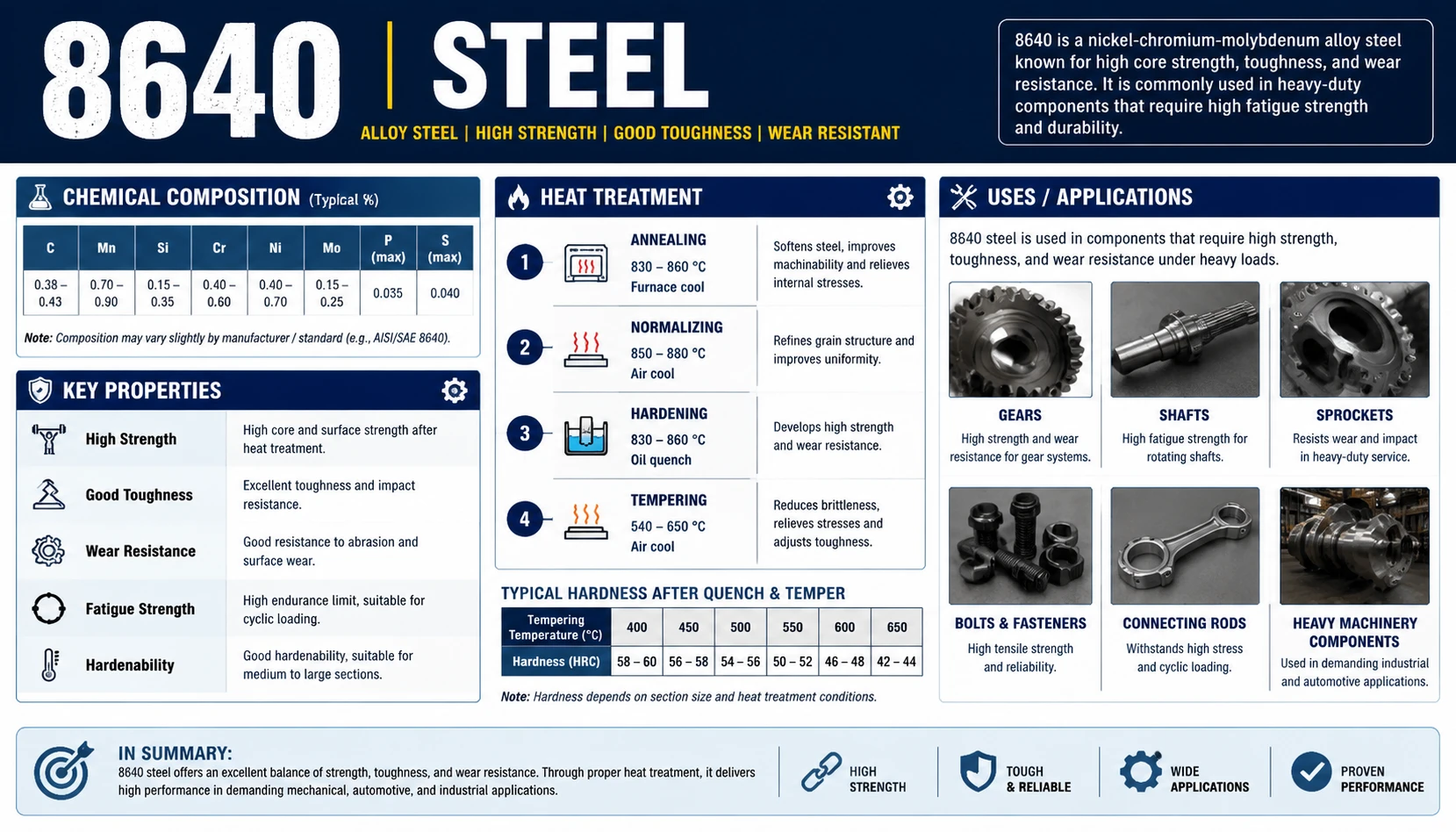
As a medium carbon alloy steel, the recipe for 8640 steel is carefully engineered to balance strength and toughness. The carbon content dictates its core hardness capability, while a precise mix of manganese, silicon, and triple-alloying elements elevates its performance far beyond standard carbon steels. This specific chemistry makes it an ideal candidate for heavy-duty equipment manufacturing components that demand reliable depth of hardening during heat treatment.
Role of Chromium, Nickel, and Molybdenum
The standout performance of 8640 alloy steel comes down to its triple-alloying technology. Each element plays a distinct, critical role:
- Nickel (Ni): Boosts overall toughness and impact resistance, ensuring the steel performs reliably under shock loads.
- Chromium (Cr): Increases hardenability and enhances resistance to wear and abrasion.
- Molybdenum (Mo): Works in tandem with chromium to maintain high strength while preventing embrittlement during tempering.
Standard Composition Limits
The chemical composition of 8640 steel is strictly controlled to guarantee predictable performance across global manufacturing supply chains.
| Element | Weight Percentage (%) |
|---|---|
| Carbon (C) | 0.38 - 0.43 |
| Manganese (Mn) | 0.75 - 1.00 |
| Chromium (Cr) | 0.40 - 0.60 |
| Nickel (Ni) | 0.40 - 0.70 |
| Molybdenum (Mo) | 0.15 - 0.25 |
| Silicon (Si) | 0.15 - 0.35 |
| Phosphorus (P) | ≤ 0.035 |
| Sulfur (S) | ≤ 0.040 |
Mechanical and Physical Properties of 8640 Steel
Understanding the mechanical and physical properties of 8640 steel is essential for choosing the right material for high-stress applications. As a medium carbon alloy steel, its balanced formulation delivers excellent strength, toughness, and wear resistance after standard heat treatments.
Tensile and Yield Strength
In its typical quenched and tempered condition, 8640 alloy steel exhibits impressive load-bearing capabilities.
- Yield Strength: Typically ranges from 700 to 900 MPa, allowing components to withstand high loads without permanent deformation.
- Tensile Strength: Generally sits between 850 and 1050 MPa, providing the necessary resistance against structural pulling and breaking forces under extreme tension.
Hardness and Ductility
The addition of nickel, chromium, and molybdenum allows 8640 steel to achieve a uniform hardness that protects against surface wear while keeping the core tough.
- Hardness: Usually ranges from 25 to 35 HRC (Rockwell C) in a normalized or annealed state, but can be hardened well above 50 HRC via direct oil quenching for heavy-duty wear applications.
- Ductility: Despite its high hardness capacity, it maintains an elongation rate of 15% to 20% and an excellent reduction of area, ensuring components bend or flex under extreme shock rather than fracturing abruptly.
Thermal and Electrical Properties
The physical properties of this grade ensure stable performance in environments subject to friction and temperature fluctuations.
| Property | Typical Value |
|---|---|
| Density | 7.85 g/cm³ |
| Thermal Conductivity | ~42.6 W/m·K |
| Specific Heat Capacity | 477 J/kg·K |
| Electrical Resistivity | 0.22 µΩ·m |
These thermal metrics mean the material manages heat dissipation efficiently during high-speed operations, reducing the risk of thermal fatigue in moving mechanical parts.
The Manufacturing and Heat Treatment Process
Melting and Casting Processes
Production of 8640 alloy steel begins with precise melting, typically utilizing electric arc furnaces (EAF) or basic oxygen furnaces. During this stage, tight control over the chemical composition ensures the exact balance of carbon, nickel, chromium, and molybdenum. As professional precision casting service providers, we monitor this molten stage rigorously to prevent impurities, ensuring the steel exhibits uniform structural integrity before it is cast into ingots or continuously cast into billets.
Hot Working and Cold Drawing
Once cast, the billets undergo hot working at high temperatures to refine the grain structure and shape the steel into rough forms. For applications requiring tighter dimensional tolerances and a smoother surface finish, the steel undergoes cold drawing. This process is performed below the recrystallization temperature, significantly enhancing the yield strength and hardness of the material. This makes it ideal for precision-machined components used across heavy industries, including high-stress parts found in gas turbine systems and power generation equipment.
Annealing, Quenching, and Tempering
Heat treatment is where 8640 steel achieves its optimal balance of toughness and strength. The process follows a strict sequence:
- Annealing: Heated to approximately 840°C–870°C and slowly cooled in the furnace to improve machinability and relieve internal stresses.
- Quenching: Heated above the critical temperature to around 815°C–845°C, then rapidly cooled in oil to form a hard, martensitic structure.
- Tempering: Reheated to a specific temperature between 400°C and 650°C, depending on the target mechanical properties. This final step adjusts the hardness and restores necessary ductility.
| Heat Treatment Stage | Temperature Range | Cooling Medium | Primary Objective |
|---|---|---|---|
| Annealing | 840°C – 870°C | Furnace Cooling | Soften material, improve machinability |
| Quenching | 815°C – 845°C | Oil | Maximize hardness and strength |
| Tempering | 400°C – 650°C | Air | Balance hardness with core toughness |
Common Supply Forms and Specifications
As leading providers of high-precision custom casting services, we stock and supply 8640 alloy steel in multiple industrial forms to match your exact manufacturing setups. Whether you require raw material for heavy forging or precision stock for immediate machining, we deliver this medium-carbon alloy to precise dimensional tolerances.
8640 Hot Rolled SBQ Bar
Our 8640 Hot Rolled SBQ (Special Bar Quality) bars are engineered for demanding structural and mechanical applications. These bars feature an excellent surface finish and uniform grain structure, making them the ideal choice for subsequent forging, heat treating, or machining.
- Primary Uses: Forging stock, heavy-duty shafts, and structural blanks.
- Surface Condition: Black hot rolled, scaled, or pickled upon request.
Cold Drawn Round Bars
For high-speed automated production, we offer 8640 cold drawn round bars. Cold drawing improves the mechanical properties, yields a smooth scale-free finish, and delivers tight dimensional accuracy that reduces setup times on CNC equipment.
- Key Benefits: Superior machinability, enhanced tensile strength, and straightness.
- Application: High-strength fasteners, gears, and turned components.
Available Shapes and Size Ranges
We maintain a robust inventory of 8640 steel to accommodate global manufacturing standards. Custom sizes and specific cut-to-length requirements can be accommodated through our processing facilities.
| Supply Form | Standard Size Range (Diameter / Thickness) | Dimensional Tolerance |
|---|---|---|
| Hot Rolled Round Bars | 20 mm – 300 mm (0.75" – 12") | ASTM A29 / Commercial |
| Cold Drawn Round Bars | 10 mm – 100 mm (0.375" – 4") | h9, h10, h11 |
| Square & Flat Bars | Available upon request | Custom Spec |
| Custom Forgings | Based on technical drawings | Per Specification |
Industrial Applications of 8640 Steel
Automotive and Mechanical Components
In the automotive and machinery sectors, 8640 steel is a go-to choice for manufacturing parts that face constant stress and friction. Thanks to its balanced alloy blend, this medium carbon steel delivers excellent fatigue resistance and toughness. We regularly utilize this grade to produce critical components that keep vehicles and machinery running smoothly.
- Crankshafts and Camshafts: High-endurance parts requiring excellent wear resistance.
- Axles and Steering Knuckles: Components that demand high torsional strength to handle heavy operational loads.
- Connecting Rods: Hard-working parts requiring a perfect balance of durability and weight.
For specialized or custom complex machinery components, manufacturers often pair these robust alloy bars with advanced investment casting steel alloy techniques to achieve precise net-shape designs without sacrificing material integrity.
High-Strength Fasteners and Gears
When it comes to power transmission and heavy-duty fastening, standard carbon steel simply won't cut it. 8640 alloy steel provides the deep hardenability needed to ensure that gears and fasteners don't strip, shear, or deform under extreme pressure.
- Heavy-Duty Gears: Spur gears, bevel gears, and pinions that require a hard outer case and a tough, shock-absorbing core.
- High-Tensile Bolts and Studs: Industrial fasteners rated for high-stress clamping applications in engines and heavy machinery.
- Splined Shafts: Power transmission shafts that experience sudden torque spikes.
Structural and Heavy Engineering Uses
In heavy engineering, equipment failure is not an option. We rely on 8640 steel for structural components that must endure brutal environmental conditions and massive physical loads. Its reliable response to heat treatment makes it highly adaptable for large-scale engineering projects.
- Hydraulic Ram Shafts: Used in construction equipment like excavators and cranes where bending resistance is vital.
- Oil and Gas Drills: Tool joints and drive collars that operate under high downhole pressure.
- Rigging and Lifting Hooks: Heavy-duty structural forgings that demand absolute reliability against catastrophic brittle fractures.
Frequently Asked Questions About 8640 Steel
How Does 8640 Compare to Other Alloy Steels?
8640 steel is a triple-alloy medium carbon grade that strikes an excellent balance between strength, toughness, and wear resistance. When compared to standard carbon steels, the addition of chromium, nickel, and molybdenum gives 8640 much better hardenability and core strength after heat treatment.
- 8640 vs. 4140: While 4140 relies heavily on chromium and molybdenum for deep hardening, 8640 utilizes nickel to improve toughness, making it less prone to brittleness in high-impact environments.
- 8640 vs. 8620: 8620 is a low-carbon carburizing steel meant for surface hardening. In contrast, 8640 has a higher carbon content (around 0.40%), allowing it to achieve high through-hardness without requiring carburization.
For projects requiring alternative high-performance metals with excellent wear profiles, checking out specialized options like https://haoyumaterial.com/416-stainless-steel-cnc-machined-parts/](https://haoyumaterial.com/416-stainless-steel-cnc-machined-parts/)">416 stainless steel CNC machined parts can help determine the best fit for your specific application.
What are the Machinability and Weldability Ratings?
In its annealed condition, 8640 alloy steel offers good machinability, rated at roughly 60-65% of the B1112 standard. It chips cleanly and responds well to standard cutting tools, though using carbide tooling is recommended once the material is hardened.
Welding 8640 steel requires care due to its medium carbon content, which increases the risk of cracking.
- Preheating: Always preheat the material to 400°F–600°F (204°C–316°C) before welding.
- Post-Weld Heat Treatment (PWHT): Sustained post-heating or a slow cool in ashes/lime is critical to prevent martensite formation and joint embrittlement.
How Do Heat Treatments Affect Its Properties?
Heat treatment completely transforms the mechanical capabilities of 8640 steel, allowing us to tailor its hardness and tensile strength to your exact engineering requirements.
| Heat Treatment Stage | Temperature Range | Resulting Properties & Character |
|---|---|---|
| Annealing | 1500°F - 1600°F (815°C - 870°C) | Maximizes ductility, lowers hardness, ensures optimal machinability. |
| Quenching (Oil) | 1525°F - 1575°F (830°C - 860°C) | Develops a fully martensitic structure, maximizing hardness and yield strength. |
| Tempering | 400°F - 1200°F (205°C - 650°C) | Restores toughness and impact resistance; higher tempering temperatures lower hardness but increase ductility. |