What Is the Tensile Strength of Bolts?
Definition and Importance in Engineering
The tensile strength of bolts is the maximum amount of axial pulling force a fastener can withstand before fracturing or breaking. In structural engineering, heavy machinery manufacturing, and high-stress applications, understanding this limit is critical. Selecting a bolt with the correct ultimate tensile strength ensures that joints remain secure under extreme operational loads, preventing catastrophic mechanical failures and ensuring global compliance with rigorous safety standards.
Tensile Strength vs. Yield Strength vs. Proof Load
When engineering reliable joints, it is essential to distinguish between the three primary mechanical load limits:
- Proof Load: The maximum force a bolt can endure without causing any permanent, plastic deformation. The fastener will return to its original shape once the load is released.
- Yield Strength: The point at which the bolt material begins to deform permanently. Loading a bolt past its yield strength means it will remain stretched even after the force is removed.
- Ultimate Tensile Strength: The absolute maximum tension or pulling force the bolt can handle before completely snapping apart.
| Strength Metric | Material Behavior Under Load | Engineering Significance |
|---|---|---|
| Proof Load | Safe zone; 100% elastic recovery | Design limit for tight, repeatable clamp load |
| Yield Strength | Permanent stretching begins | Structural compromise; bolt must be replaced |
| Tensile Strength | Complete material fracture | Maximum structural failure threshold |
Key Tensile Strength Terms for Bolts
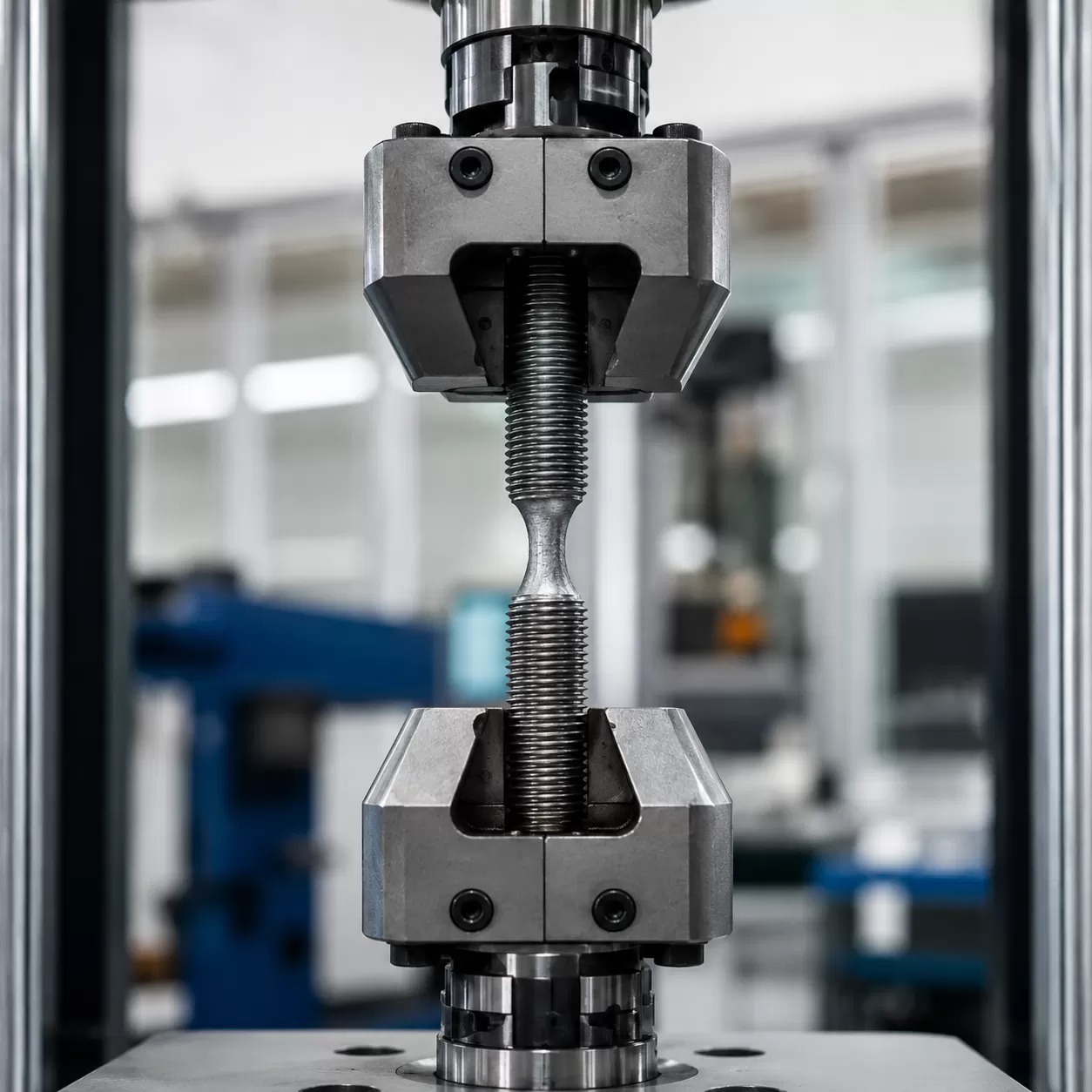
To truly master fastener selection and avoid critical joint failures, you need to speak the language of engineering. When evaluating the tensile strength of bolts, a few non-negotiable technical terms define how a fastener handles mechanical stress under an axial pulling force.
- Ultimate Tensile Strength (UTS): This is the absolute maximum load a bolt can withstand before breaking or fracturing. If your joint exceeds this limit, catastrophic failure is guaranteed.
- Yield Strength: This marks the boundary of permanent damage. Up to this point, a bolt behaves like a rubber band—stretch it, and it snaps back to its original shape. Once you surpass the yield strength, the bolt deforms permanently and will never tighten correctly again.
- Proof Load: Consider this the safe operating limit. It is the maximum allowable tensile force that a bolt can support without causing any permanent deformation. It typically sits right around 85% to 90% of the yield strength.
- Fastener Grade / Property Class: The grading system stamped on a bolt head that indicates its strength capabilities. Higher numbers or more radial lines dictate superior load capacities.
- Clamp Load: The downward force created when you torque a bolt to its proper specification. This pressure holds the two mating surfaces together, preventing shifting or separation under heavy vibration.
Understanding these metrics is vital, especially when dealing with advanced applications like high-performance alloys. For instance, components utilizing a specialized titanium alloy offer an exceptional strength-to-weight ratio, allowing for massive tensile resilience without adding unnecessary bulk to your assembly.
How Is Bolt Tensile Strength Measured and Determined?
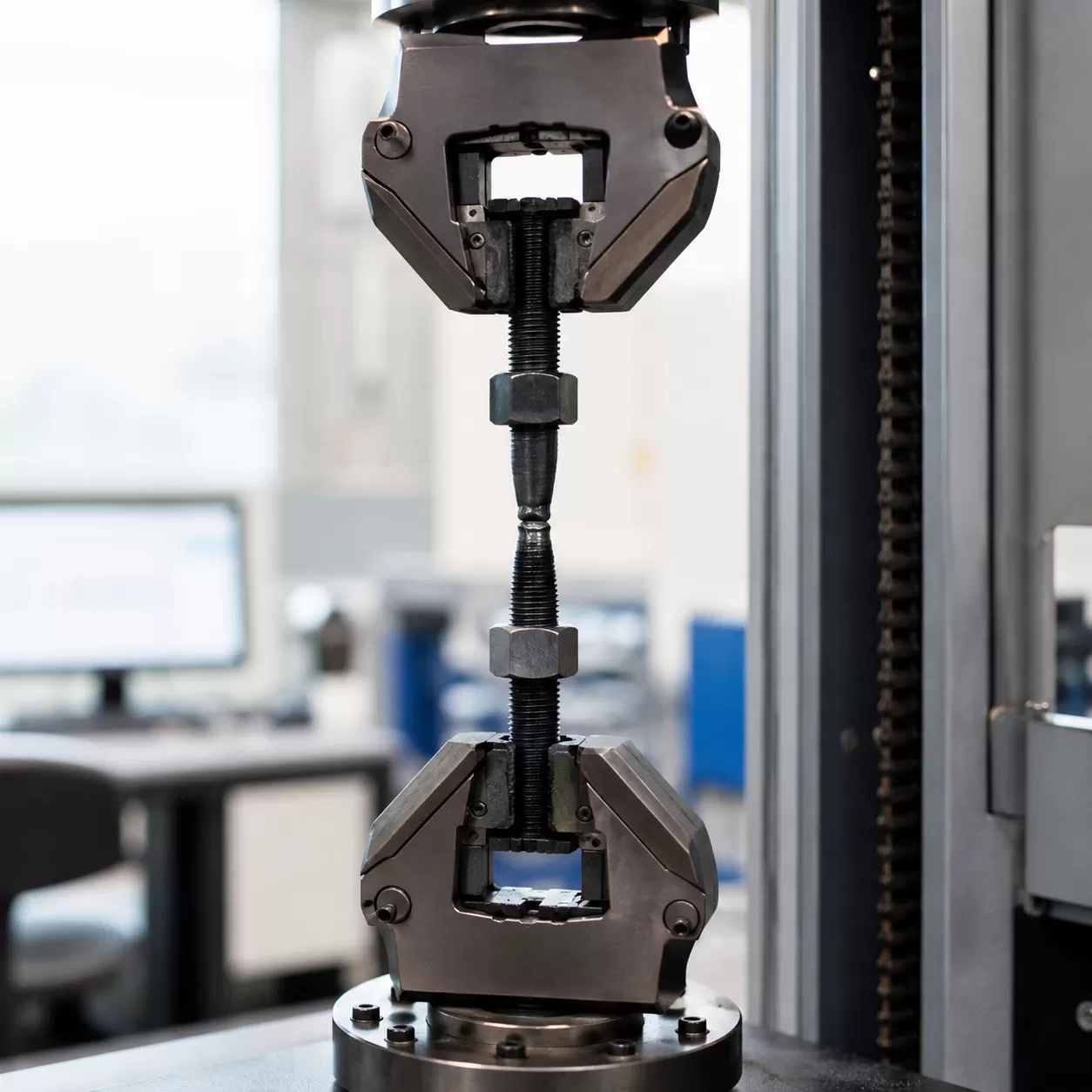
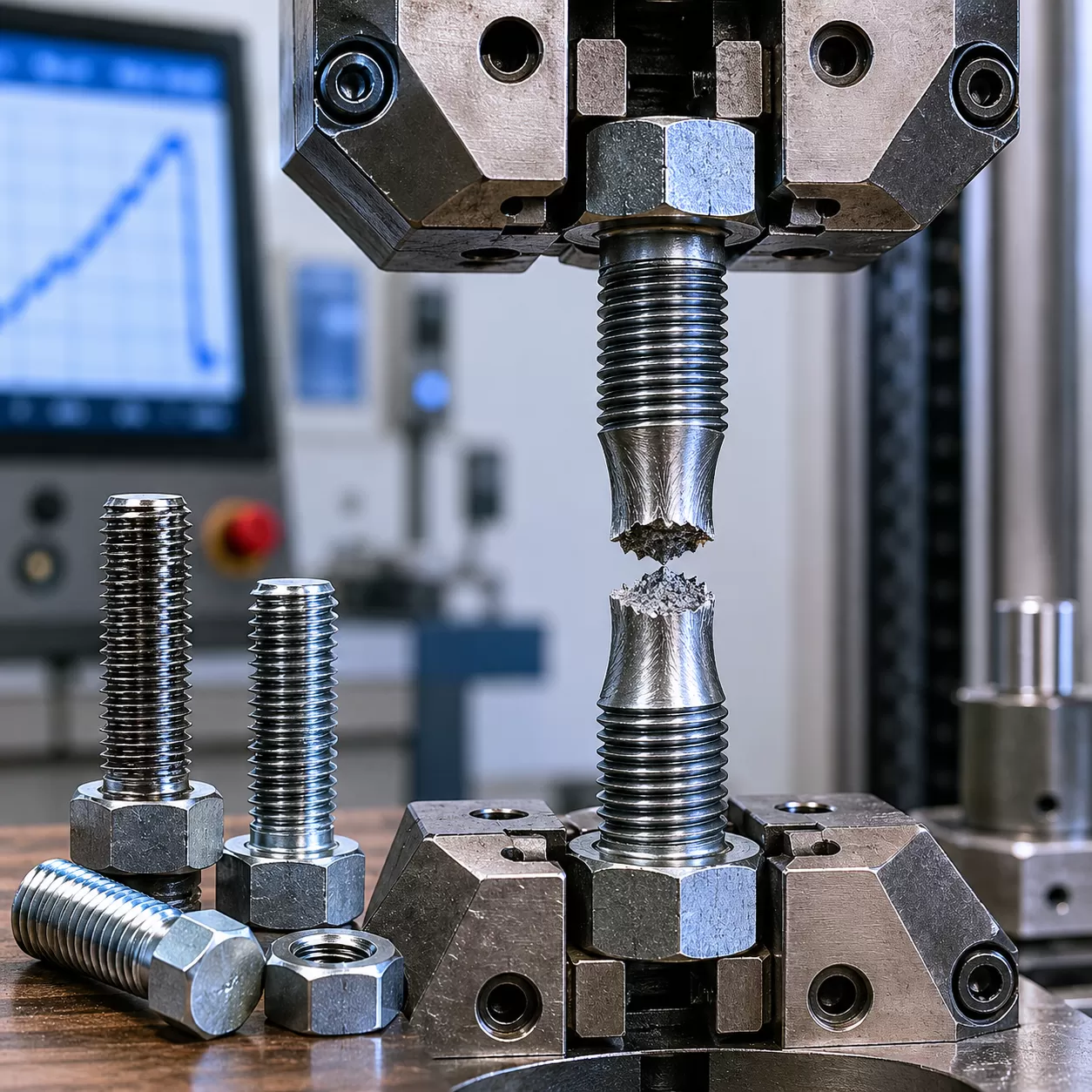
To guarantee safety in heavy-duty applications, we rely on rigorous testing to determine exactly when a fastener will give way. Understanding the tensile strength of bolts isn't about guesswork; it involves pulling the metal to its absolute limit to see how it performs under extreme stress.
Standard Testing Methods and the Wedge Tensile Test
The most common way we verify a bolt's integrity is through axial tension testing. However, the wedge tensile test is the gold standard for finished fasteners. In this setup, a wedge is placed under the bolt head to create a specific angle of misalignment while the machine applies an axial pulling force. This forces the bolt to handle both tension and bending simultaneously, simulating real-world "worst-case" scenarios where surfaces might not be perfectly flat.
Calculating Tensile Strength and Clamp Load
Determining the capacity of a fastener requires precise math. We calculate the ultimate tensile strength by dividing the maximum load the bolt carries during the test by its stress area.
- Tensile Stress Area: This is the cross-sectional area of the threaded section, which is always smaller than the solid shank.
- Clamp Load: This is the "squeeze" force created when you tighten a bolt. It is typically set at 75% of the proof load to ensure the bolt stays in its elastic range.
- Yield Strength: The point where the bolt begins to permanently stretch and will not return to its original shape.
For specialized projects requiring custom hardware, we often look toward alloy casting foundry techniques to ensure the base materials meet these strict mechanical requirements before the bolts are even machined. Using high-quality cast aluminum mold plates in the production phase also ensures that the components being bolted together can handle the high clamping forces required.
| Term | What it Measures |
|---|---|
| Tensile Strength | Maximum pull force before the bolt snaps. |
| Proof Load | The limit of force a bolt can take without permanent deformation. |
| Clamp Load | The tension created to hold two parts together securely. |
Understanding Bolt Strength Grades and Standards
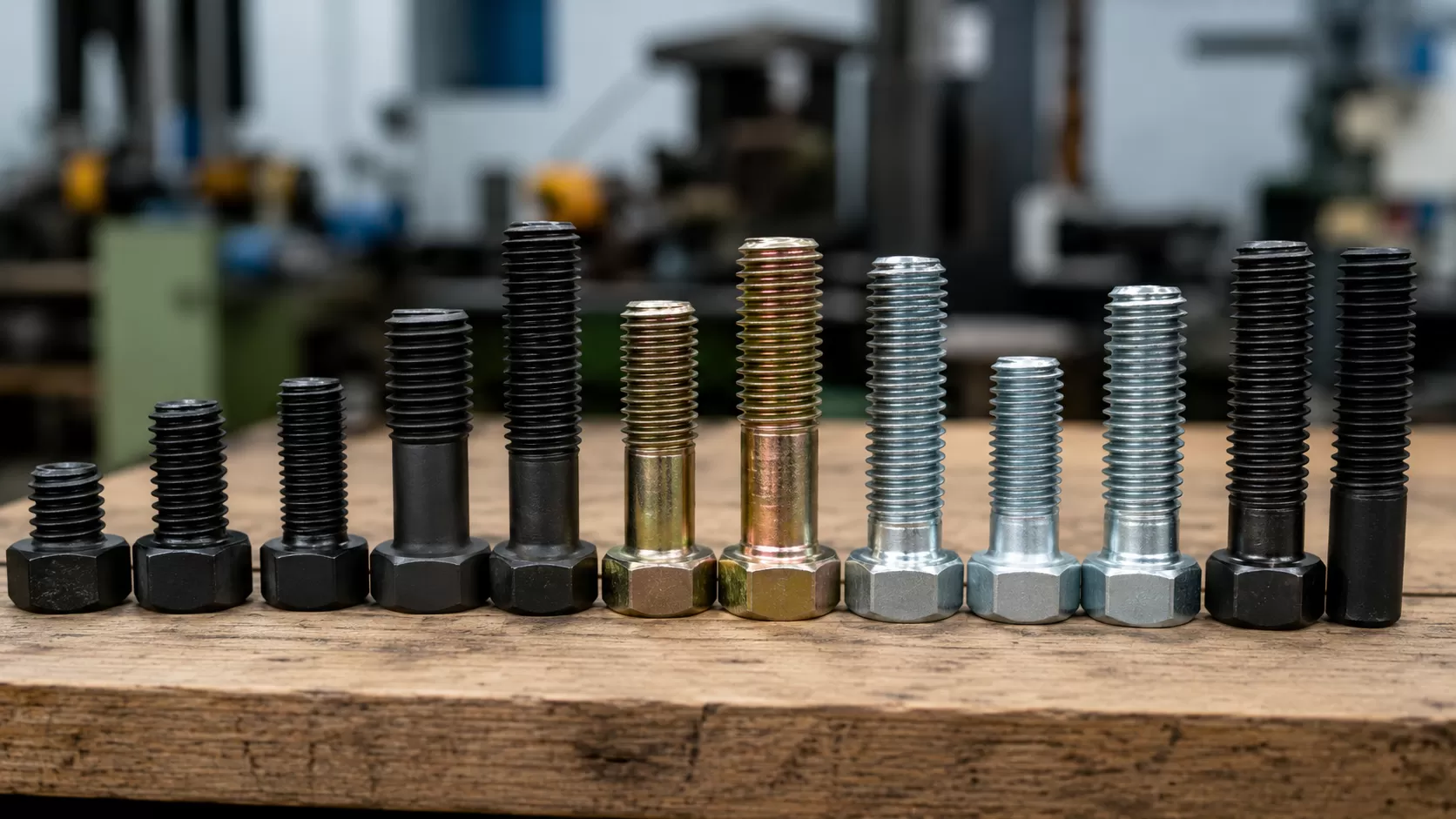
When we talk about the tensile strength of bolts, we aren't just guessing. We rely on strict international standards that dictate exactly how much stress a fastener can handle before it snaps or deforms. Whether you are sourcing parts for heavy machinery or critical infrastructure, knowing your grades is the only way to ensure safety and performance.
Imperial and US Bolts (SAE and ASTM Grades)
In the US and regions using imperial measurements, we primarily look at SAE (Society of Automotive Engineers) and ASTM (American Society for Testing and Materials) standards.
- SAE J429: This is the go-to for automotive and general engineering.
- Grade 2: Low carbon steel, standard strength.
- Grade 5: Medium carbon steel, quenched and tempered for higher ultimate tensile strength.
- Grade 8: Medium carbon alloy steel, providing the highest strength for heavy-duty applications.
- ASTM A325 & A490: These are the heavy hitters for structural steel joints, often used in bridges and buildings where reliability is non-negotiable.
Metric Bolts (ISO Property Classes)
For the global market, ISO property classes are the standard. These are identified by two numbers separated by a dot (e.g., 8.8, 10.9, 12.9).
- The first number: Multiplying this by 100 gives you the ultimate tensile strength in MPa.
- The second number: Represents the ratio of yield strength to tensile strength.
- Common Classes:
- Class 8.8: Known as "structural grade," widely used in engine and equipment assembly.
- Class 10.9: High-strength fasteners for high-stress environments.
- Class 12.9: The strongest metric grade, typically used in precision tools and high-performance racing.
Grade Markings and Identifications on Bolt Heads
You don't need a lab to identify a bolt; you just need to look at the head. Manufacturers use specific stamps to communicate the fastener grade instantly.
| Bolt Type | Marking Style | What it tells you |
|---|---|---|
| SAE (Imperial) | Radial lines | Add 2 to the number of lines to get the Grade (e.g., 3 lines = Grade 5). |
| Metric (ISO) | Numerical digits | Clearly stamped with "8.8", "10.9", etc. |
| Stainless Steel | Letters/Numbers | Often marked as A2 or A4 to signify corrosion resistance levels. |
For specialized applications like high-pressure environments, choosing the right material is just as vital as the grade. We offer high-quality brass casting service custom OEM precision parts to ensure your assemblies meet both strength and environmental requirements. Identifying these markings correctly prevents catastrophic failures caused by under-speccing a joint.
Bolt Tensile Strength Comparison Charts
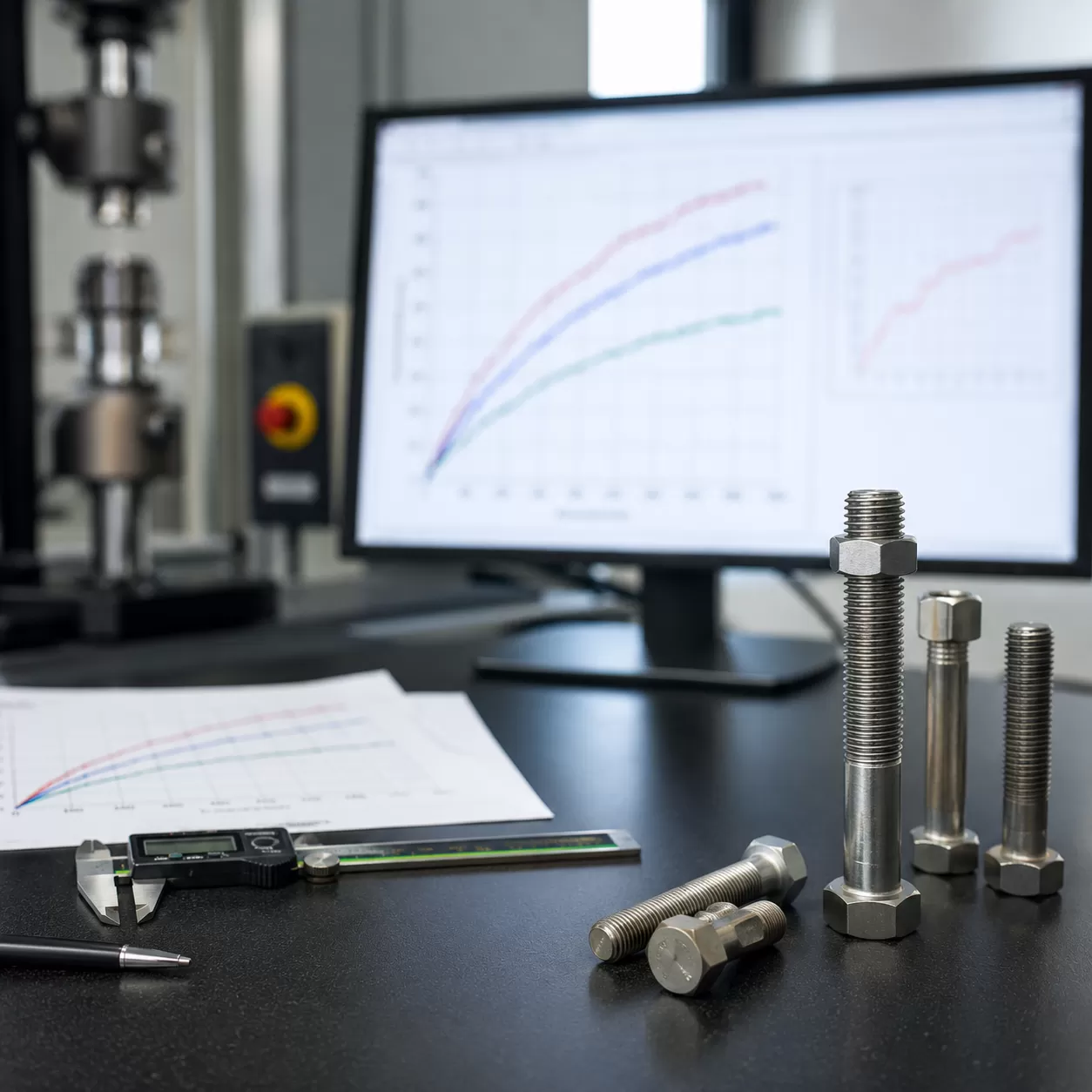
When selecting fasteners for high-stress applications, having quick access to accurate strength data is critical. Below are the comprehensive reference charts comparing the tensile strength of bolts across both imperial and metric systems to help you choose the right grade for your project.
Strength Chart for US Coarse and Fine Thread Bolts
For imperial fasteners, the Society of Automotive Engineers (SAE) and the American Society for Testing and Materials (ASTM) set the standards. These bolts are graded by lines on the bolt head. Higher grade numbers indicate a higher ultimate tensile strength and yield strength.
| Fastener Grade | Size Range (Inches) | Proof Load (PSI) | Yield Strength (PSI) | Minimum Tensile Strength (PSI) |
|---|---|---|---|---|
| SAE Grade 2 | 1/4" to 3/4" | 55,000 | 57,000 | 74,000 |
| SAE Grade 5 | 1/4" to 1" | 85,000 | 92,000 | 120,000 |
| SAE Grade 8 | 1/4" to 1-1/2" | 120,000 | 130,000 | 150,000 |
| ASTM A325 | 1/2" to 1-1/2" | 85,000 | 92,000 | 120,000 |
| ASTM A490 | 1/2" to 1-1/2" | 120,000 | 130,000 | 150,000 |
Strength Chart for Metric Fasteners
Metric bolts use a property class numbering system marked on the head (such as 8.8 or 10.9). The first number represents one-hundredth of the nominal tensile strength in Megapascals (MPa). The second number represents the ratio of yield strength to tensile strength. For demanding industrial setups, we frequently manufacture custom fasteners from durable alloy steel to meet these exact metric specifications.
| Property Class | Size Range | Proof Load (MPa) | Yield Strength (MPa) | Tensile Strength (MPa) |
|---|---|---|---|---|
| Class 4.6 | M5 to M36 | 225 | 240 | 400 |
| Class 8.8 | M16 and under | 580 | 640 | 800 |
| Class 10.9 | M16 and under | 830 | 940 | 1,040 |
| Class 12.9 | M1.6 to M36 | 970 | 1,100 | 1,220 |
International Grade and Property Class Comparisons
Matching domestic requirements with international standards is a common challenge in global sourcing. This quick-reference cross-reference table aligns US fastener grade standards with equivalent metric property classes based on their axial pulling force capabilities and overall performance under a clamp load.
- SAE Grade 2 roughly equates to Metric Class 4.6 or Class 5.8. These are ideal for general, low-stress assembly work.
- SAE Grade 5 aligns directly with Metric Class 8.8. This is the standard "medium strength" automotive and structural engineering grade.
- SAE Grade 8 matches the performance of Metric Class 10.9. These are high-strength fasteners utilized in heavy machinery, aerospace, and high-stress industrial applications.
How to Choose the Right Bolt Strength Grade
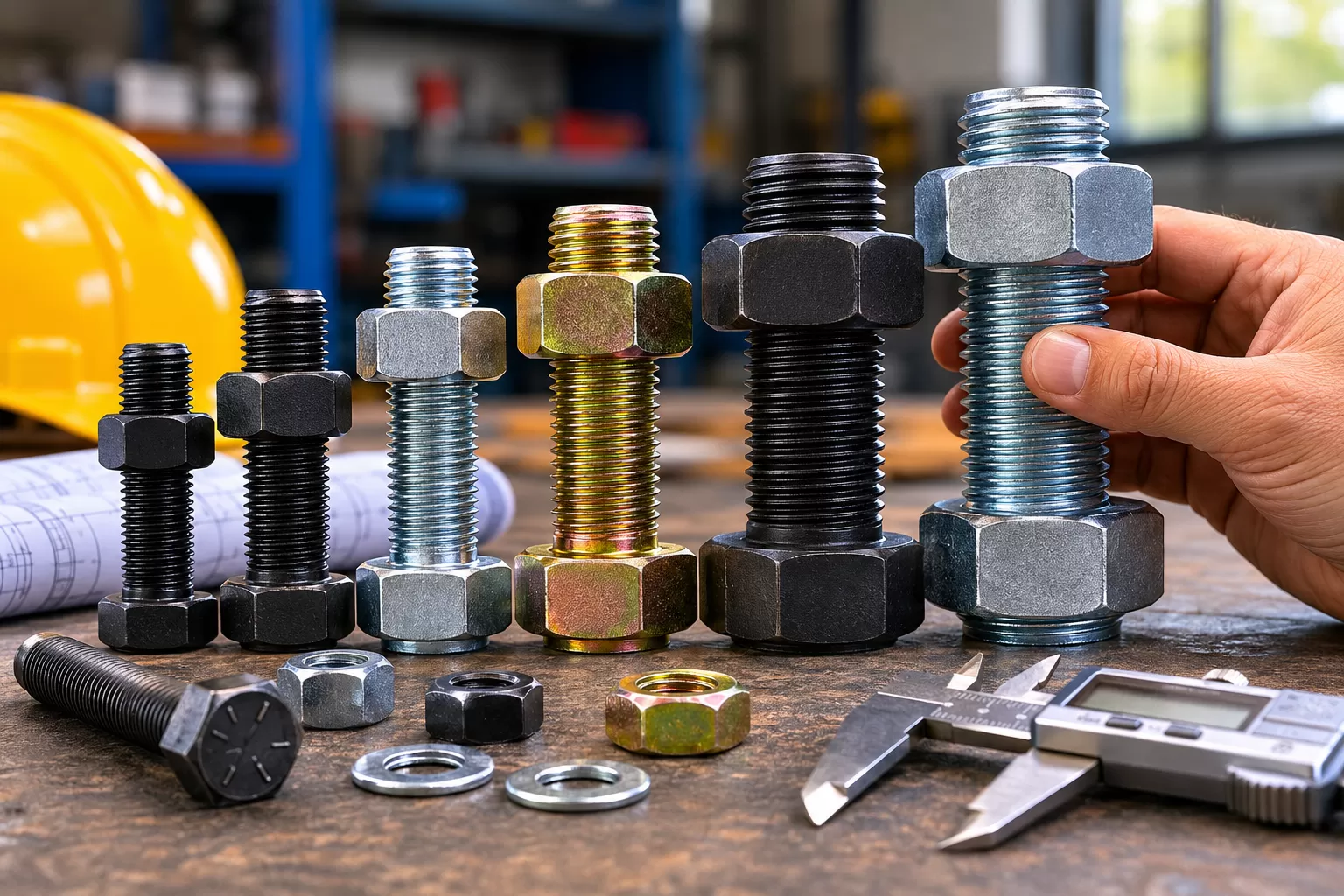
Picking the right tensile strength of bolts keeps your assembly secure and prevents catastrophic structural failures. Selecting the correct fastener grade requires balancing application needs, environmental conditions, and load calculations.
General Application and Use Case Selection Guidelines
Different industries demand different bolt strength grades. High-stress environments require heavy-duty fasteners, while light assembly can rely on standard grades.
- Low-Stress Applications: Household furniture, light electronics, and non-structural automotive trim typically use SAE Grade 2 or Metric Class 4.6/5.8.
- Medium-Duty Applications: General automotive repairs, manufacturing machinery, and brackets rely on SAE Grade 5 or Metric Class 8.8.
- High-Stress Applications: Structural steel framing, heavy earthmoving equipment, and suspension systems require SAE Grade 8 or Metric Class 10.9/12.9 to handle severe axial pulling force.
Material and Environmental Considerations
Environment dictates the bolt material just as much as mechanical load. Corrosive environments, extreme temperatures, and chemical exposure destroy standard carbon steel fasteners.
For high-corrosion or high-temperature environments, specialized alloys are essential. When standard steel grades fail to meet environmental demands, we utilize advanced alloys like 15-5 PH steel high-strength corrosion-resistant alloy to manufacture custom components that withstand both extreme mechanical stress and harsh elements.
| Material / Grade | Best Used For | Environmental Resistance |
|---|---|---|
| Standard Carbon Steel (Grade 2 / Class 5.8) | Indoor, dry environments | Low |
| Medium Carbon Alloy (Grade 5/8 / Class 8.8/10.9) | Automotive, heavy machinery | Moderate (Requires plating/coating) |
| Stainless Steel / High Alloys | Marine, chemical processing, outdoor | Excellent |
Load Requirements and Safety Factors
Engineers must calculate the precise ultimate tensile strength, yield strength, and proof load limits before selecting a fastener.
- Determine the Total Load: Calculate both static loads (constant weight) and dynamic loads (vibrations and moving parts).
- Apply the Safety Factor: Never design up to the exact limit of the bolt. Standard engineering practices apply a safety factor (typically 2:1 to 5:1) to ensure the clamp load remains secure under unexpected stress spikes.
- Preload Target: Ensure the installation torque matches the required preload without exceeding the bolt's yield point, preventing premature fatigue failure.
FAQs
What is the difference between bolt tensile strength and yield strength?
Tensile strength (specifically ultimate tensile strength) is the maximum axial pulling force a bolt can withstand before fracturing. Yield strength is the limit where the bolt begins to permanently stretch and deform, meaning it will not return to its original length once the load is removed.
Why is proof load important for heavy-duty fasteners?
Proof load represents the maximum safe force a bolt can handle without any permanent deformation. It is typically set at 85% to 90% of the yield strength. Testing for proof load ensures your low carbon steel bolts or high-strength fasteners perform reliably under specified tension without weakening.
How do I find the tensile strength of a metric bolt?
You can determine the strength by looking at the property class number stamped on the bolt head (e.g., 8.8, 10.9, or 12.12). Multiply the first number by 100 to get the nominal tensile strength in Megapascals (MPa). For instance, a 10.9 grade bolt has a tensile strength of roughly 1000 MPa.
What is a wedge tensile test?
The wedge tensile test is a standard quality control method used to evaluate both the tensile strength and the ductility of a bolt. By placing a wedge under the bolt head during an axial pulling force test, technicians expose the fastener to combined bending and tension loads to ensure it meets strict industry standards.