Overview
This 3 way valve body casting is produced by investment casting (or sand/shell routes for larger bodies) with CNC finish on flange ends, stem bores, and sealing faces. Programs cover T pattern housings in CF8 grade stainless for three way ball valve OEM builds used in mixing and diverting service.
What Is a 3 Way Valve Body Casting?
A 3 way valve body casting is the primary fluid control valve housing that houses three distinct flow ports within a single integrated unit. Unlike standard two-way valve bodies that simply stop or start flow, a three-way housing acts as a central hub to direct, combine, or split media between three separate pipelines. These housings are cast to endure demanding internal pressure, thermal cycles, and aggressive media.
Valve Body Highlights
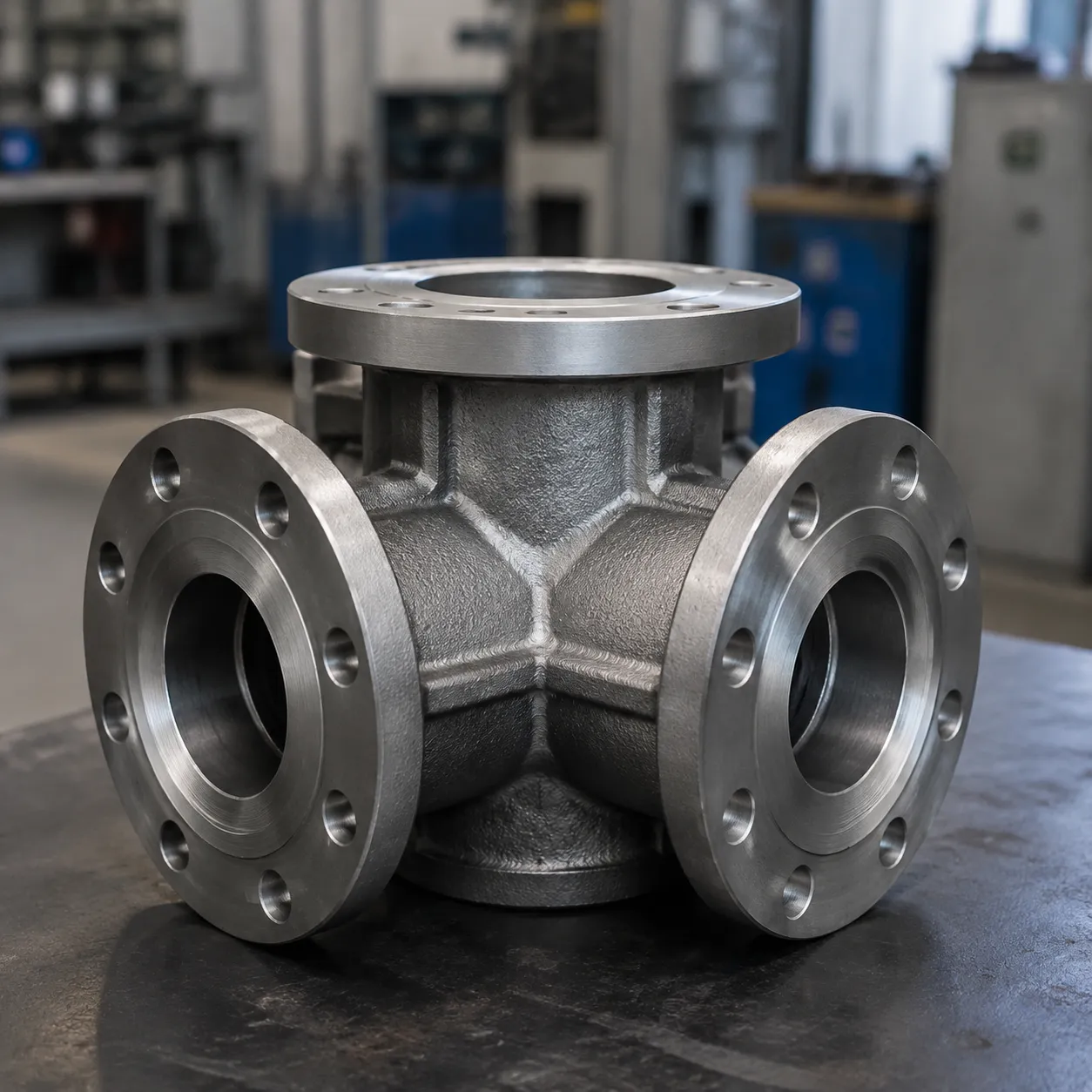
- T-Pattern Flange Layout: Hero samples show a T pattern body with one vertical port and two opposing horizontal ports, each closed by a thick circular flange.
- Machined Flange Ends: As-cast exterior with bright, finish-machined flange faces and full bolt circles ready for pipeline make-up.
- Mix / Divert Ready Cavities: Internal channels sized for three way ball valve or plug valve trim packages without dead-leg traps when investment-cast.
Understanding the 3 Way Valve Body Structure
The internal cavity of a three way ball valve or plug valve casting features three flow channels connecting to a central control chamber:
- Robust Pressure Envelope: Precision-cast wall thickness engineered to meet ASME safety margins under working pressure.
- Versatile Connection Ports: Cast with flange ends, threaded ports, or butt-weld connections for seamless line installation.
- Optimized Internal Channels: Smooth cast surfaces cut down on fluid turbulence and pressure loss.
T-Port vs L-Port Valve Body Casting Configurations
The functional capability of the casting depends on its internal port geometry. Two core configurations are manufactured:
| Configuration | Internal Geometry | Primary Function | Typical Applications |
|---|---|---|---|
| T-Port Valve Body (T pattern) | Inner passages form a "T" shape | Mixing two inputs into one, or diverting one input to two outlets simultaneously | Fluid blending, heat exchanger bypass loops |
| L-Port Valve Body Casting (L pattern) | Inner passages form a 90 degree "L" shape | Diverting flow from one inlet to one selected outlet at a time | Media switching between alternate storage tanks |
Key Function in Mixing and Diverting Fluid Flows
A mixing and diverting valve housing is designed specifically to manage multi-directional fluid behavior:
- Fluid Mixing: Combines two incoming fluid lines (such as hot and cold water) into a single blended outflow at a precise ratio.
- Flow Diverting: Directs a single incoming fluid stream to one of two downstream lines, ideal for bypass routes, filtration switching, or system relief.
Typical Program Specs (3 Way Valve Body Casting Parts)
| Parameter | Typical Range |
|---|---|
| Process | Silica sol investment casting; sand or shell mold for larger industrial bodies |
| Port patterns | T pattern and L pattern (T-port / L-port geometries) |
| Alloys | CF8 grade / CF8M grade (SS304/SS316 cast equivalents); cast iron / ductile iron; copper based alloys and lead free valves on request |
| Size window (investment) | Approx. 1/2" to 8" precision bodies; larger via sand/shell |
| End connections | Flange ends (machined faces + bolt circles), threaded, socket weld, butt weld |
| Supply scope | As-cast / semi-machined / finish-machined OEM Parts with NDT and MTR packages |
Common Casting Processes for 3 Way Valve Body Casting
Choosing the right casting method for a 3 way valve body casting directly impacts fluid dynamics, pressure ratings, and surface finish. Three core manufacturing processes cover typical engineering specifications.
Investment Casting (Lost Wax)
When flow control systems require zero dead zones and high internal precision, investment casting valve body production is the preferred route.
High Precision: Delivers tight dimensional tolerances and smooth internal flow channels.
Hygienic Performance: Eliminates internal crevices, making it ideal for sanitary, dairy, and chemical applications.
Minimal Machining: Produces near-net shapes that drastically reduce post-processing costs.
Sand Casting for Large Industrial Valve Bodies
For heavy-duty pipelines requiring massive sand cast valve body structures, sand casting remains the most cost-effective choice.
Scalability: Handles large nominal diameters and thick wall sections easily.
Material Flexibility: Adaptable to standard cast iron, ductile iron, and carbon steel alloys.
Shell Mold Casting and Permanent Mold Options
For production runs needing better surface finishes than sand casting but higher production speed, shell molding and permanent mold casting hit the sweet spot.
Consistent Quality: Provides reliable wall thickness control and superior grain structure.
Non-Ferrous Expertise: Permanent mold routes support precision aluminum and copper based alloys for specialized valve housing components, including lead free valves for potable-water programs.
Integrated Tooling: Paired with industrial precision casting and CNC machining capabilities, every T-port or L-port configuration can be held to drawing.
Valve Body Casting Process Comparison
| Casting Process | Primary Application | Surface Finish & Accuracy | Key Advantage |
|---|---|---|---|
| Investment Casting (Lost Wax) | Complex 3-way geometries, sanitary applications | High precision (Ra 3.2-6.3 um) | Near-net shape, zero dead zones |
| Sand Casting | Large industrial & high-pressure valves | Standard precision (Ra 12.5-25 um) | Low tooling cost for massive parts |
| Shell & Permanent Mold | Mid-to-high volume valve production | Medium-high precision (Ra 6.3-12.5 um) | Fast production cycles & tight wall tolerances |
Best Material Selection for 3 Way Valve Body Casting
Choosing the right alloy for a 3 way valve body casting directly dictates component lifespan, pressure ratings, and chemical compatibility. Custom valve housings follow metallurgical standards matched to the fluid control environment.
Stainless Steel (CF8 & CF8M) for Corrosion Resistance
Stainless steel remains the gold standard for hygienic, corrosive, and chemical processing applications.
- CF8 Grade: The cast equivalent of 304 stainless steel. Excellent for general corrosion resistance, water treatment, and food-grade fluid handling.
- CF8M Grade: The cast equivalent of 316 stainless steel. Formulated with molybdenum for superior resistance to pitting, chlorides, and aggressive industrial chemicals. A stainless steel CF8M valve casting ensures maximum durability in harsh marine and petro-chemical operations.
For related stainless OEM body programs beyond three-port layouts, see the sibling cast stainless steel valve body page.
Cast Iron and Ductile Iron for Standard Pressure Applications
For municipal, HVAC, and industrial heating lines requiring high mechanical strength without high material costs:
- Cast Iron: Cost-effective choice for low-pressure, static water and steam lines - including many industrial plug valve bodies.
- Ductile Iron Valve Casting: Features added magnesium to transform graphite into nodules, dramatically increasing tensile strength, ductility, and shock resistance under hydraulic surges.
Material trade-offs versus stainless programs are covered in the site guide on cast iron vs ductile iron valve body selection.
Copper Based Alloys, Lead Free Valves, and Special Alloy Steels
Non-ferrous and severe-service programs expand beyond stainless and iron:
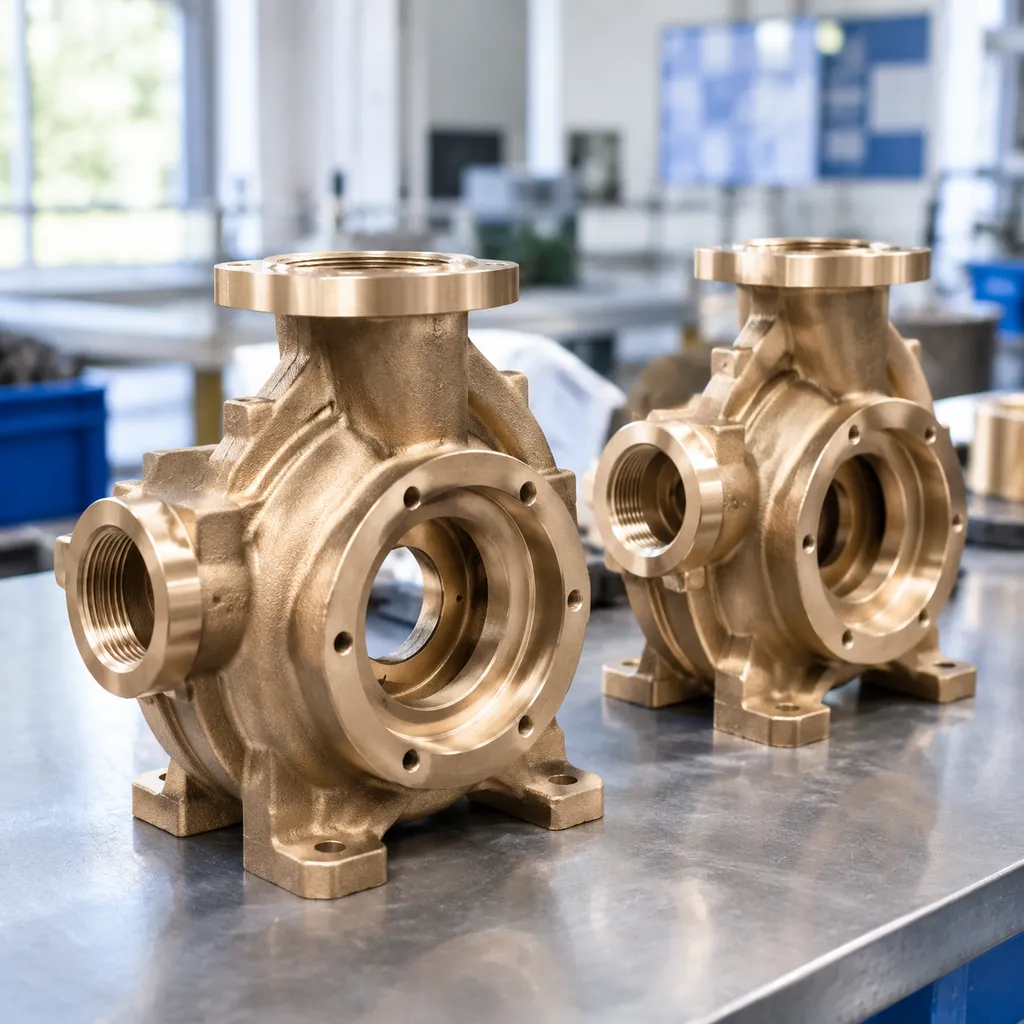
- Copper based alloys: Bronze and related copper alloys for corrosion-resistant valve body castings in water and specialty fluid service.
- Lead free valves: Lead-free copper-alloy body castings for potable-water and regulated drinking-water valve programs.
- High-temperature / chemical alloys: When operating conditions involve extreme heat, heavy friction, or highly concentrated acids, cobalt and other specialty alloys deliver wear, oxidation, and heat resistance for critical flow control housings.
Key Manufacturing Steps in 3 Way Valve Body Casting
Manufacturing a reliable 3 way valve body casting requires precise thermal management, rigid tooling, and strict dimensional control. A proven investment casting workflow keeps every valve housing free of internal structural defects under demanding pressure and flow.
1. Pattern Making and Precision Wax Mold Creation
Production begins with high-precision aluminum master tooling. Liquid wax is injected into the dies to create exact replicas of the valve body, including complex T-port and L-port internal flow passages. Individual wax patterns are then assembled onto a central runner to build a complete casting tree.
2. Ceramic Shell Building and Dewaxing Process
The wax tree is dipped repeatedly into liquid ceramic slurry and coated with fine refractory sand. After building a multi-layered ceramic shell of sufficient wall thickness, the assembly undergoes high-pressure steam autoclaving. This ceramic shell dewaxing process melts out the wax, leaving behind a clean, high-strength ceramic mold.
3. Controlled Metal Pouring and Grain Solidification
Selected alloys - such as stainless steel CF8/CF8M or ductile iron - melt in induction furnaces with strict chemistry monitoring. Pre-heated ceramic shells receive molten metal under controlled pour rates. Managing cooling rates during solidification ensures a dense grain structure while eliminating shrinkage voids.
4. Heat Treatment and CNC Precision Machining
Once cooled, the ceramic shell is knocked off, and individual valve bodies are separated from the tree. Heat treatment (such as solution annealing) optimizes material hardness and corrosion resistance. Finally, CNC machined valve body operations finish critical valve seats, stem bores, and flange ends to exact tolerances - matching the bright, flat flange faces shown on finish-machined samples.
| Production Step | Focus Area | Quality Output |
|---|---|---|
| Wax Injection | Tooling precision & assembly | Smooth internal flow channels |
| Shell Creation | Slurry dipping & drying | High-strength ceramic mold |
| Controlled Pouring | Temperature & alloy purity | Dense, void-free metal structure |
| CNC Machining | Tight-tolerance finishing | Perfect seal faces & flange alignment |
For a complete breakdown of production standards and manufacturing capabilities, see the precision metal casting guide for engineers and OEM buyers.
CNC Finish Options for 3 Way Valve Body Casting Flange Ends
Finish scope is quoted separately from the raw casting so buyers can order as-cast blanks or ready-to-assemble OEM Parts.
| Finish level | What is machined | Typical use |
|---|---|---|
| As-cast / unmachined | Gate pads cleaned; flanges left stock | Buyers with in-house CNC lines |
| Semi-machined | Flange faces rough-turned; bolt circles optional | Reduce stock for final fit-up |
| Finish-machined | Flange faces, bolt circles, stem bore, seat areas to drawing | Ready for assembly and hydrostatic test |
Quality Inspection and Defect Prevention in 3 Way Valve Body Casting
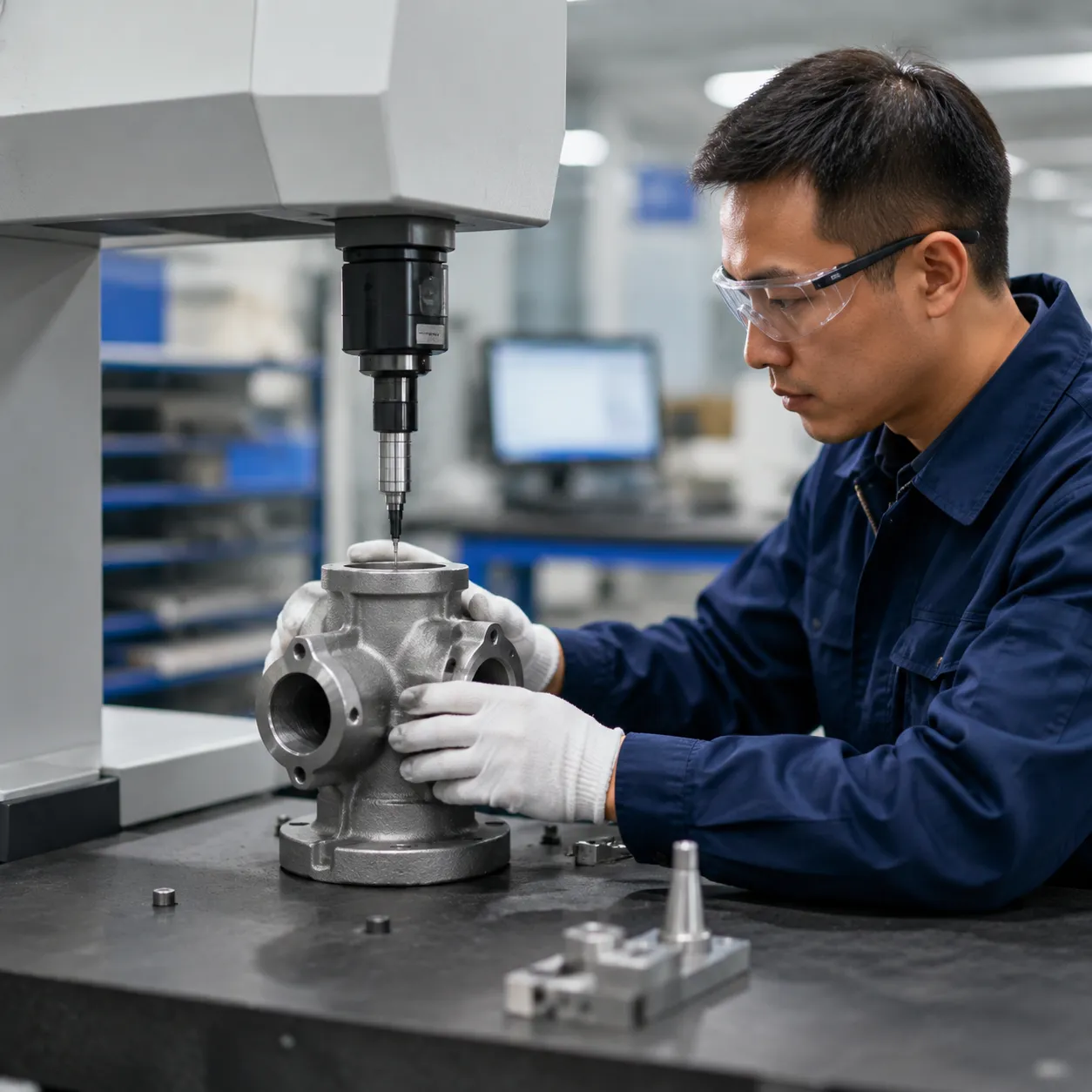
A single hidden defect in a 3 way valve body casting can cause severe leaks, pressure drops, or costly system downtime. Strict quality assurance protocols run from raw material melting to final machining to keep critical flow control free of structural flaws.
Pressure Testing Standards: API 598 and ASME B16.34
Every 3 way valve body casting is designed and verified against top global industry standards:
- ASME B16.34 Standards: Ensures minimum wall thickness, appropriate pressure-temperature ratings, and structural safety margins for valve bodies.
- API 598 Pressure Testing: Applies high-pressure hydrostatic shell tests and pneumatic seat tests to guarantee total leak-tight sealing under working pressures.
Non-Destructive Testing (NDT) for Porosity and Cracks
Internal defects like gas pockets or stress cracks can compromise valve life. Non-destructive testing (NDT) inspects valve housings without damaging the finished part. Testing and quality control procedures eliminate structural flaws before components reach the field.
| NDT Inspection Method | Defect Target | Key Benefit |
|---|---|---|
| Radiographic Testing (RT) | Internal shrinkage voids & gas porosity | Complete 3D internal structure visibility |
| Dye Penetrant Testing (PT) | Surface cracks, pinholes, & micro-seams | Rapid identification of surface-breaking defects |
| Ultrasonic Testing (UT) | Wall thickness variations & subsurface voids | Precise wall integrity verification |
Minimizing Common Casting Defects
Preventing defect formation starts in the mold design phase. Molten metal behavior is controlled to stop common issues before they happen:
- Shrinkage Minimization: Advanced mold flow simulation optimizes gating and riser design, ensuring a steady supply of molten metal as the valve body cools and solidifies.
- Slag Inclusions Prevention: High-purity ceramic foam filters strain out oxides and impurities during metal pouring.
- Gas Porosity Control: Precision vacuum-assisted pouring and proper ceramic shell venting remove trapped gases, keeping fluid flow paths smooth and clean.
Applications of 3 Way Valve Body Castings Across Industries
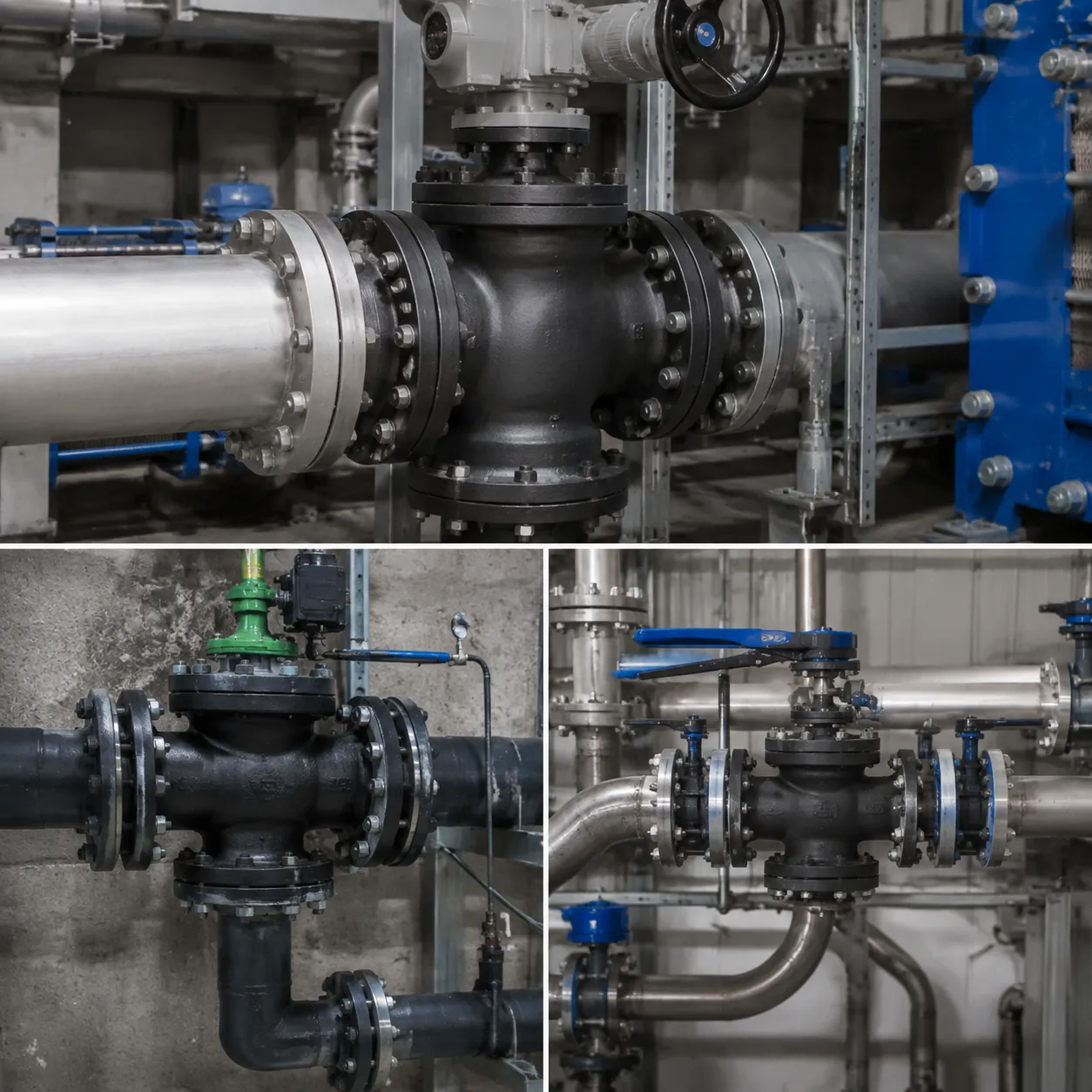
Every industry demands reliable flow regulation, and precision 3 way valve body casting solutions deliver exact control where standard two-way valves fall short. Custom castings serve key global sectors as follows:
Dairy and Hygienic Food Processing Flow Control
Sanitary processing requires zero bacteria traps and seamless cleaning routines.
Zero Dead Zones: High-precision dairy grade valve body casting units use polished, smooth interior surfaces to prevent residue buildup.
Corrosion Resistance: Utilizing stainless steel CF8M valve casting alloys allows housings to withstand aggressive chemical washdowns and automated Clean-in-Place (CIP) cycles.
Petroleum, Oil, and Chemical Processing
Heavy industrial media require rugged, leak-proof housings built for extreme pressure and thermal fluctuations.
Robust Flow Regulation: Heavy-duty mixing and diverting valve housing units manage aggressive chemicals, crude oil, and volatile gases safely.
Versatile Production: From investment cast stainless steel to specialized aluminum sand casting valve bodies, structural integrity is tailored to harsh operating environments.
HVAC and Industrial Heating Fluid Diversion
Commercial climate control relies on continuous fluid redirection to maintain precise temperatures.
Multi-Port Versatility: Both T-port valve body and L-port valve body casting configurations blend or switch hot and chilled liquid lines.
System Efficiency: Engineered internal flow channels minimize turbulence and pressure drop, helping cut energy costs across large heating and cooling loops.
How to Choose the Right 3 Way Valve Body Casting Manufacturer
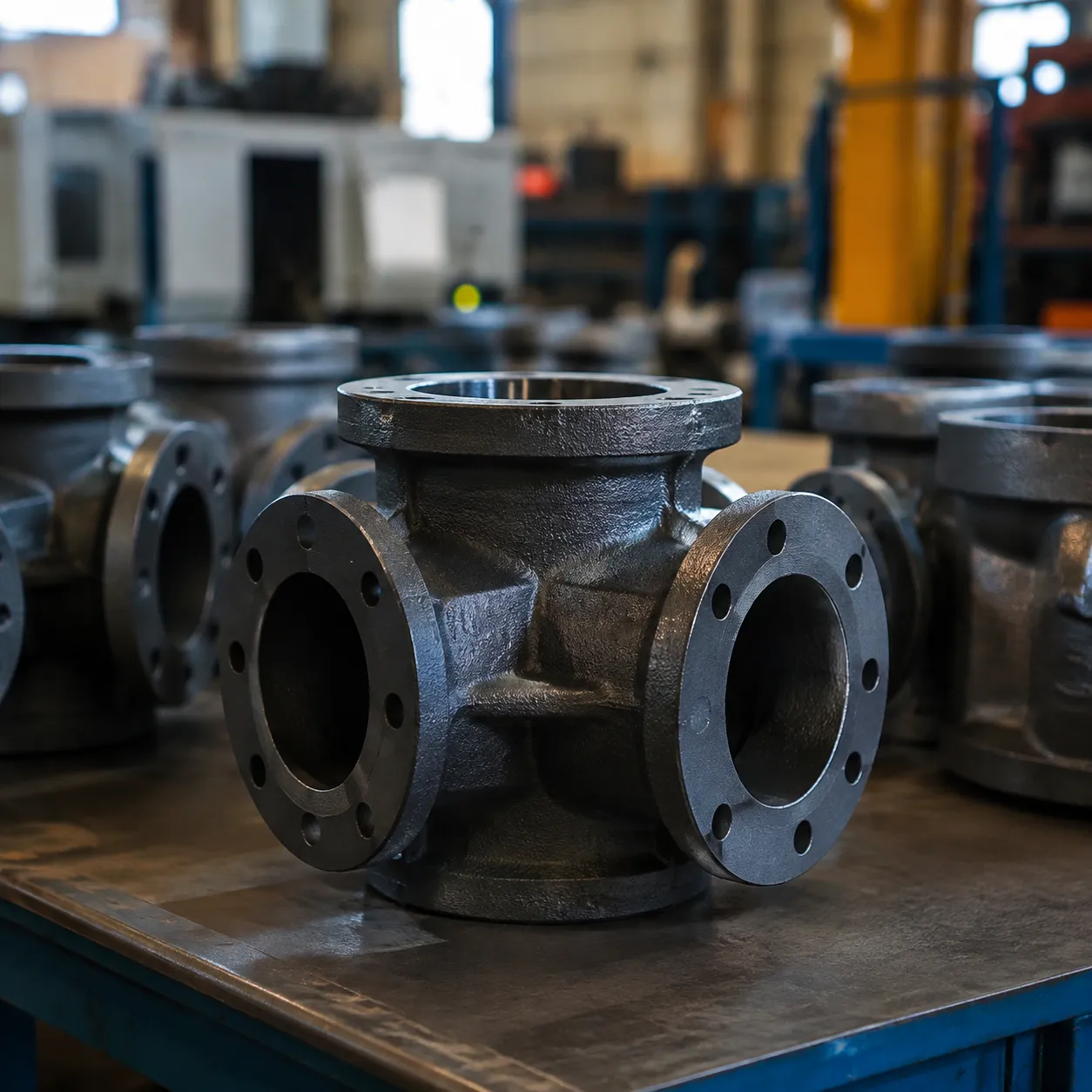
Finding the right partner for 3 way valve body casting needs comes down to precision, capacity, and flexibility. The foundry must meet tight dimensional tolerances while keeping production seamless from rapid prototyping to full scale.
Key Factors to Evaluate in an Industrial Valve Foundry
- Dimensional Tolerances & Weight Capacity: Verify that the foundry works within standardized dimensional tolerances (like casting tolerance classes CT4-CT8). Make sure pouring capacity matches valve housing requirements - from compact 1/2-inch bodies to heavy industrial units.
- Customization Capabilities: Look for support with custom wall thickness variations, optimized flow paths (T-port and L-port patterns), and direct logo or batch number engraving on the casting body.
- Prototyping Speed: A reliable foundry delivers quick 3D-printed wax patterns or rapid tooling to test fit and flow before committing to full-scale production molds.
- Mass Production Scalability: Advanced casting technology for improved foundry yield keeps metal purity and dimensional accuracy consistent across high-volume production runs.
| Evaluation Criterion | What to Look For | Why It Matters |
|---|---|---|
| Foundry Tolerances | Precision CT grades (CT4-CT6 for investment casting) | Guarantees tight seal seats and minimizes post-machining costs |
| Custom Wall Thickness | Tailored CAD modeling & pressure design | Prevents pressure leaks and structural failure under load |
| Prototyping & Scale | Fast sample turnarounds to multi-ton monthly output | Shortens time-to-market and keeps the supply chain reliable |
Engineering and procurement teams receive high-integrity 3 way valve body casting solutions tailored precisely to application specifications.
Order Custom 3 Way Valve Body Casting Parts
As a professional precision casting service provider, Vast Material supplies OEM/ODM 3 way valve body casting Parts from silica sol investment casting through CNC machining of flange ends, NDT, and documented material traceability.
| Quote input | What to send |
|---|---|
| Drawings | 2D/3D, alloy (CF8 grade / CF8M grade / cast iron / copper based alloys), pressure class, end connection |
| Port pattern | T pattern or L pattern; mixing vs diverting duty |
| Process preference | Investment casting (silica sol), shell, or sand for large bodies |
| Machining scope | As-cast, semi-machined, or finish-machined flange faces / stem bore / seats |
| QA package | MTR/PMI, PT/RT/UT as specified, hydrostatic shell test when required |
Request a quote with drawings, alloy, port pattern, and annual volume for custom three-way valve body parts.
Frequently Asked Questions About 3 Way Valve Body Casting
Common sourcing and specification questions for a 3 way valve body casting are answered below for buyers and industrial engineers.
What is the difference between CF8 and CF8M valve body castings?
The primary difference lies in their chemical composition and corrosion resistance.
- CF8 (Cast 304 Stainless Steel): Excellent general corrosion resistance for water, food processing, and standard industrial fluids.
- CF8M (Cast 316 Stainless Steel): Contains 2% to 3% Molybdenum. This addition provides superior protection against pitting corrosion caused by chlorides, harsh acids, and marine environments.
| Feature / Grade | CF8 (304 Equivalent) | CF8M (316 Equivalent) |
|---|---|---|
| Molybdenum Content | None | 2.0% - 3.0% |
| Corrosion Resistance | High (Standard fluids) | Exceptional (Chlorides & acids) |
| Cost | Cost-effective | Slightly higher |
| Primary Applications | HVAC, dairy, water systems | Chemical, petroleum, marine |
How does investment casting eliminate dead zones in valve bodies?
Dead zones are trapped internal cavities where fluid stagnates, causing contamination or corrosion.
Through an advanced lost wax stainless steel valve body casting process, ultra-smooth internal flow channels are achieved that traditional tooling cannot replicate:
- Seamless Internal Radii: Soft, rounded internal turns in both T-port and L-port geometries.
- Superior Surface Finish: Shell molds yield surface finishes up to Ra 3.2 um, preventing media residue from sticking.
- Zero Internal Cavities: Eliminates internal parting lines or rough draft angles that trap fluid.
Can 3 way valve body castings handle high thermal shock and pressure?
Yes, provided the valve body is properly designed and heat-treated. Heavy-duty valve housings are manufactured to withstand rigorous pressure spikes and rapid temperature changes.
- Uniform Wall Thickness: Strict casting tolerances prevent localized stress points during rapid heating or cooling.
- Solution Annealing: Heat treatment refines the internal grain structure, maximizing ductility and tensile strength.
- Rigid Testing Standards: Every high-pressure 3 way valve body casting undergoes strict API 598 pressure testing and non-destructive testing (NDT) to ensure zero internal shrinkage or porosity before delivery.
What valve body Parts are typically supplied?
Programs commonly supply the pressure-containing three-port body casting plus finish-machined flange ends. Related Parts can include stem-bore prep, seat rings prepared for assembly, and actuator mounting pads - shipped as body-only OEM parts or kits per drawing.
T pattern vs L pattern - which should be specified?
T pattern bodies support simultaneous mixing or dual-outlet diverting. L pattern bodies switch one inlet to one selected outlet at a time. Confirm the ball/plug cavity and stop positions on the drawing before tooling.
Are copper based alloys and lead free valves available?
Yes. In addition to CF8/CF8M and cast iron programs, copper based alloys and lead free valves body castings can be quoted for water and specialty service when drawings and alloy specs are provided.