Investment Casting vs. Additive Manufacturing
Modern industrial manufacturing demands an uncompromising balance between structural integrity, cost efficiency, and design flexibility. When choosing between investment casting vs additive manufacturing, engineering teams must evaluate how each process manipulates material to meet rigorous operational standards. Rather than mutually exclusive rivals, these technologies represent distinct approaches to transforming raw engineering alloys into high-specification components.
What Is Investment Casting?
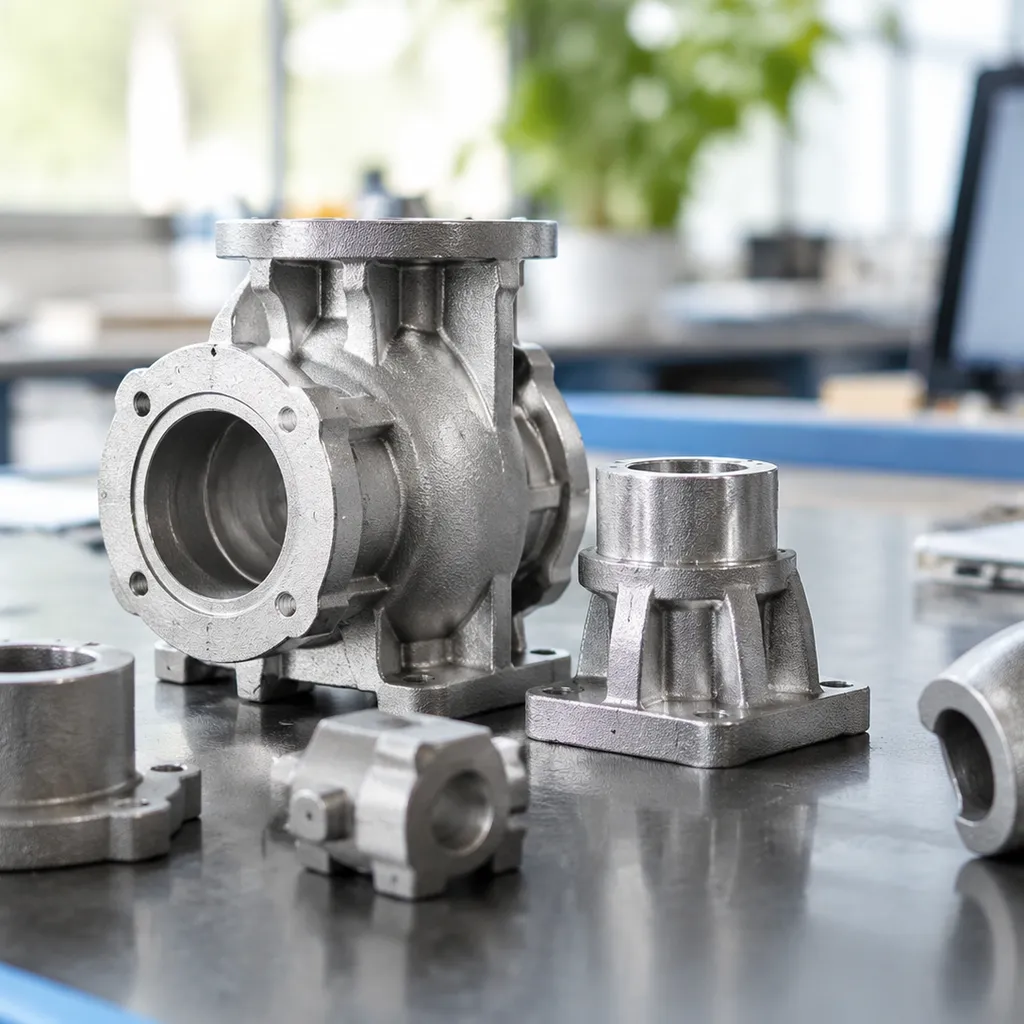
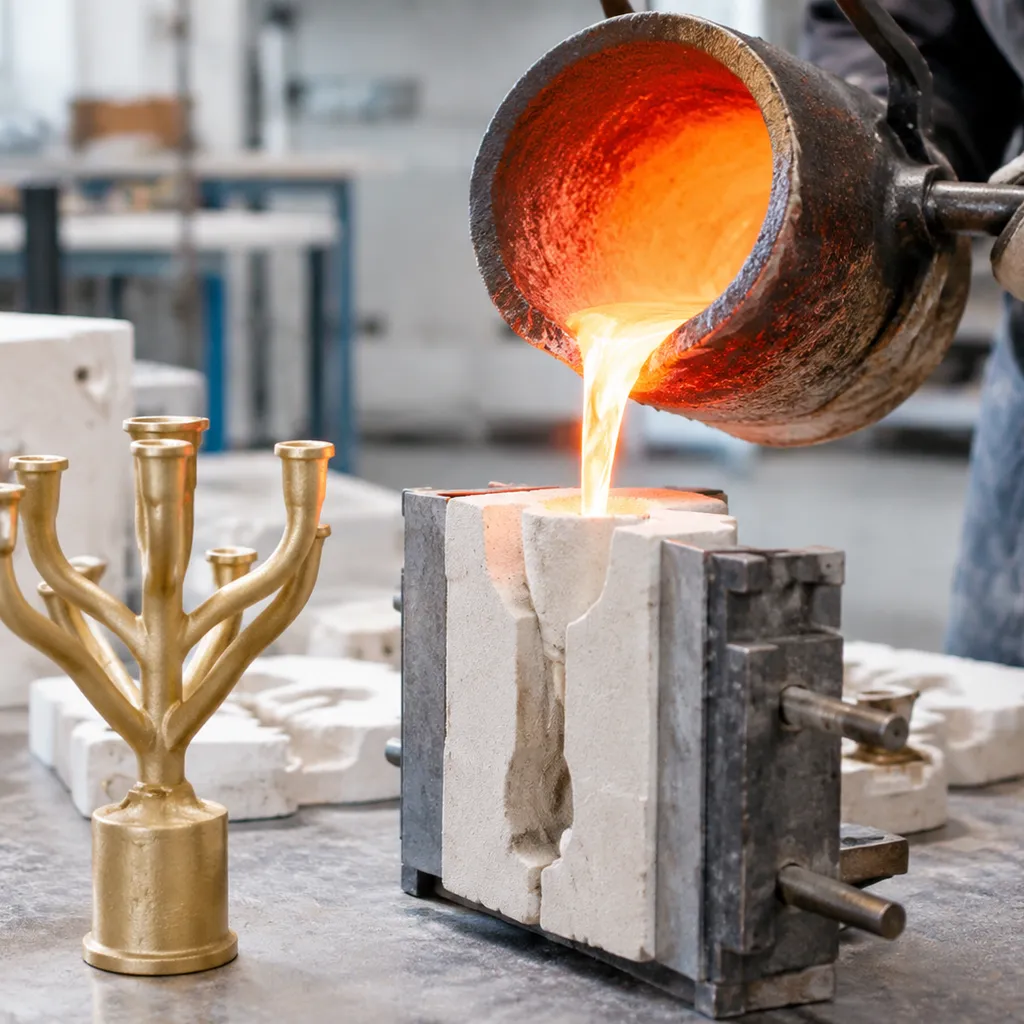
Investment casting, commonly known as the lost-wax process, is a precision metal casting technique engineered for repeatable, near-net-shape components.[1] The workflow follows a proven sequence:
- Pattern Creation: Wax patterns are injected into precision-machined metal dies.
- Shell Building: The wax assembly is repeatedly dipped into a refractory ceramic slurry and coated with stucco to form a durable shell.
- Dewaxing and Firing: The wax is melted out in an autoclave, leaving an empty ceramic mold cavity that is fired for structural strength.
- Pouring: Molten alloy is poured into the preheated mold under strict metallurgical control.[1]
- Finishing: After cooling, the ceramic shell is broken away, and parts undergo cut-off, heat treatment, and final finishing.
This method delivers dense, isotropic grain structures across an extensive range of pourable alloys, from standard stainless steels to advanced cobalt- and nickel-based superalloys.
What Is Additive Manufacturing (Metal 3D Printing)?
Additive manufacturing (AM), or industrial metal 3D printing, constructs components directly from digital 3D CAD models by depositing and fusing material layer by layer.[2] Core technologies utilized for high-spec components include:
- Powder Bed Fusion (PBF): Thermal energy (a laser or electron beam) selectively melts microscopic metal powder particles across thin layers.[2]
- Binder Jetting: A liquid binding agent is selectively deposited onto powder beds, followed by curing and high-temperature sintering to achieve structural density.[2]
Metal AM bypasses the need for hard tooling, unlocking immense design flexibility for intricate internal cooling channels, optimized lattice structures, and consolidated multi-piece assemblies.
Core Differences in How Parts Are Made
The core divergence between investment casting and additive manufacturing lies in the transition of material from raw stock to finished geometry:
| Manufacturing Metric | Investment Casting | Additive Manufacturing (Metal AM) |
|---|---|---|
| Material State Transformation | Liquid phase: Molten alloy fills a ceramic cavity to solidify | Solid-to-liquid-to-solid (or sintered): Layerwise fusion of metal powders |
| Tooling Dependency | Requires machined tooling (dies) for wax pattern production | Tool-free; builds directly from sliced digital CAD data |
| Internal Structures | Limited by ceramic core removal and draft angles | Capable of printing enclosed voids, curved channels, and lattices |
| Metallurgical Characteristics | Consistent isotropic mechanical properties throughout the part | Directional microstructures; often requires Hot Isostatic Pressing (HIP) to close internal porosity[3][4] |
| Economic Sweet Spot | Medium-to-high production volume with amortized tooling | Prototypes, one-offs, and highly complex, low-volume components |
Investment Casting vs. Additive Manufacturing: Key Comparison Metrics
When evaluating investment casting vs additive manufacturing, the choice comes down to engineering economics, material integrity, and volume requirements. Both processes produce high-integrity components, but each delivers value at different stages of the production lifecycle.
| Comparison Metric | Investment Casting | Additive Manufacturing (Metal 3D Printing) |
|---|---|---|
| Tooling Investment | High upfront cost for metal wax dies | Zero tooling required (direct from CAD) |
| Unit Cost Scaling | Drops significantly as volume increases | Remains largely flat regardless of volume |
| Design Limits | Requires core extraction and draft angles | Enables enclosed lattices and conformal channels |
| Alloy Versatility | Broad: almost any pourable engineered alloy | Limited to commercially qualified metal powders |
| Metallurgy | Solid, isotropic grain structures | Layered structure; often requires HIP to clear voids |
Production Volume, Tooling, and Unit Cost
- Tooling costs: Investment casting requires dedicated metal tooling to inject sacrificial wax patterns. This requires upfront capital before the first part is poured. Additive manufacturing completely bypasses hard tooling, building components directly from a digital file.
- Production volume: Metal 3D printing features a virtually flat cost curve. It costs roughly the same per part to print part 1 as it does part 100. Investment casting carries high initial costs, but the unit price drops steeply as the production run scales, making it far more cost-effective for medium to high volumes.
Geometric Complexity and Design Freedom
Both technologies handle complex geometry, but they approach design flexibility differently:
- Metal additive manufacturing: Delivers freedom for consolidated assemblies, organic lattice structures, and curved internal cooling channels that tooling cannot access.
- Investment casting: Excels at producing near-net-shape components with complex external features, thin walls, and undercut profiles. However, parts must allow for ceramic shell slurry penetration and core removal.
Material Selection and Metallurgical Properties
- Alloy availability: Investment casting supports virtually any air-melt or vacuum-melt alloy, including specialty stainless steels, cobalt alloys, and high-temperature nickel superalloys. Metal 3D printing is restricted to specific alloy powders that are certified for laser powder bed fusion or binder jetting.
- Structural integrity: A properly poured molten alloy solidifies into an isotropic microstructure with uniform mechanical properties in all directions. Metal 3D printed components exhibit directional (anisotropic) properties along the build axis and frequently require secondary Hot Isostatic Pressing (HIP) to eliminate residual porosity and internal voids.[3][4]
Lead Time and Prototyping Speed
Lead time priorities dictate which method makes sense during design validation:
- Metal additive manufacturing produces single-piece prototypes within days, making it ideal for rapid design iterations without committing to tooling.
- Traditional investment casting lead times are driven by the time it takes to build the injection die. To eliminate this bottleneck during early-stage validation, we use our rapid prototyping and tooling services for low-volume production to print expendable patterns directly for casting, bypassing hard dies entirely.
Dimensional Tolerances and Surface Finish
Both processes reduce the need for roughing cuts, but fine tolerances still demand attention:
- Surface texture: Investment casting delivers a uniform, smooth as-cast surface derived from fine ceramic slurries. Additive manufacturing surfaces often retain layer lines, powder adhesion, or rough support-removal witness marks.
- Post-processing: Neither process completely eliminates subtractive machining. Critical datum planes, bearing bores, and precision threads in both cast and printed parts require final precision machining to hit final assembly specifications.
Low-Volume Cases for Investment Casting vs Additive Manufacturing
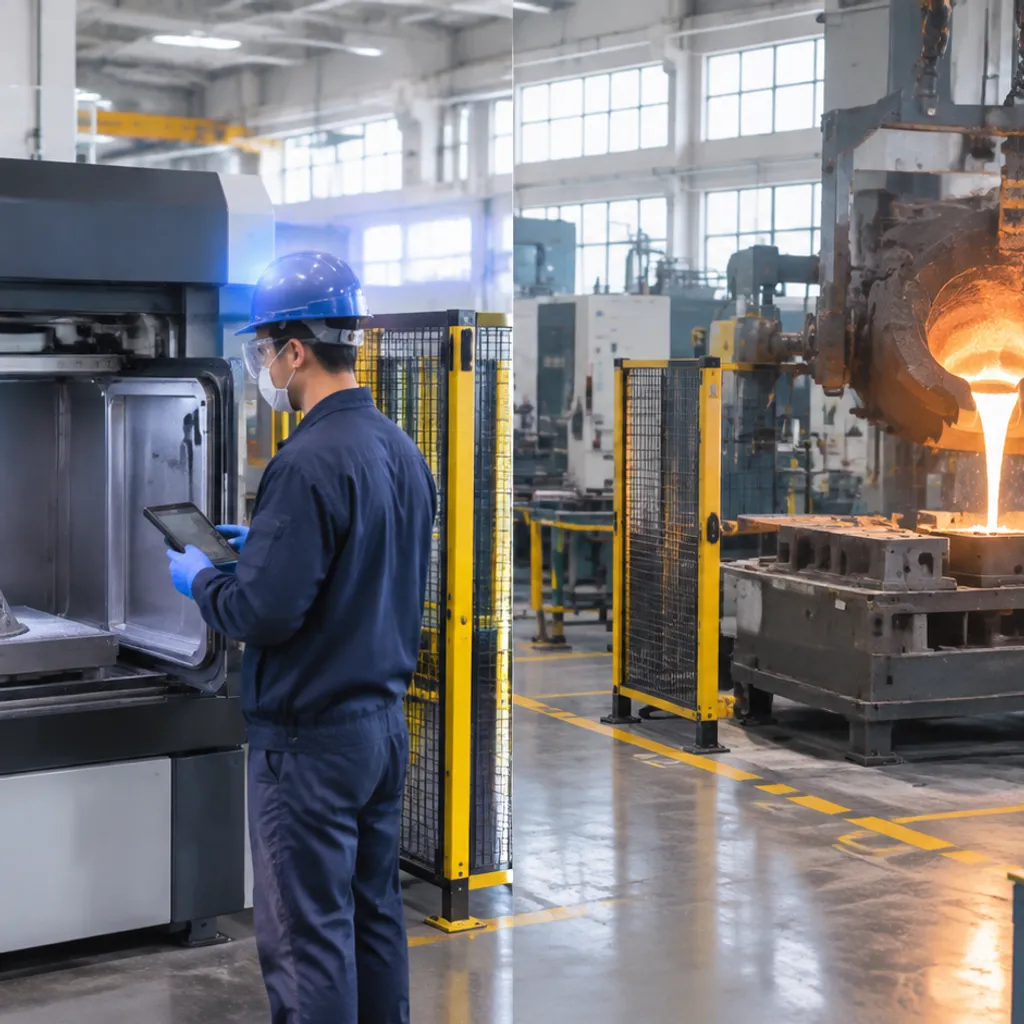
When evaluating investment casting vs additive manufacturing, metal 3D printing proves its worth whenever speed, design freedom, and zero tooling take priority over mass production economies. We guide our partners toward additive solutions when traditional molding introduces unnecessary overhead or limits component functionality.
Rapid Prototyping and Low-Volume Production
If your project requires single-digit quantities, functional test units, or frequent design revisions, metal 3D printing is the clear winner.
- Short Lead Times: We produce functional metal components in days rather than waiting weeks or months for hard molds.
- Agile Iteration: Engineers can leverage the advantages of rapid prototyping for faster and smarter manufacturing, validating physical fit and stress performance before committing capital.
- Low-Volume Efficiency: For orders spanning 1 to 50 parts, paying a higher unit cost on a powder bed fusion or binder jetting machine is far cheaper than amortizing custom tooling dies.
Highly Complex and Consolidated Part Geometries
Additive manufacturing frees component design from traditional draft angles, split lines, and core pulls. We recommend additive technologies when a design features:
- Conformal Internal Channels: Curved cooling lines in heat exchangers and fluid manifolds that molten metal casting or CNC drills cannot reach.
- Lattice Structures & Topology Optimization: Weight-reduction profiles engineered for aerospace and motorsport that remove bulk while maintaining directional stiffness.
- Part Consolidation: Merging multi-piece assemblies into a single, seamless digital build, eliminating welded joints and potential leak paths.
On-Demand Production Without Upfront Tooling
Eliminating hard tooling fundamentally changes inventory management and financial risk. Metal 3D printing pulls directly from digital CAD files, turning physical warehouses into digital spare-part libraries.
| Factor | Additive Manufacturing Fit |
|---|---|
| Tooling Investment | Zero upfront; no wax dies or core boxes required |
| Ideal Order Size | 1 to 50 units (prototypes, bridge runs, custom replacements) |
| Design Flexibility | Infinite; update CAD files instantly between build cycles |
| Geometric Scope | Organic contours, lattice cores, and internal voids |
| Supply Chain Setup | On-demand digital manufacturing near the point of use |
By removing fixed tooling costs, additive manufacturing offers the ultimate agility for specialized machinery, legacy spare parts, and high-value, low-volume industrial hardware.
Scale Cases for Investment Casting vs Additive Manufacturing
While 3D printing captures attention for rapid iterations, traditional metal casting remains the undisputed workhorse for commercial industrial manufacturing. In the evaluation of investment casting vs additive manufacturing, investment casting wins whenever scale, raw mass, structural uniformity, and specialized alloy availability dictate the bottom line.
Medium to High-Volume Production Scalability
Additive manufacturing unit costs remain largely flat whether you print ten parts or ten thousand. Investment casting behaves differently: once you absorb initial tooling costs, per-part costs drop dramatically.
- Economies of Scale: Wax patterns can be injected in seconds, allowing high-throughput mold creation.
- Predictable Cycle Times: Pouring hundreds of parts in a single casting cluster drastically reduces cycle times compared to the slow layer-by-layer build rates of metal 3D printing.
- Tooling Amortization: For medium-to-high production volumes, die costs quickly amortize, delivering a far lower total cost of ownership.
Large Components and Dense Structural Castings
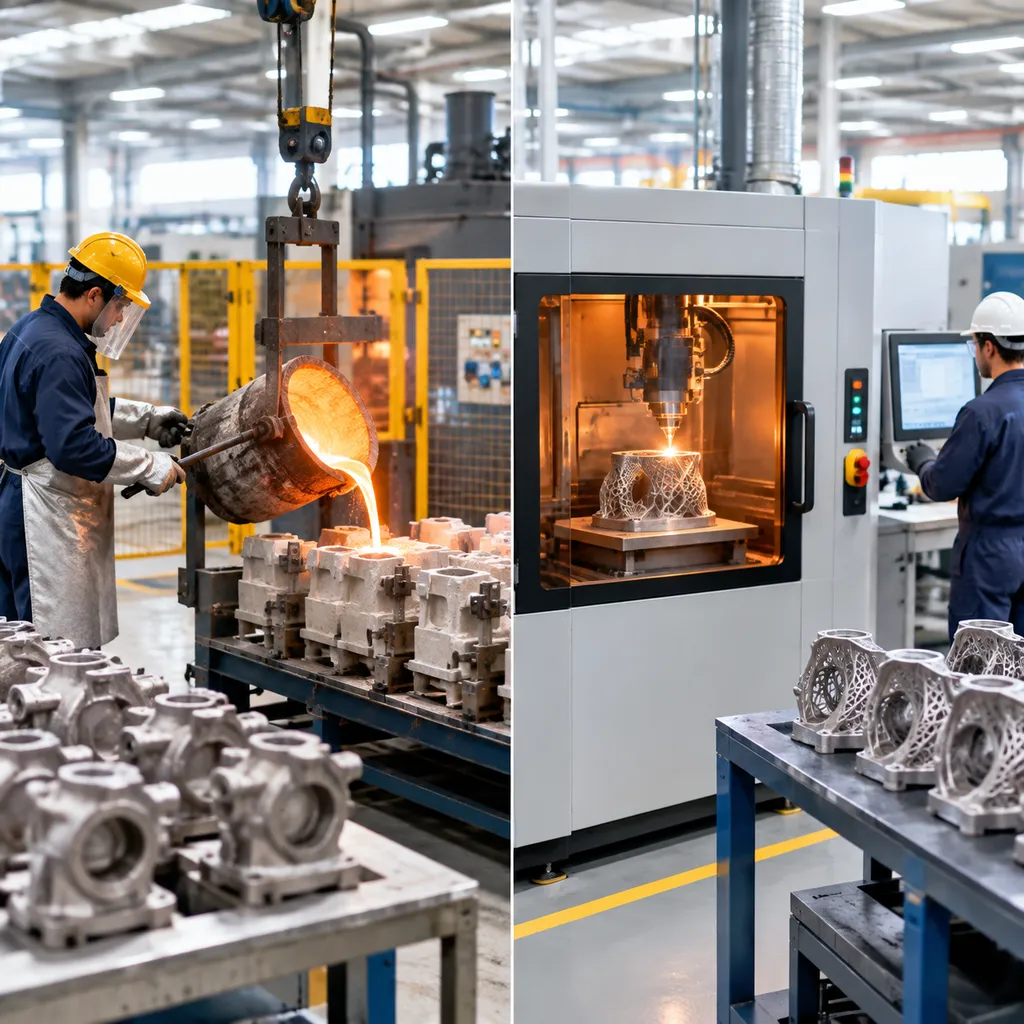
Metal additive systems are strictly bounded by build chamber sizes and laser scan envelopes. Investment casting eliminates these physical bottlenecks:
- Broad Envelope Range: Accommodates small fittings through large, heavy-walled cross sections beyond typical powder-bed build envelopes.
- Isotropic Integrity: Molten alloy solidifies uniformly to deliver solid, isotropic grain structures that naturally comply with stringent aerospace, energy, and defense standards.
- Void-Free Density: Unlike powder bed printing processes that risk micro-porosity and delamination between layers, properly gated cast components provide predictable metallurgical soundness right out of the mold.[3]
Wide Material and Specialty Alloy Availability
Additive manufacturing requires specialized, gas-atomized powders that are expensive and limited in variety. Investment casting melts almost any pourable engineering alloy directly:
| Factor | Investment Casting | Additive Manufacturing (Metal AM) |
|---|---|---|
| Alloy Breadth | Virtually unlimited (steels, nickel, cobalt, copper base) | Limited to weldable, atomized commercial powders |
| Material Cost | Standard master heats and raw ingot pricing | High-cost specialized powder consumables |
| Microstructure | Uniform isotropic grain structure | Directional grain growth; potential residual stress |
We cast custom metals tailored to harsh operating conditions, utilizing specialized cobalt alloy casting solutions for extreme wear and heat alongside our comprehensive alloy guide for high-performance precision casting to fulfill demanding metallurgical requirements without powder-bed constraints.
Printed-Pattern Route for Investment Casting vs Additive Manufacturing
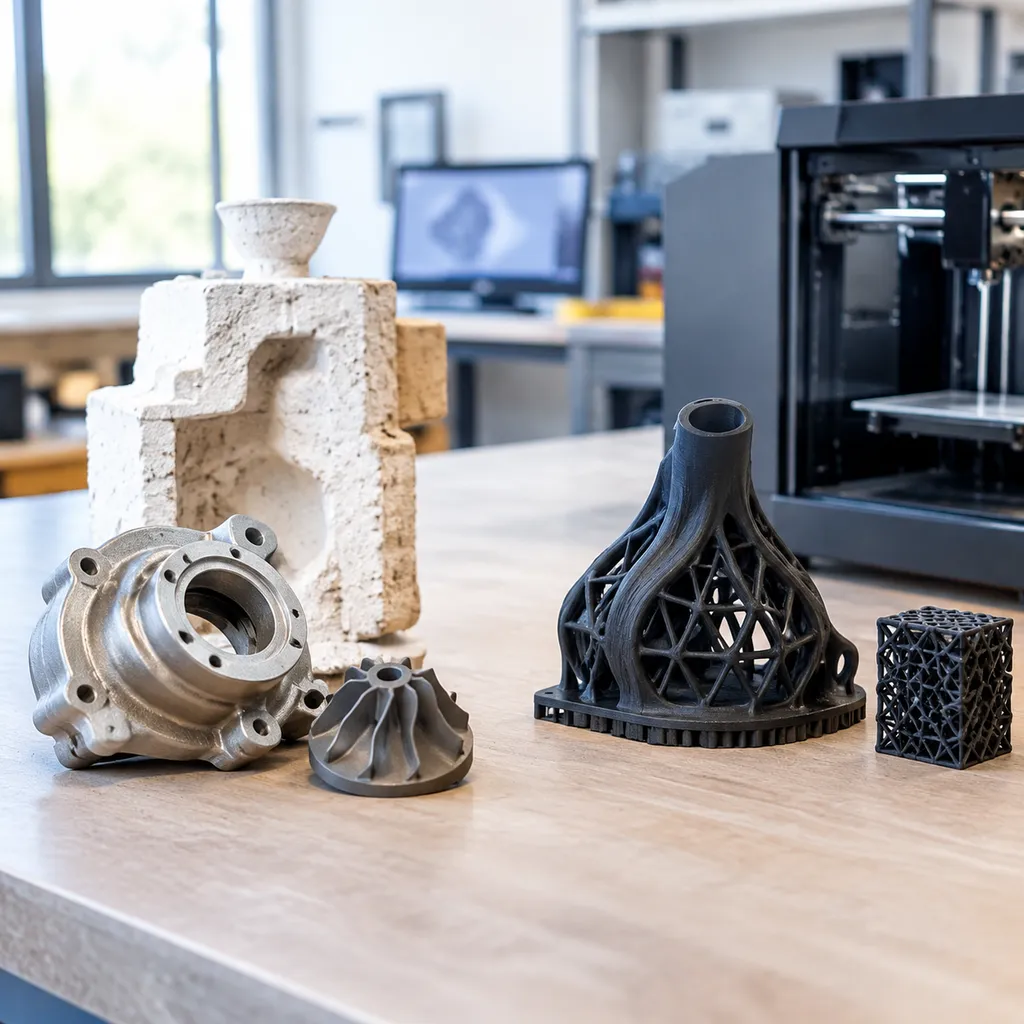
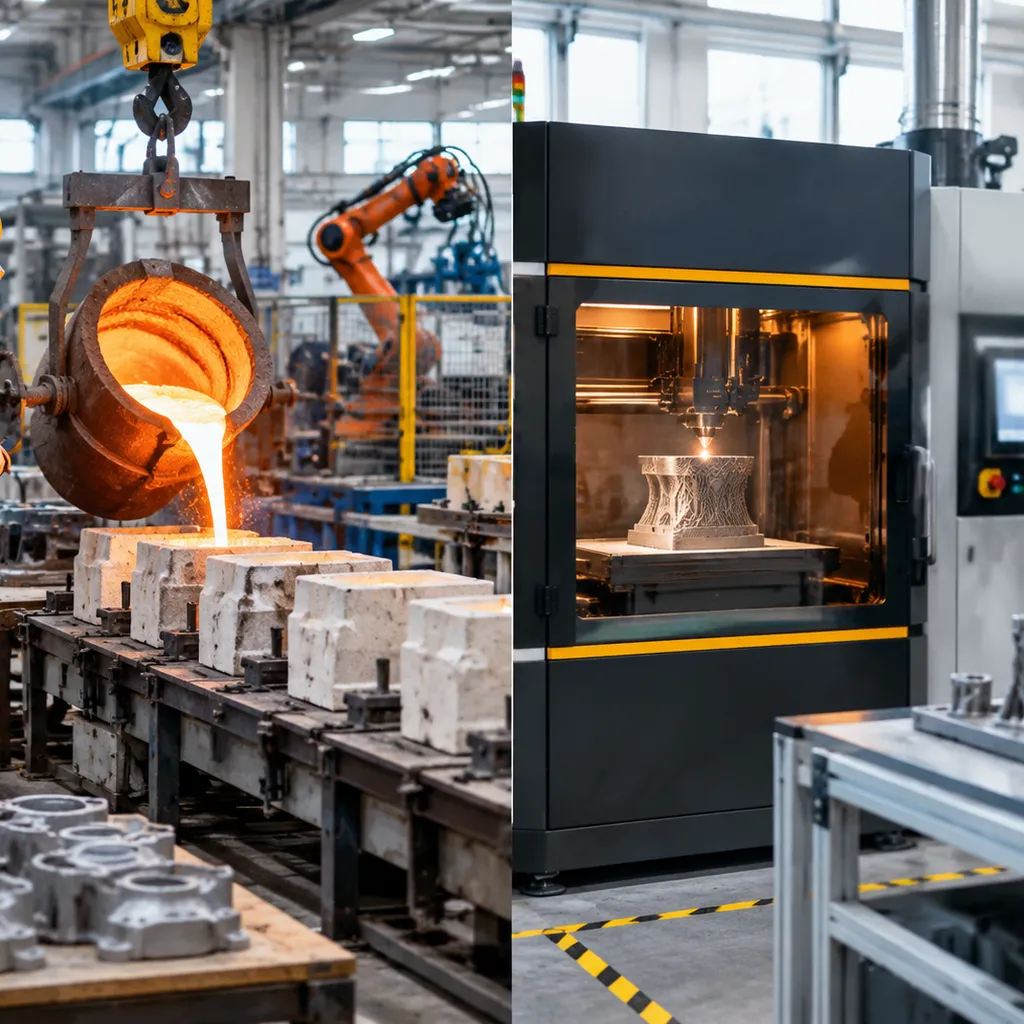
The debate around investment casting vs additive manufacturing usually treats these two technologies as rivals. In our foundry operations, we treat them as powerful partners. By blending modern metal 3D printing techniques with traditional metal casting, we eliminate the most punishing constraints of both processes: steep upfront tooling expenses and tight build-envelope restrictions.
This integrated approach creates an agile manufacturing route. You capture the intricate design freedom of additive workflows while leveraging the metallurgical soundness, isotropic grain structure, and alloy breadth of proven casting methods.
Using 3D-Printed Sacrificial Patterns to Eliminate Tooling
Traditional lost-wax casting relies on metal dies to inject wax patterns. When you only need a pilot batch or an iteration on a prototype, machining that hard tooling incurs high tooling costs and adds weeks to the schedule.
We solve this bottleneck by printing expendable patterns directly from CAD files using stereolithography or binder jetting:
- Zero Hard Tooling: We print patterns in specialized polymers or clean-burning resins without cutting an aluminum die.
- Complete Burnout: Using a reliable casting 3d printing guide for clean burnout and zero-ash resins ensures our ceramic shells remain free of residual carbon and shell-cracking expansion defects.
- Unrestricted Pouring: Once we dewax and fire the shell, we pour your specified molten alloy - from 300-series stainless steels to high-temp nickel superalloys - into the exact cavity left behind.
Accelerating Development Cycles for Complex Castings
When developing parts with organic geometries or internal fluid passages, design revisions are inevitable. Modifying hard tooling can stall production while a revised die is machined.
- Fast Design Revisions: We can modify a CAD model, print a replacement pattern overnight, and pour a new metal casting in days rather than months.
- Complex Internal Passages: 3D printing handles complex geometry, undercut features, and thin-walled channels that cannot be pulled from a traditional rigid mold.
- Risk Reduction: We validate the fit, finish, and fluid dynamics of real cast parts before you sign off on capital-intensive mass-production tooling.
Bridging the Gap Between Prototyping and Mass Production
Moving from a single prototype to full-scale manufacturing is where many engineering projects stall. A direct additive component often fails to match the grain structure or certification standards required for production castings.
- Identical Metallurgy: Because the printed pattern yields a genuine investment casting, your test parts share identical metallurgical properties with future mass-produced components.
- Low-Volume Bridge Production: We deliver tens to hundreds of parts to satisfy immediate field demand while your permanent tooling is being cut.
- Smooth Scalability: Once your geometry is fully validated in field trials, we transition the exact same part geometry into high-volume wax dies without altering your material specs or engineering approvals.
How to Choose the Right Manufacturing Process
Selecting between investment casting vs additive manufacturing comes down to balancing production volume, geometric requirements, total lead times, and metallurgical standards. We evaluate every component against these core operational criteria to pinpoint the optimal route:
| Decision Factor | Investment Casting | Additive Manufacturing (Metal 3D Printing) | Hybrid Approach (Printed Patterns) |
|---|---|---|---|
| Optimal Volume | Medium to high production runs | 1 to low dozens (prototypes/custom) | Bridge production and low-volume cast runs |
| Tooling Investment | High initial die tooling costs | Zero tooling required | Zero hard tooling (uses 3D printed sacrificial patterns) |
| Design Flexibility | Near-net-shape with draft requirements | Unmatched freedom (lattices, internal voids) | Complex cast geometries without complex hard dies |
| Material Availability | Broad pourable alloys (steels, superalloys) | Limited to qualified metal powders | Broad pourable alloy range |
| Internal Structure | Isotropic grain structure, solid density | Can have directional anisotropy, requires HIP | Dense cast grain structure |
Calculating Volume Break-Even Points and Total ROI
The financial break-even line between these technologies is defined by your total production volume:
- Additive Manufacturing (AM): Zero upfront tooling costs make metal 3D printing the most cost-effective solution for functional prototypes, one-offs, and short runs. However, the per-part cost curve remains relatively flat as volume increases due to fixed build rates, powder expenses, and long machine hours.
- Investment Casting: Hard tooling requires an upfront capital commitment and longer initial lead times. Once dies are machined, the per-unit cost drops significantly, delivering unmatched economies of scale over hundreds or thousands of parts. When considering early manufacturing economics, reviewing sand casting vs die casting alongside investment casting can further clarify how tooling amortization impacts your bottom line.
- The Hybrid Solution: If you need cast metallurgical integrity without committing to permanent tooling, 3D printing sacrificial wax or polymer patterns delivers short-run cast components quickly while bypassing traditional die fabrication expenses.
Evaluating Mechanical Performance and Industry Certifications
- Metallurgical Soundness: Investment casting delivers a proven, uniform grain structure with isotropic mechanical properties that comply reliably with long-standing ASTM, AMS, and ASME specifications.
- Porosity and HIP Requirements: Metal 3D printing builds parts layer by layer, which can introduce microscopic voids and directional mechanical variations. To achieve full density and fatigue resistance, AM parts often require post-build Hot Isostatic Pressing (HIP) and extensive precision machining.[4]
- Alloy Certification: While metal additive manufacturing is limited to qualified, commercially viable printable powders, investment casting allows us to pour virtually any engineered alloy, including high-temperature nickel superalloys, cobalt alloys, and specialized stainless grades, without compromising certified chemical limits.
References
- Investment Casting Institute - The Investment Casting Process (PDF) ↩
- NIST - Additive Manufacturing Technologies: Powder Bed Fusion and Binder Jetting ↩
- NIST - Understanding Anisotropic Tensile Properties of Laser Powder Bed Fusion Metals ↩
- NIST - Hot Isostatic Pressing to Close Internal Porosity in Additively Manufactured Ti-6Al-4V ↩